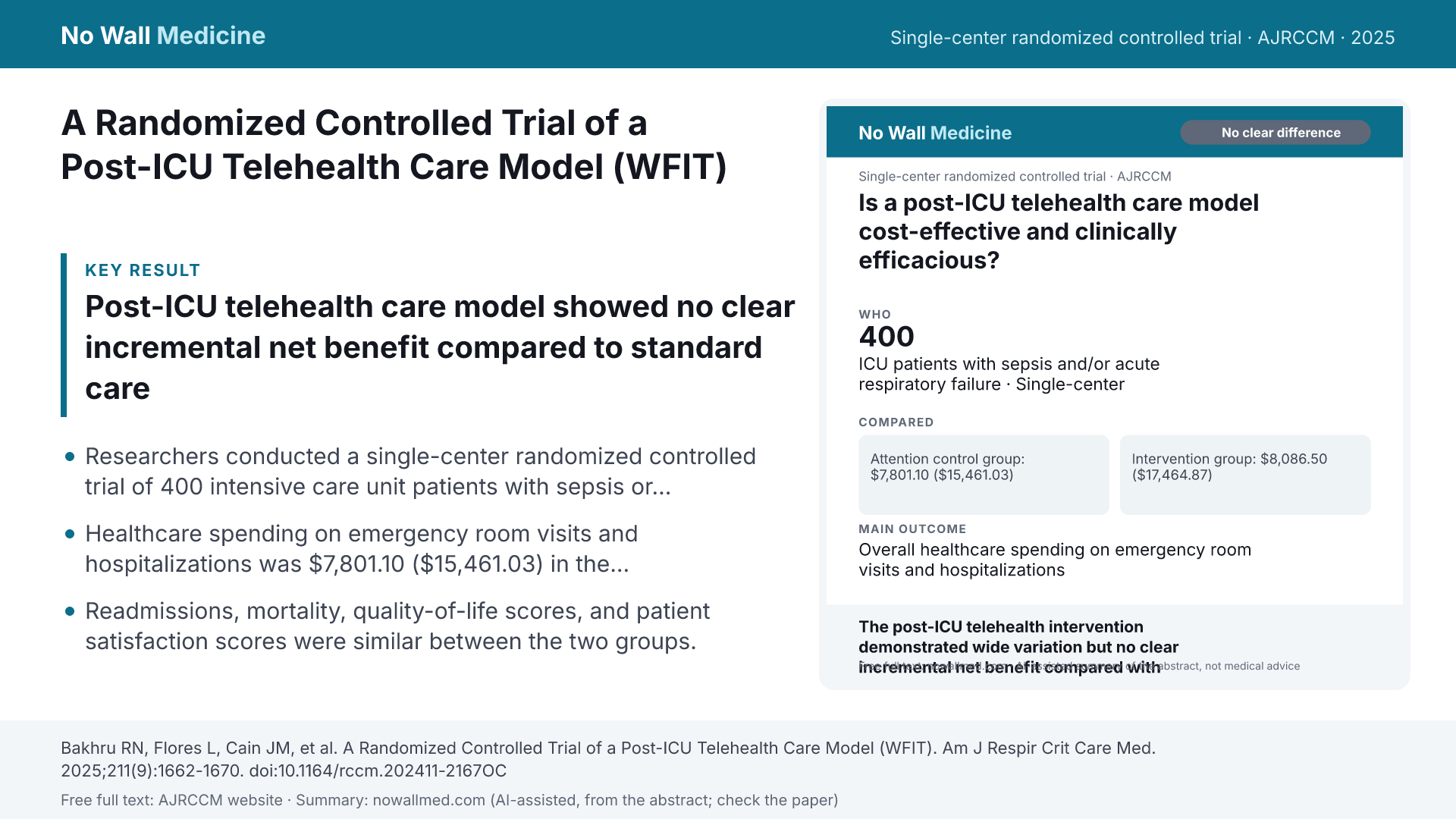
Post-ICU telehealth care model showed no clear incremental net benefit compared to standard care
A Randomized Controlled Trial of a Post-ICU Telehealth Care Model (WFIT)
Single-center randomized controlled trialNo clear difference
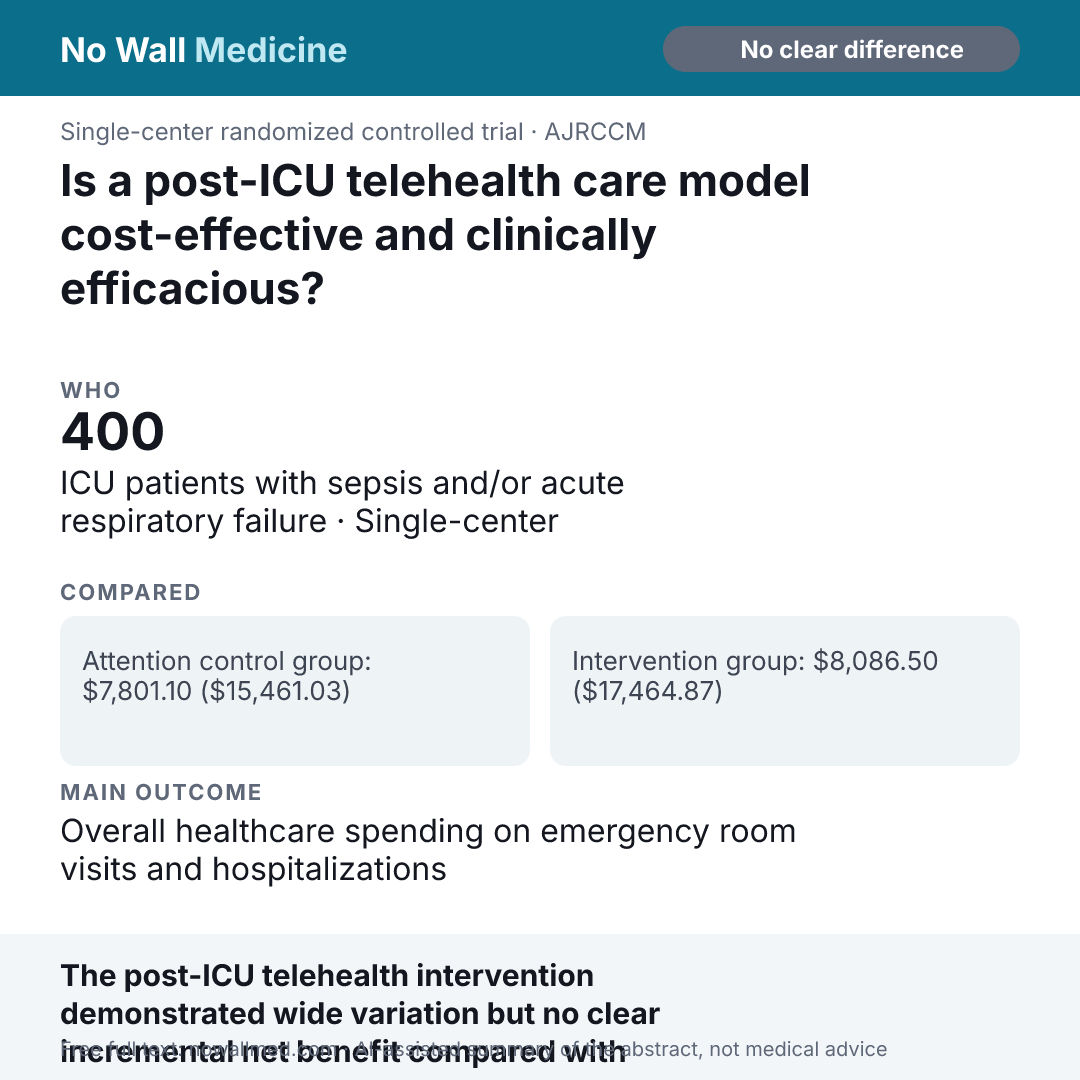
Is a post-ICU telehealth care model cost-effective and clinically efficacious?
Who
400
ICU patients with sepsis and/or acute respiratory failure · Single-center
Compared
Attention control group: $7,801.10 ($15,461.03)
Intervention group: $8,086.50 ($17,464.87)
Main outcome
Overall healthcare spending on emergency room visits and hospitalizations
Bottom line: The post-ICU telehealth intervention demonstrated wide variation but no clear incremental net benefit compared with standard care.
AJRCCM · 2025-06-18 · NCT04576065
Why it matters: Survivors of critical illness face high risks of poor long-term outcomes, and researchers wanted to evaluate the cost-effectiveness and clinical efficacy of a telehealth care model.
Headline and visual abstract written with AI from the paper’s abstract, with every number checked against it. Read the paper before relying on them.
Was this summary helpful?
Subject terms
Cite this article
Bakhru RN, Flores L, Cain JM, et al. A Randomized Controlled Trial of a Post-ICU Telehealth Care Model (WFIT). Am J Respir Crit Care Med. 2025;211(9):1662-1670. doi:10.1164/rccm.202411-2167OC
Spotted a mistake? Suggest a correction