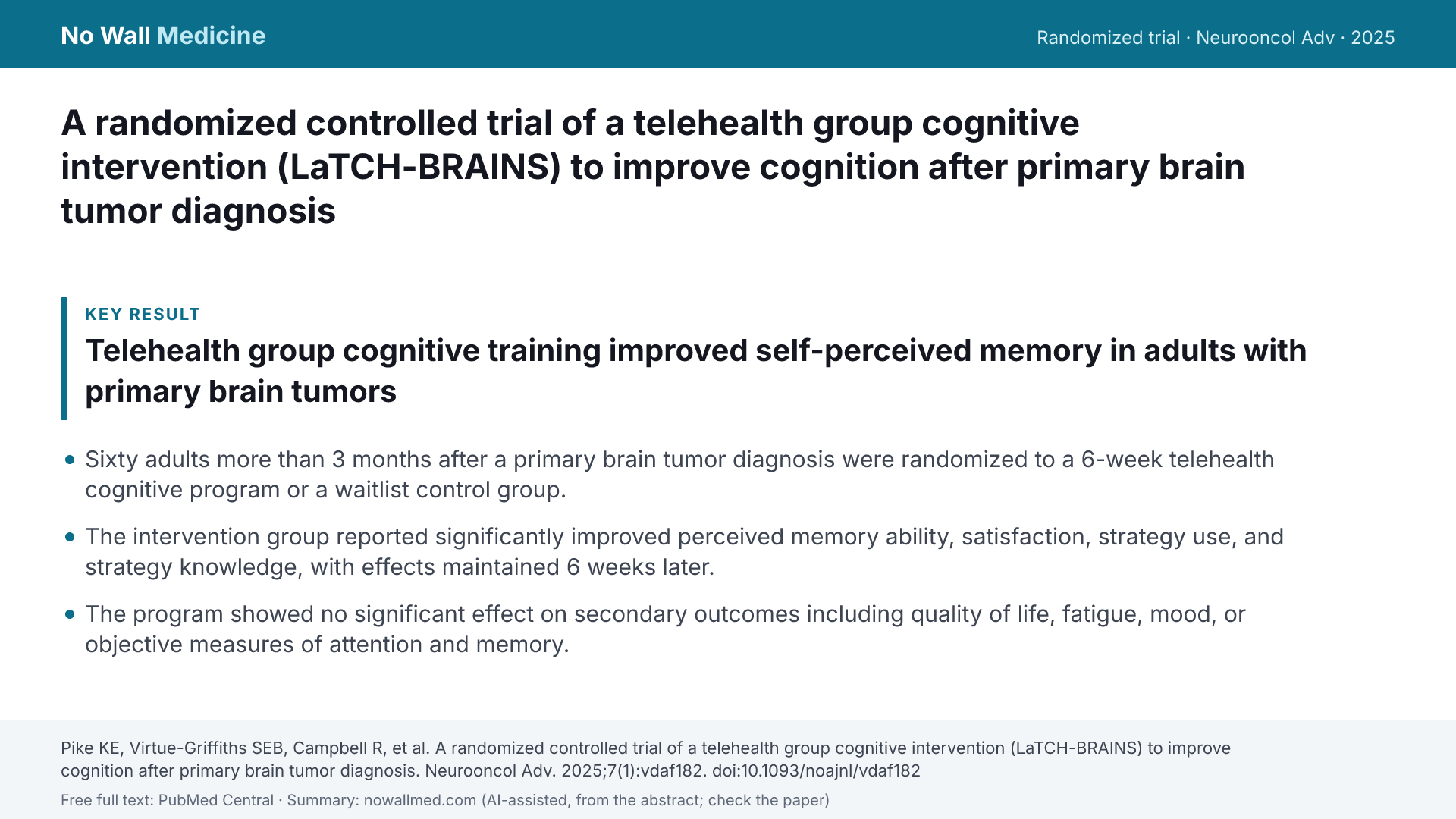
Telehealth group cognitive training improved self-perceived memory in adults with primary brain tumors
A randomized controlled trial of a telehealth group cognitive intervention (LaTCH-BRAINS) to improve cognition after primary brain tumor diagnosis
Why it matters: Tailored cognitive interventions are currently unavailable within Australia for people experiencing cognitive changes following a primary brain tumor diagnosis.
Key points
- Sixty adults more than 3 months after a primary brain tumor diagnosis were randomized to a 6-week telehealth cognitive program or a waitlist control group.
- The intervention group reported significantly improved perceived memory ability, satisfaction, strategy use, and strategy knowledge, with effects maintained 6 weeks later.
- The program showed no significant effect on secondary outcomes including quality of life, fatigue, mood, or objective measures of attention and memory.
Headline and key points written with AI from the paper’s abstract, with every number checked against it. Read the paper before relying on them.
Was this summary helpful?
Cite this article
Pike KE, Virtue-Griffiths SEB, Campbell R, Legge DM, Lion K, Moller CI. A randomized controlled trial of a telehealth group cognitive intervention (LaTCH-BRAINS) to improve cognition after primary brain tumor diagnosis. Neurooncol Adv. 2025. doi:10.1093/noajnl/vdaf182
Spotted a mistake? Suggest a correction