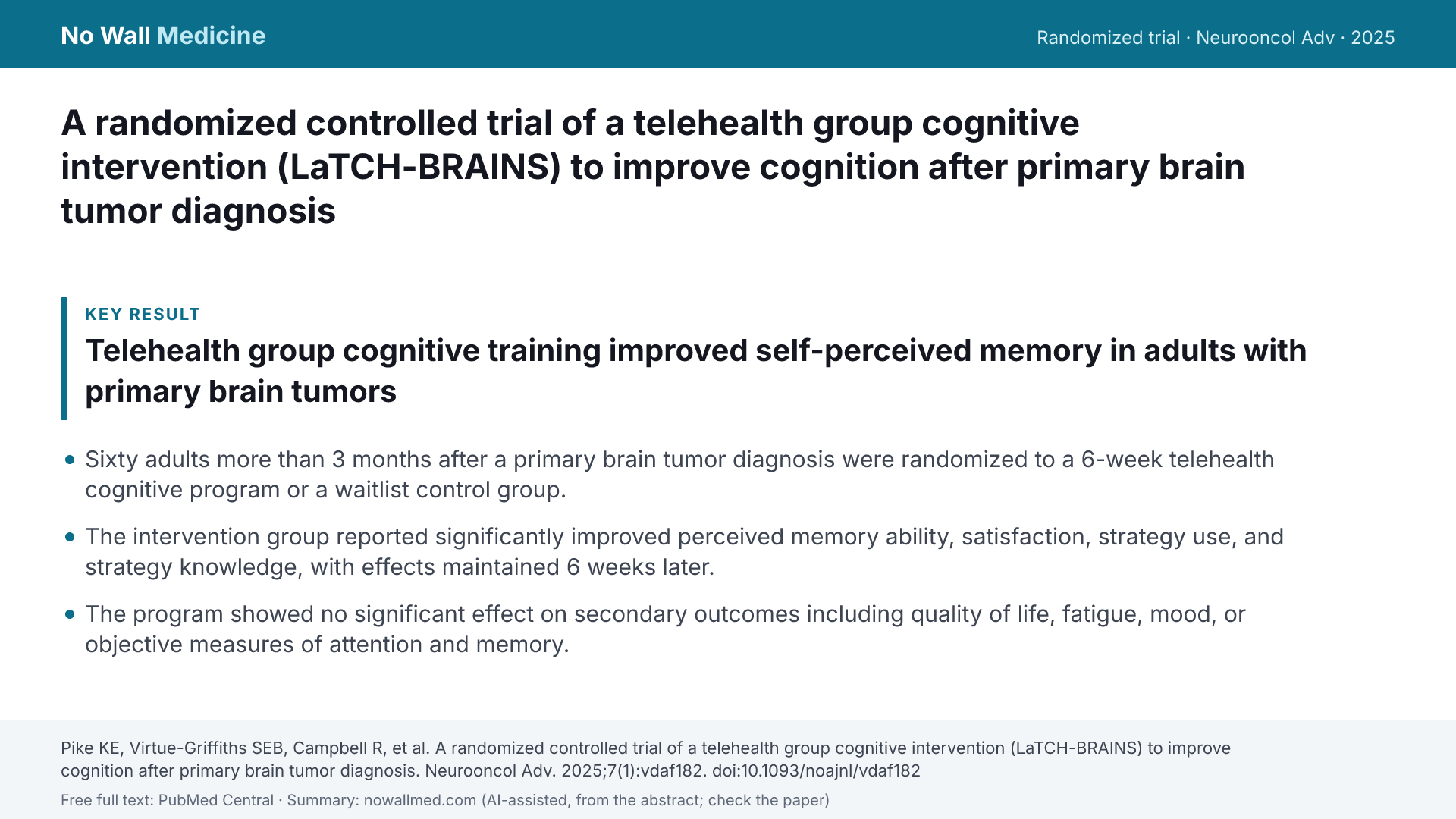
A randomized controlled trial of a telehealth group cognitive intervention (LaTCH-BRAINS) to improve cognition after primary brain tumor diagnosis
Key result: Telehealth group cognitive training improved self-perceived memory in adults with primary brain tumors
Key points
- Sixty adults more than 3 months after a primary brain tumor diagnosis were randomized to a 6-week telehealth cognitive program or a waitlist control group.
- The intervention group reported significantly improved perceived memory ability, satisfaction, strategy use, and strategy knowledge, with effects maintained 6 weeks later.
- The program showed no significant effect on secondary outcomes including quality of life, fatigue, mood, or objective measures of attention and memory.
Why it matters: Tailored cognitive interventions are currently unavailable within Australia for people experiencing cognitive changes following a primary brain tumor diagnosis.
Discussion prompts
- Would these patients look like yours? Who was left out?
- Is the main outcome one that matters to patients?
- Is the difference large enough to change what you do?
Cite: Pike KE, Virtue-Griffiths SEB, Campbell R, et al. A randomized controlled trial of a telehealth group cognitive intervention (LaTCH-BRAINS) to improve cognition after primary brain tumor diagnosis. Neurooncol Adv. 2025. doi:10.1093/noajnl/vdaf182
Free full text: PubMed Central · Summary and visual abstract: nowallmed.com/a/a-randomized-controlled-trial-of-a-telehealth-group-cognitive-1kh4yr/ (AI-assisted from the abstract; check the paper before relying on it).