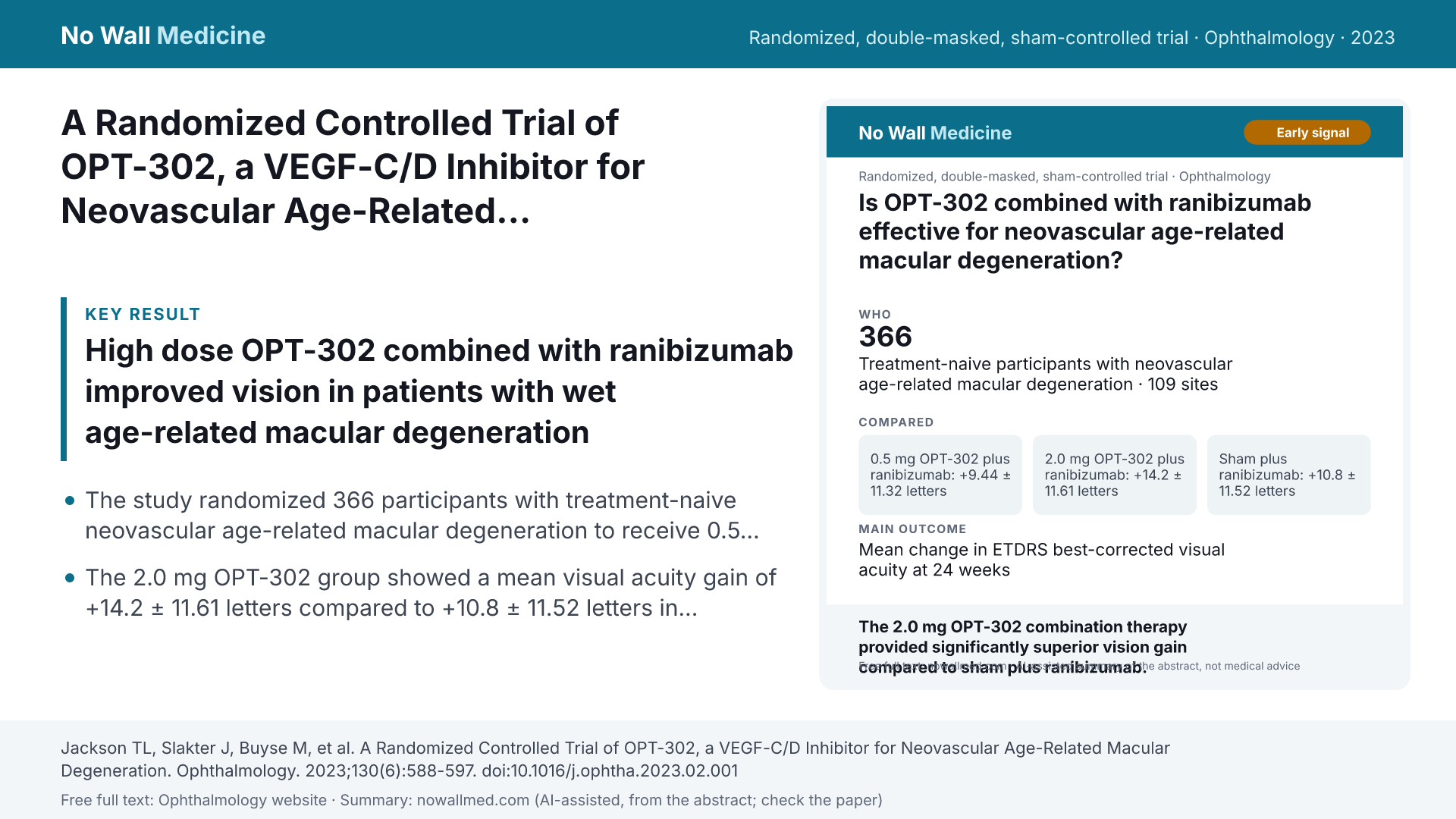
High dose OPT-302 combined with ranibizumab improved vision in patients with wet age-related macular degeneration
A Randomized Controlled Trial of OPT-302, a VEGF-C/D Inhibitor for Neovascular Age-Related Macular Degeneration
Randomized, double-masked, sham-controlled trialEarly signal
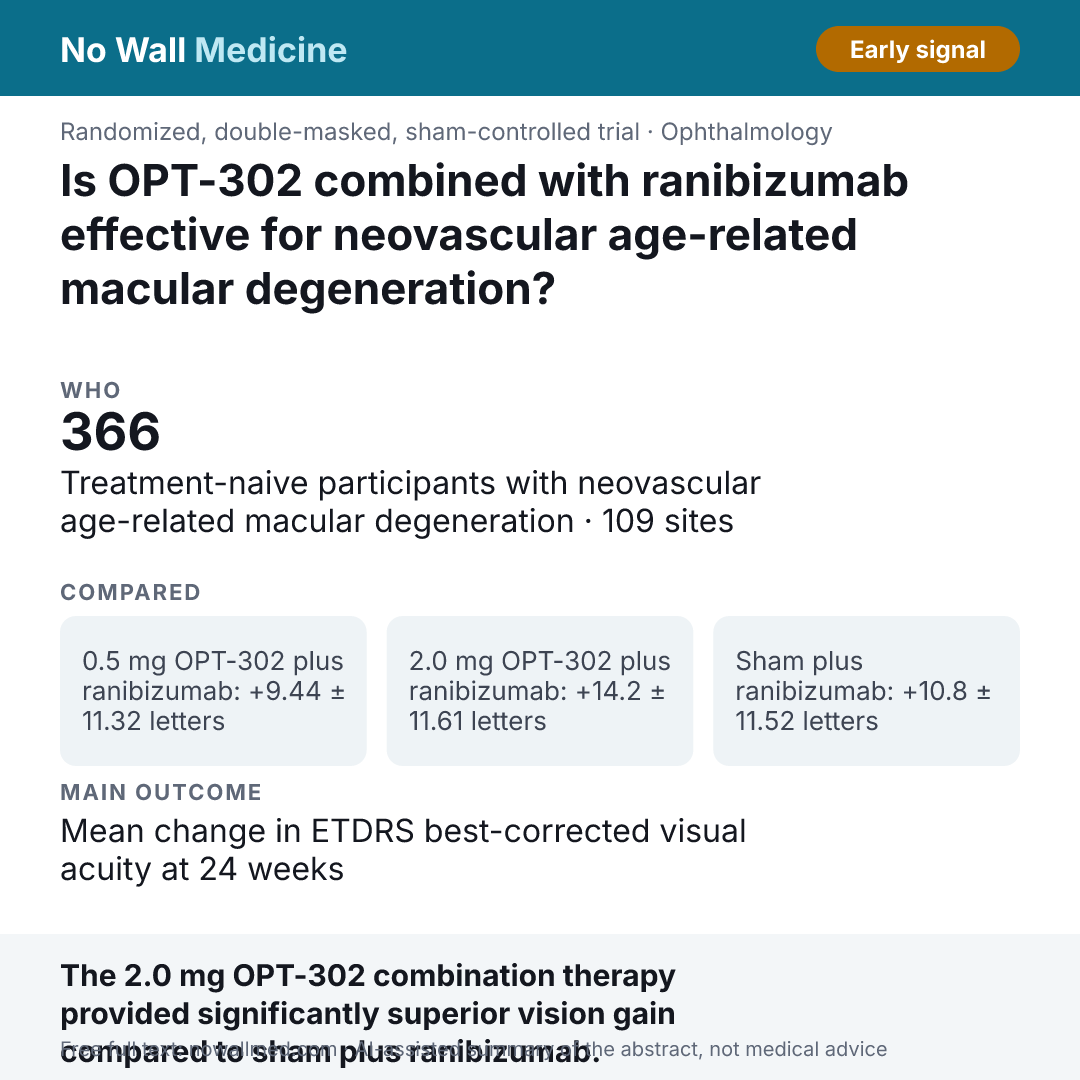
Is OPT-302 combined with ranibizumab effective for neovascular age-related macular degeneration?
Who
366
Treatment-naive participants with neovascular age-related macular degeneration · 109 sites across Europe, Israel, and the United States
Compared
0.5 mg OPT-302 plus ranibizumab: +9.44 ± 11.32 letters
2.0 mg OPT-302 plus ranibizumab: +14.2 ± 11.61 letters
Sham plus ranibizumab: +10.8 ± 11.52 letters
Main outcome
Mean change in ETDRS best-corrected visual acuity at 24 weeks
Bottom line: The 2.0 mg OPT-302 combination therapy provided significantly superior vision gain compared to sham plus ranibizumab.
Ophthalmology · 2023-02-06 · Save PNG
Clinical question: Is OPT-302 combined with ranibizumab effective for neovascular age-related macular degeneration?
Why it matters: Standard anti-VEGF-A drugs do not inhibit VEGF-C and D, which may explain why some patients with wet age-related macular degeneration do not respond fully to treatment.
Key points
- The study randomized 366 participants with treatment-naive neovascular age-related macular degeneration to receive 0.5 mg OPT-302, 2.0 mg OPT-302, or a sham injection alongside ranibizumab.
- The 2.0 mg OPT-302 group showed a mean visual acuity gain of +14.2 ± 11.61 letters compared to +10.8 ± 11.52 letters in the sham group.
- Serious adverse events occurred in 13.3% of the 0.5 mg group, 5.6% of the 2.0 mg group, and 8.3% of the sham group.
Headline and key points written with AI from the paper’s abstract, with every number checked against it. Read the paper before relying on them.
Was this summary helpful?
Subject terms
Headline, design, result, key points, caveat and citation as plain text.
Cite this article
Jackson TL, Slakter J, Buyse M, et al. A Randomized Controlled Trial of OPT-302, a VEGF-C/D Inhibitor for Neovascular Age-Related Macular Degeneration. Ophthalmology. 2023;130(6):588-597. doi:10.1016/j.ophtha.2023.02.001
Spotted a mistake? Suggest a correction