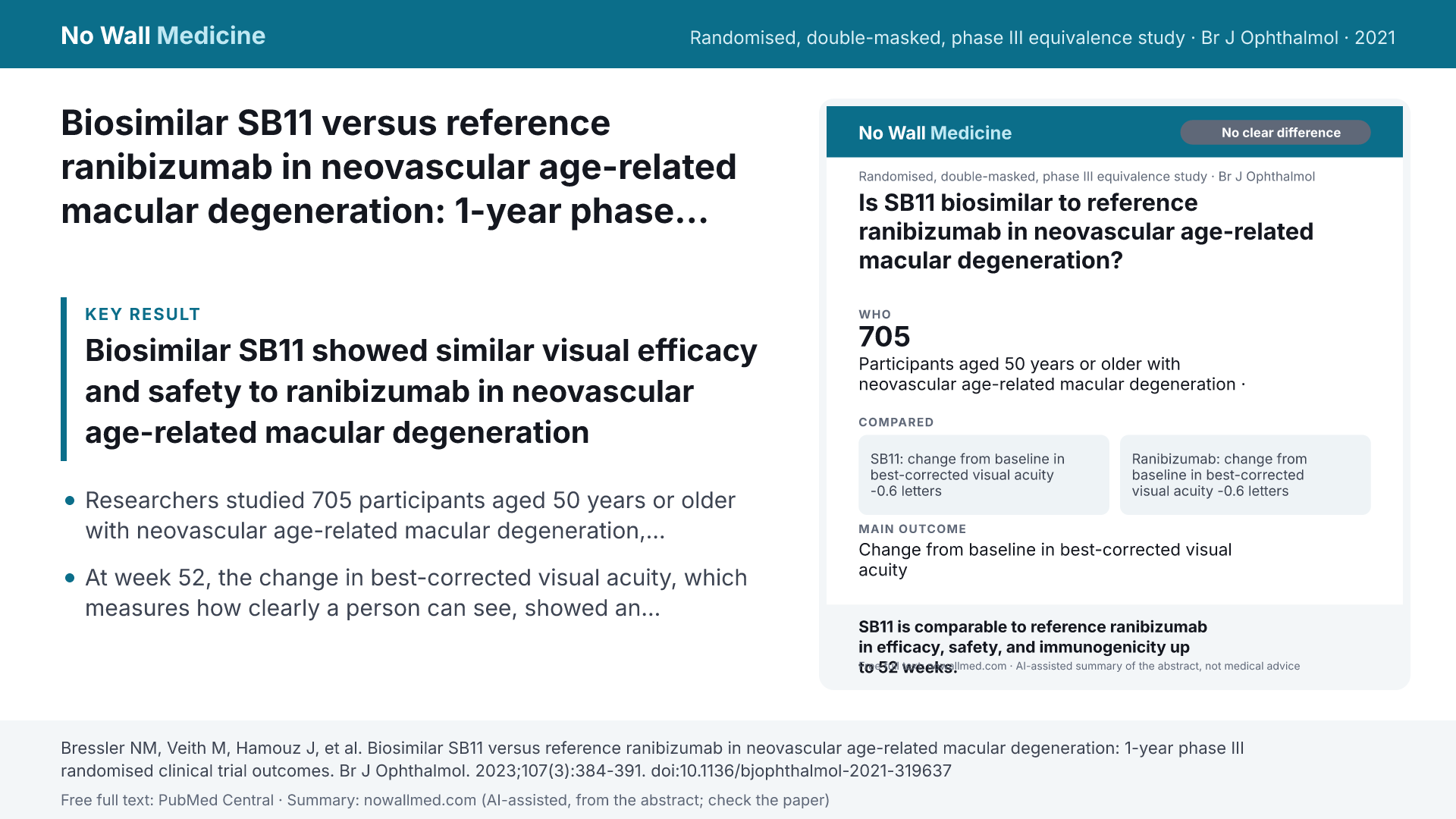
Biosimilar SB11 showed similar visual efficacy and safety to ranibizumab in neovascular age-related macular degeneration
Biosimilar SB11 versus reference ranibizumab in neovascular age-related macular degeneration: 1-year phase III randomised clinical trial outcomes
Randomised, double-masked, phase III equivalence studyNo clear difference
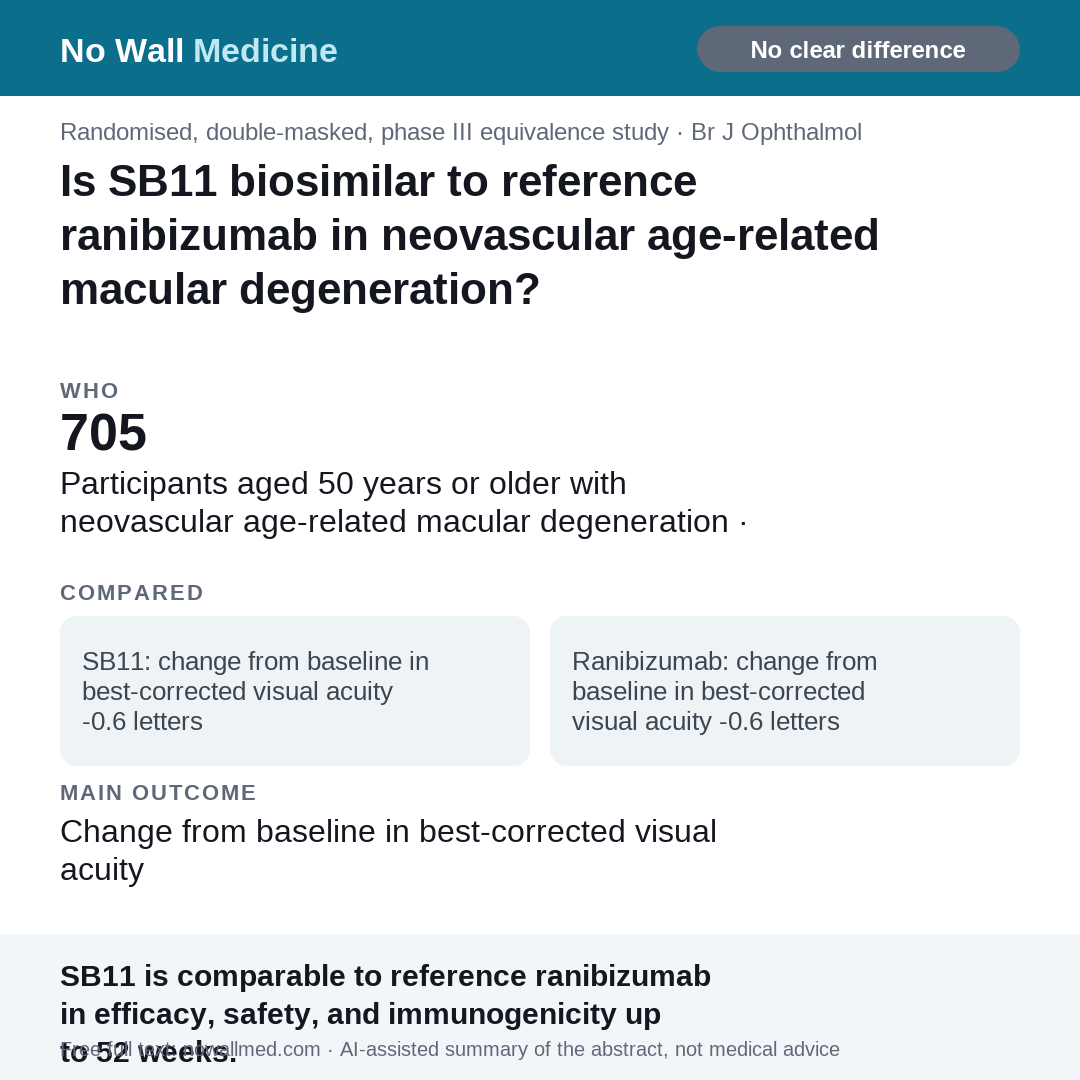
Is SB11 biosimilar to reference ranibizumab in neovascular age-related macular degeneration?
Who
705
Participants aged 50 years or older with neovascular age-related macular degeneration · Multicentre
Compared
SB11: change from baseline in best-corrected visual acuity -0.6 letters
Ranibizumab: change from baseline in best-corrected visual acuity -0.6 letters
Main outcome
Change from baseline in best-corrected visual acuity
Result: -0.6 letters (90% CI -2.1 to 0.9)
Bottom line: SB11 is comparable to reference ranibizumab in efficacy, safety, and immunogenicity up to 52 weeks.
Br J Ophthalmol · 2021-10-16Download image
Clinical question: Is SB11 biosimilar to reference ranibizumab in neovascular age-related macular degeneration?
Why it matters: Longer-term data on the efficacy, safety, and how the body processes the drug were needed to support the biosimilarity of SB11 compared to ranibizumab.
Key points
- Researchers studied 705 participants aged 50 years or older with neovascular age-related macular degeneration, comparing monthly injections of SB11 to the reference drug ranibizumab.
- At week 52, the change in best-corrected visual acuity, which measures how clearly a person can see, showed an adjusted treatment difference of -0.6 letters.
- Ocular treatment-emergent adverse events occurred in 32.0% of the SB11 group and 29.7% of the ranibizumab group, while serious ocular events occurred in 2.9% and 2.3% respectively.
Headline and key points written with AI from the paper’s abstract, with every number checked against it. Read the paper before relying on them.
Was this summary helpful?
Abstract
Background/aims
To provide longer-term data on efficacy, safety, immunogenicity and pharmacokinetics (PK) of ranibizumab biosimilar SB11 compared with the reference ranibizumab (RBZ) in patients with neovascular age-related macular degeneration (nAMD). Methods
Setting: Multicentre. Design: Randomised, double-masked, parallel-group, phase III equivalence study. Patient population: ≥50 years old participants with nAMD (n=705), one 'study eye'. Intervention
1:1 randomisation to monthly intravitreal injection of 0.5 mg SB11 or RBZ. Main outcome measures: Visual efficacy endpoints, safety, immunogenicity and PK up to 52 weeks. Results
Baseline and disease characteristics were comparable between treatment groups. Of 705 randomised participants (SB11: n=351; RBZ: n=354), 634 participants (89.9%; SB11: n=307; RBZ: n=327) completed the study until week 52. Previously reported equivalence in primary efficacy remained stable up to week 52 and were comparable between SB11 and RBZ. The adjusted treatment difference between SB11 and RBZ in full analysis set at week 52 of change from baseline in best-corrected visual acuity was -0.6 letters (90% CI -2.1 to 0.9) and of change from baseline in central subfield thickness was -14.9 µm (95% CI -25.3 to -4.5). The incidence of ocular treatment-emergent adverse events (TEAEs) (SB11: 32.0% vs RBZ: 29.7%) and serious ocular TEAE (SB11: 2.9% vs RBZ: 2.3%) appeared comparable between treatment groups, and no new safety concerns were observed. The PK and immunogenicity profiles were comparable, with a 4.2% and 5.5% cumulative incidence of antidrug antibodies up to week 52 for SB11 and RBZ, respectively. Conclusions
Longer-term results of this study further support the biosimilarity established between SB11 and RBZ.
Abstract reproduced under the article’s CC BY NC licence.
Subject terms
Cite this article
Bressler NM, Veith M, Hamouz J, Ernest J, Zalewski D, Studnička J. Biosimilar SB11 versus reference ranibizumab in neovascular age-related macular degeneration: 1-year phase III randomised clinical trial outcomes. Br J Ophthalmol. 2021. doi:10.1136/bjophthalmol-2021-319637
Spotted a mistake? Suggest a correction
Top studies every Monday
The week’s key trials and guidelines in your specialties, plus any topics you follow. By email, free.
Get the weekly digest