A randomized double-blind trial of intranasal dexmedetomidine versus intranasal esketamine for procedural sedation and analgesia in young children
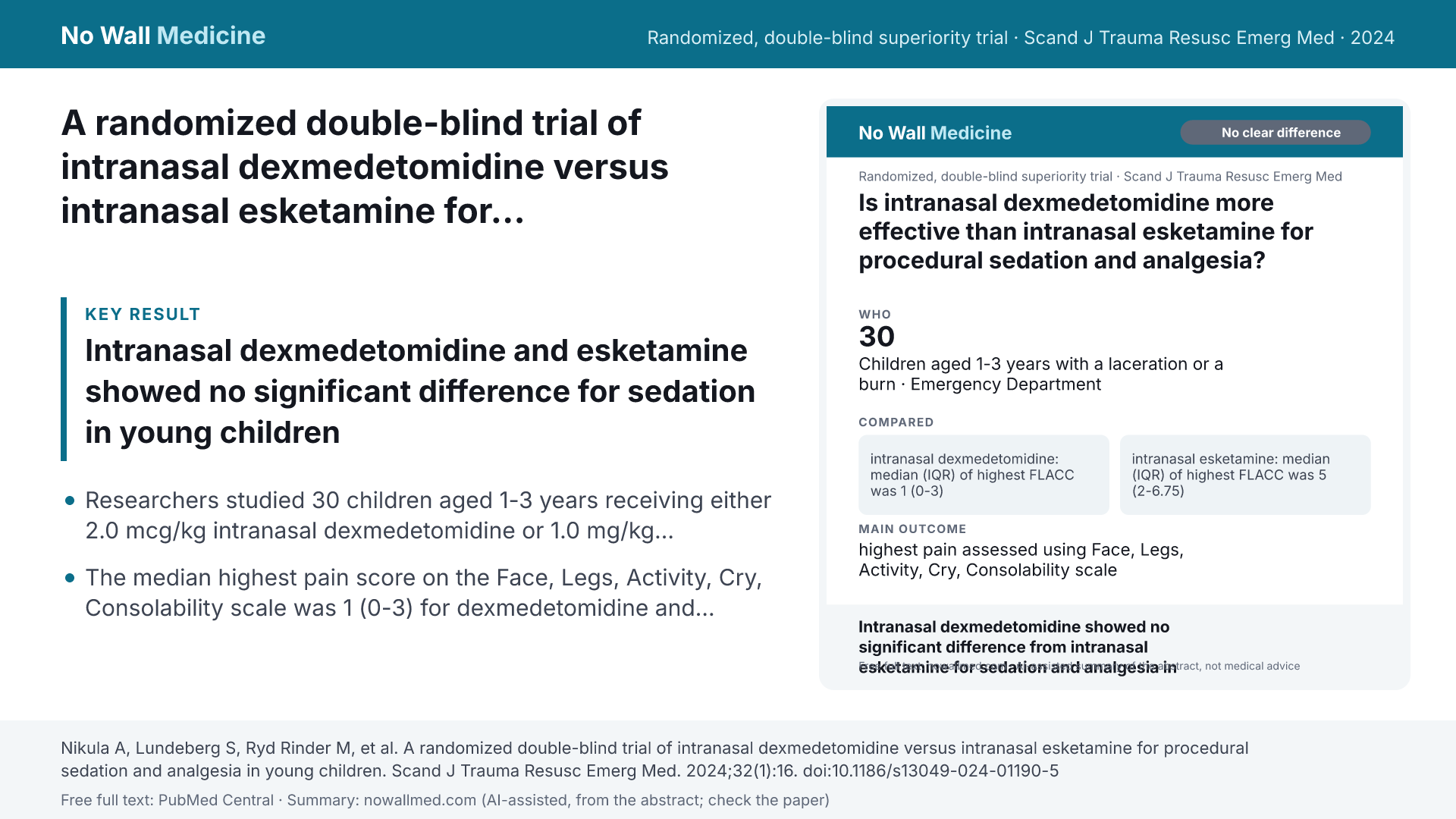
Key result: Intranasal dexmedetomidine and esketamine showed no significant difference for sedation in young children
Randomized, double-blind superiority trialNo clear difference
Is intranasal dexmedetomidine more effective than intranasal esketamine for procedural sedation and analgesia?
Who
30
Children aged 1-3 years with a laceration or a burn · Emergency Department
Compared
intranasal dexmedetomidine: median (IQR) of highest FLACC was 1 (0-3)
intranasal esketamine: median (IQR) of highest FLACC was 5 (2-6.75)
Main outcome
highest pain assessed using Face, Legs, Activity, Cry, Consolability scale
Result: p-value 0.09
Bottom line: Intranasal dexmedetomidine showed no significant difference from intranasal esketamine for sedation and analgesia in young children.
Limitation: The study was underpowered due to changes in treatment and logistical reasons.
Scand J Trauma Resusc Emerg Med · 2024-03-04
Key points
- Researchers studied 30 children aged 1-3 years receiving either 2.0 mcg/kg intranasal dexmedetomidine or 1.0 mg/kg intranasal esketamine for minor injuries.
- The median highest pain score on the Face, Legs, Activity, Cry, Consolability scale was 1 (0-3) for dexmedetomidine and 5 (2-6.75) for esketamine, but this was not statistically significant.
- While 85.7% of parents were very satisfied with dexmedetomidine compared to 46.2% with esketamine, this difference also did not reach statistical significance.
Discussion prompts
- Would these patients look like yours? Who was left out?
- Is the main outcome one that matters to patients?
- Is the difference large enough to change what you do?
Cite: Nikula A, Lundeberg S, Ryd Rinder M, et al. A randomized double-blind trial of intranasal dexmedetomidine versus intranasal esketamine for procedural sedation and analgesia in young children. Scand J Trauma Resusc Emerg Med. 2024;32(1):16. doi:10.1186/s13049-024-01190-5
Free full text: PubMed Central · Summary and visual abstract: nowallmed.com/a/a-randomized-double-blind-trial-of-intranasal-dexmedetomidine-versus-1l5gfls/ (AI-assisted from the abstract; check the paper before relying on it).