Intranasal dexmedetomidine and esketamine showed no significant difference for sedation in young children
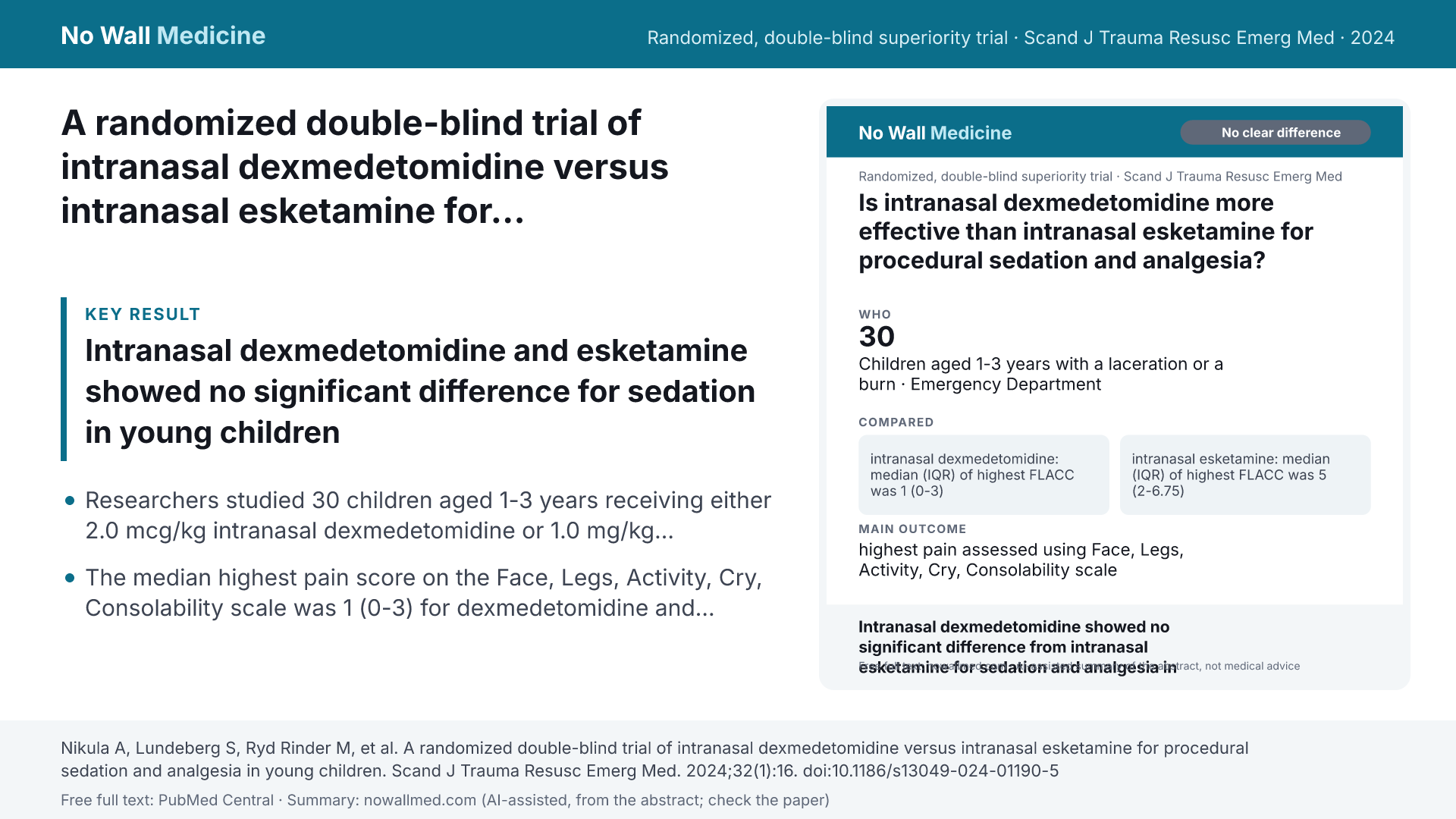
A randomized double-blind trial of intranasal dexmedetomidine versus intranasal esketamine for procedural sedation and analgesia in young children
Randomized, double-blind superiority trialNo clear difference
Is intranasal dexmedetomidine more effective than intranasal esketamine for procedural sedation and analgesia?
Who
30
Children aged 1-3 years with a laceration or a burn · Emergency Department
Compared
intranasal dexmedetomidine: median (IQR) of highest FLACC was 1 (0-3)
intranasal esketamine: median (IQR) of highest FLACC was 5 (2-6.75)
Main outcome
highest pain assessed using Face, Legs, Activity, Cry, Consolability scale
Result: p-value 0.09
Bottom line: Intranasal dexmedetomidine showed no significant difference from intranasal esketamine for sedation and analgesia in young children.
Limitation: The study was underpowered due to changes in treatment and logistical reasons.
Scand J Trauma Resusc Emerg Med · 2024-03-04Download image
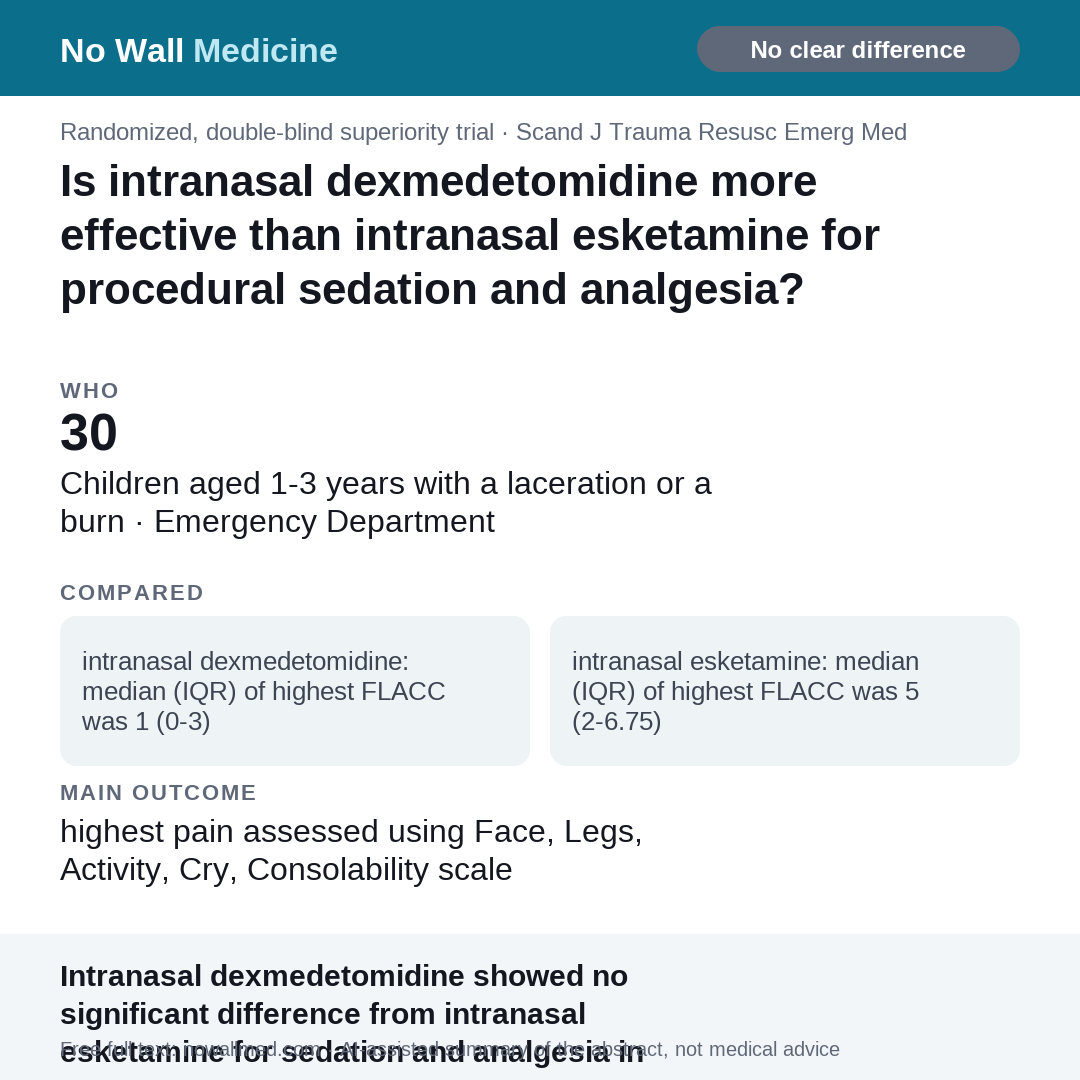
Clinical question: Is intranasal dexmedetomidine more effective than intranasal esketamine for procedural sedation and analgesia?
Key points
- Researchers studied 30 children aged 1-3 years receiving either 2.0 mcg/kg intranasal dexmedetomidine or 1.0 mg/kg intranasal esketamine for minor injuries.
- The median highest pain score on the Face, Legs, Activity, Cry, Consolability scale was 1 (0-3) for dexmedetomidine and 5 (2-6.75) for esketamine, but this was not statistically significant.
- While 85.7% of parents were very satisfied with dexmedetomidine compared to 46.2% with esketamine, this difference also did not reach statistical significance.
Headline and key points written with AI from the paper’s abstract, with every number checked against it. Read the paper before relying on them.
Was this summary helpful?
Subject terms
Cite this article
Nikula A, Lundeberg S, Ryd Rinder M, et al. A randomized double-blind trial of intranasal dexmedetomidine versus intranasal esketamine for procedural sedation and analgesia in young children. Scand J Trauma Resusc Emerg Med. 2024;32(1):16. doi:10.1186/s13049-024-01190-5
Spotted a mistake? Suggest a correction