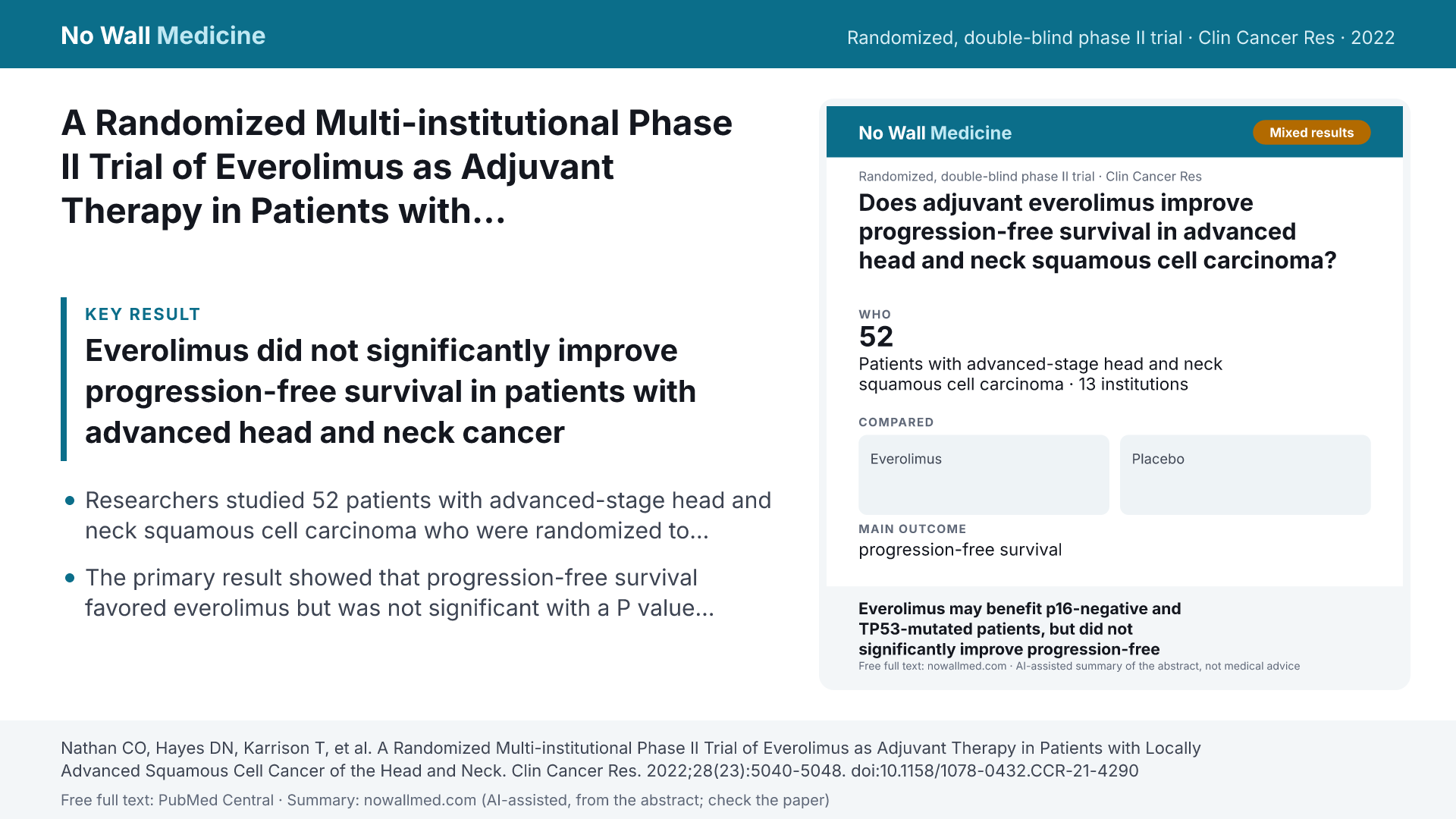
Everolimus did not significantly improve progression-free survival in patients with advanced head and neck cancer
A Randomized Multi-institutional Phase II Trial of Everolimus as Adjuvant Therapy in Patients with Locally Advanced Squamous Cell Cancer of the Head and Neck
Randomized, double-blind phase II trialMixed results
Does adjuvant everolimus improve progression-free survival in advanced head and neck squamous cell carcinoma?
Who
52
Patients with advanced-stage head and neck squamous cell carcinoma · 13 institutions
Compared
Everolimus
Placebo
Main outcome
progression-free survival
Result: hazard ratio 0.44 (95% confidence interval 0.17-1.17)
Bottom line: Everolimus may benefit p16-negative and TP53-mutated patients, but did not significantly improve progression-free survival overall.
Clin Cancer Res · 2022-10-05Download image
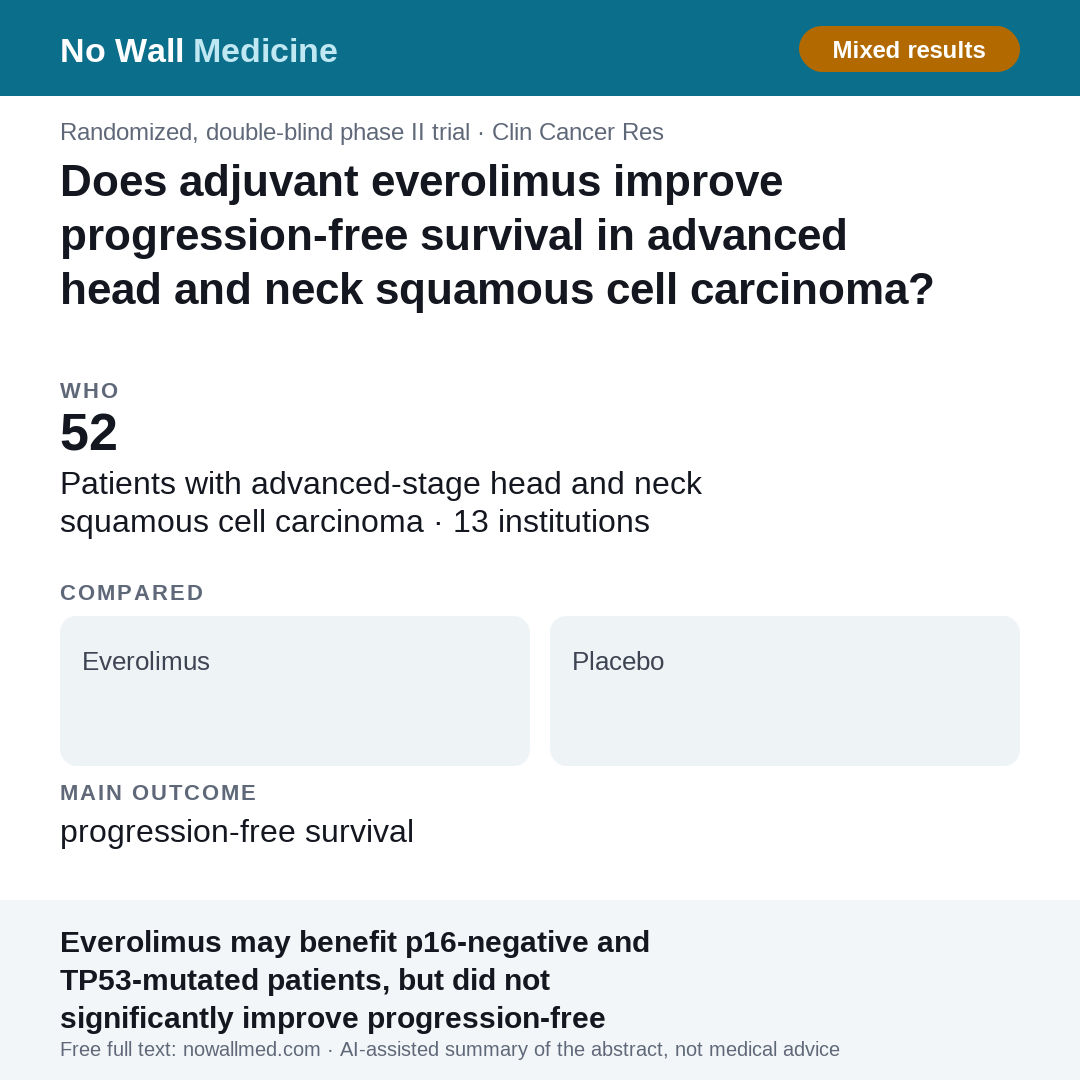
Clinical question: Does adjuvant everolimus improve progression-free survival in advanced head and neck squamous cell carcinoma?
Why it matters: It is unknown if adding the mTOR inhibitor everolimus after definitive therapy improves progression-free survival for patients with advanced-stage head and neck squamous cell carcinoma.
Key points
- Researchers studied 52 patients with advanced-stage head and neck squamous cell carcinoma who were randomized to receive either everolimus or a placebo for up to 1 year.
- The primary result showed that progression-free survival favored everolimus but was not significant with a P value of 0.093 and a hazard ratio of 0.44.
- Everolimus was associated with higher progression-free survival in patients who were p16-negative or had TP53 mutations, but no difference was seen in overall survival.
Headline and key points written with AI from the paper’s abstract, with every number checked against it. Read the paper before relying on them.
Was this summary helpful?
Subject terms
Cite this article
Nathan CO, Hayes DN, Karrison T, et al. A Randomized Multi-institutional Phase II Trial of Everolimus as Adjuvant Therapy in Patients with Locally Advanced Squamous Cell Cancer of the Head and Neck. Clin Cancer Res. 2022. doi:10.1158/1078-0432.CCR-21-4290
Spotted a mistake? Suggest a correction