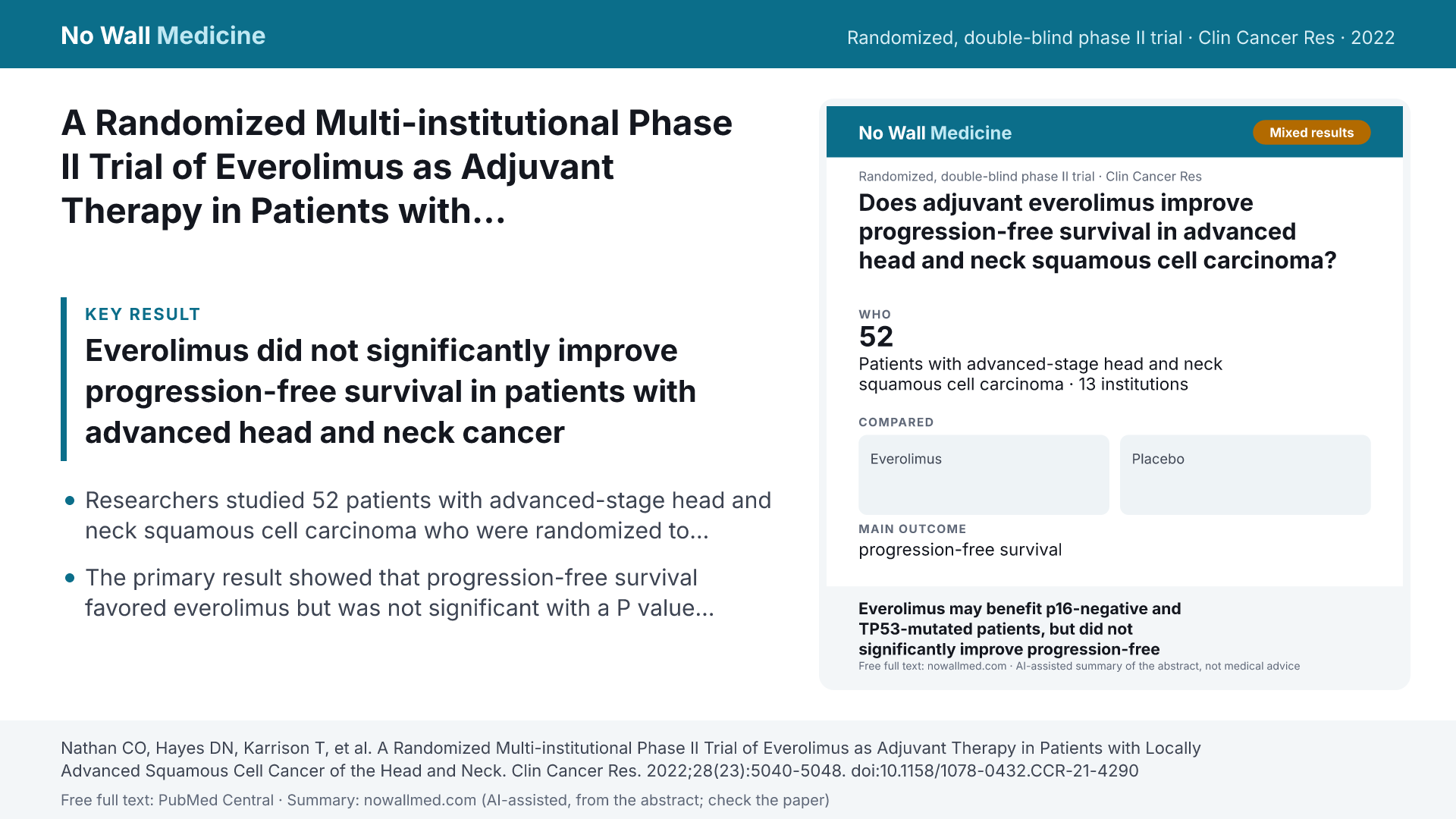
A Randomized Multi-institutional Phase II Trial of Everolimus as Adjuvant Therapy in Patients with Locally Advanced Squamous Cell Cancer of the Head and Neck
Key result: Everolimus did not significantly improve progression-free survival in patients with advanced head and neck cancer
Key points
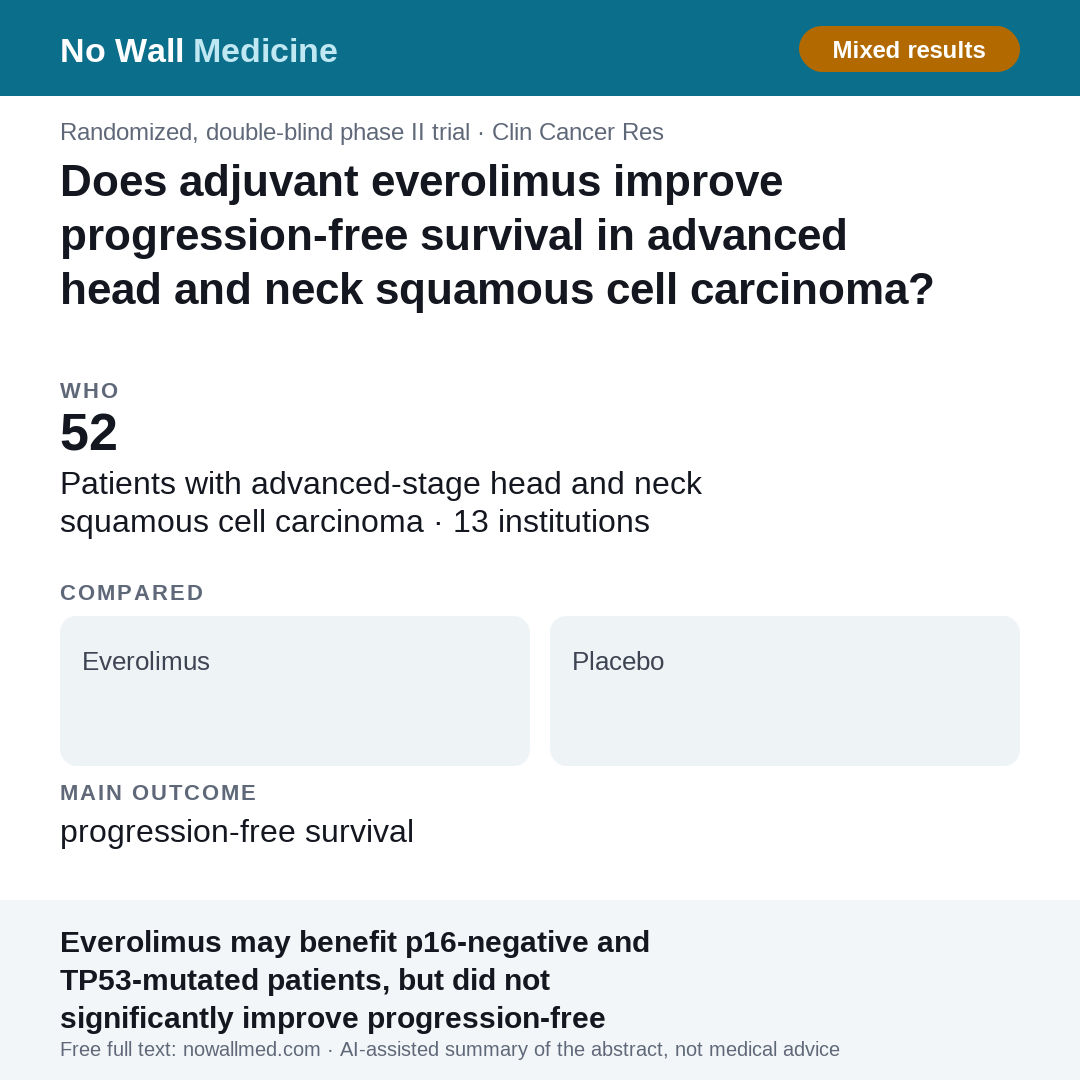
- Researchers studied 52 patients with advanced-stage head and neck squamous cell carcinoma who were randomized to receive either everolimus or a placebo for up to 1 year.
- The primary result showed that progression-free survival favored everolimus but was not significant with a P value of 0.093 and a hazard ratio of 0.44.
- Everolimus was associated with higher progression-free survival in patients who were p16-negative or had TP53 mutations, but no difference was seen in overall survival.
Why it matters: It is unknown if adding the mTOR inhibitor everolimus after definitive therapy improves progression-free survival for patients with advanced-stage head and neck squamous cell carcinoma.
Discussion prompts
- Would these patients look like yours? Who was left out?
- Is the main outcome one that matters to patients?
- Is the difference large enough to change what you do?
Cite: Nathan CO, Hayes DN, Karrison T, et al. A Randomized Multi-institutional Phase II Trial of Everolimus as Adjuvant Therapy in Patients with Locally Advanced Squamous Cell Cancer of the Head and Neck. Clin Cancer Res. 2022. doi:10.1158/1078-0432.CCR-21-4290
Free full text: PubMed Central · Summary and visual abstract: nowallmed.com/a/a-randomized-multi-institutional-phase-ii-trial-of-everolimus-as-1jdeqtu/ (AI-assisted from the abstract; check the paper before relying on it).