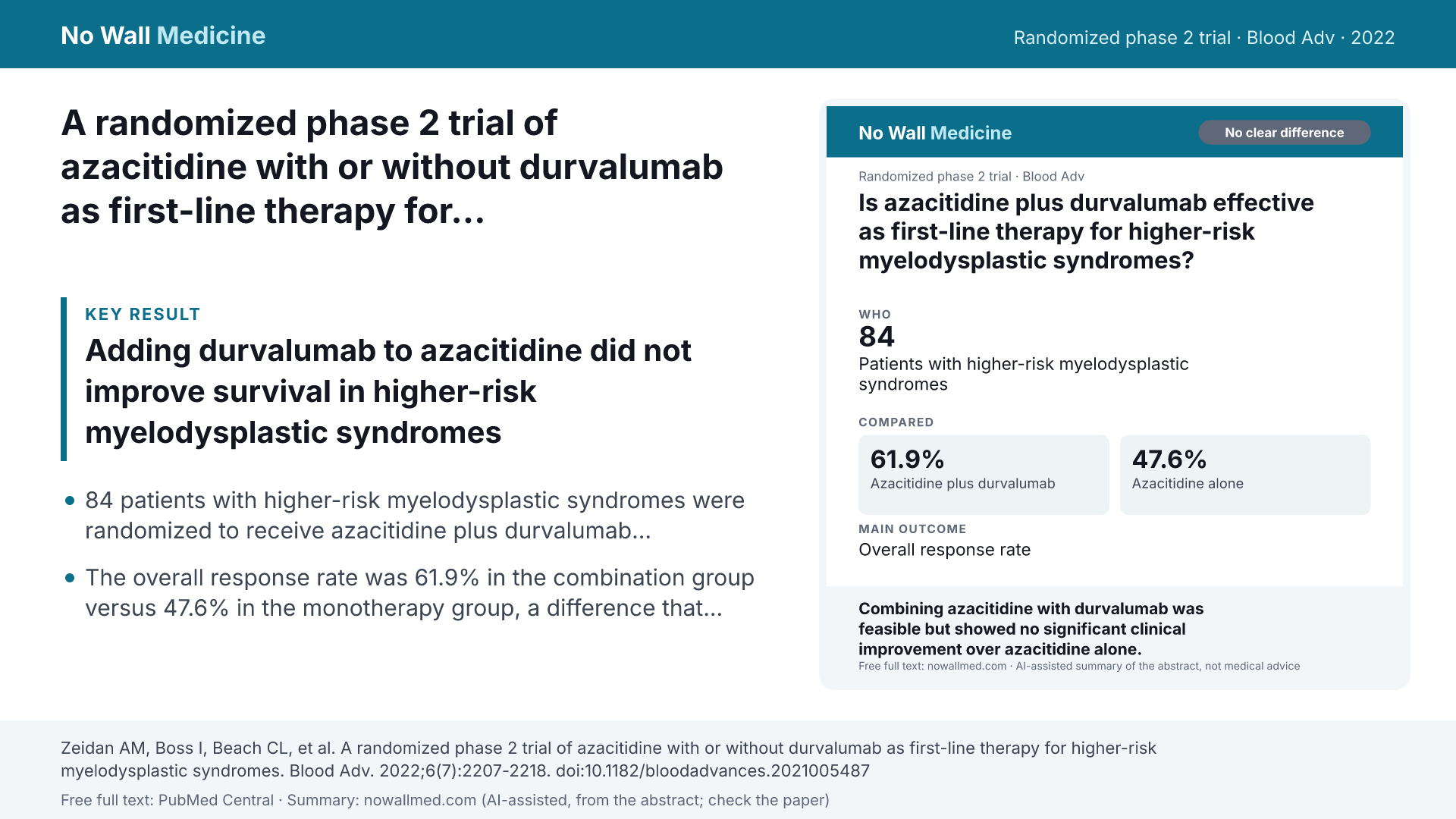
Adding durvalumab to azacitidine did not improve survival in higher-risk myelodysplastic syndromes
A randomized phase 2 trial of azacitidine with or without durvalumab as first-line therapy for higher-risk myelodysplastic syndromes
Randomized phase 2 trialNo clear difference
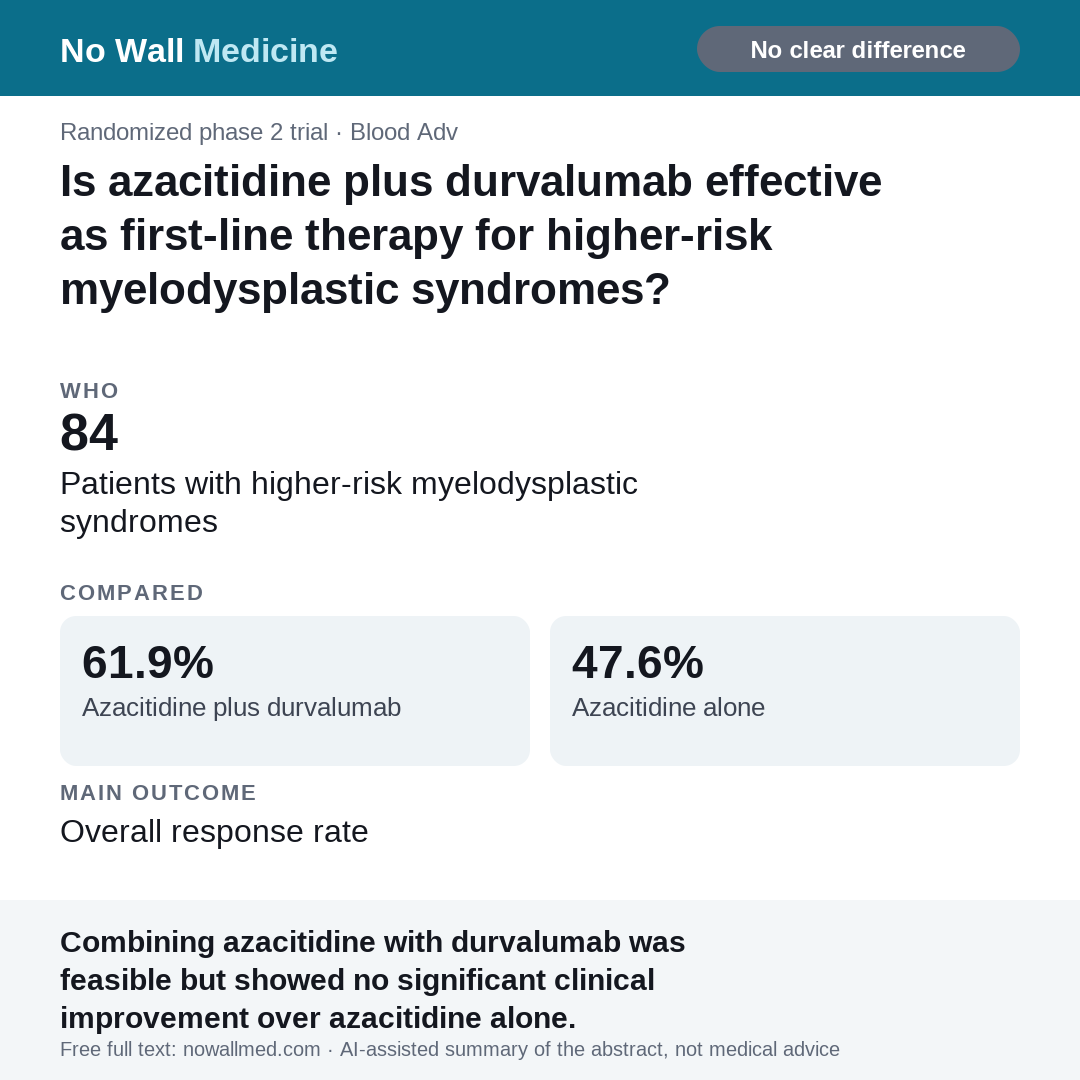
Is azacitidine plus durvalumab effective as first-line therapy for higher-risk myelodysplastic syndromes?
Who
84
Patients with higher-risk myelodysplastic syndromes
Compared
61.9%Azacitidine plus durvalumab (26 of 42)
47.6%Azacitidine alone (20 of 42)
Main outcome
Overall response rate
Bottom line: Combining azacitidine with durvalumab was feasible but showed no significant clinical improvement over azacitidine alone.
Blood Adv · 2022-01-01Download image
Same trial (NCT02775903)
Papers we list that report this registered trial, oldest first. Read a secondary analysis alongside the main results.
- Main results
Adding durvalumab to azacitidine did not improve survival in older AML patients Blood Adv 2021-12 - Related analysis No clear difference
This paper Blood Adv 2022-01
Clinical question: Is azacitidine plus durvalumab effective as first-line therapy for higher-risk myelodysplastic syndromes?
Key points
- 84 patients with higher-risk myelodysplastic syndromes were randomized to receive azacitidine plus durvalumab or azacitidine alone as first-line therapy.
- The overall response rate was 61.9% in the combination group versus 47.6% in the monotherapy group, a difference that was not statistically significant.
- Median overall survival was 11.6 months for the combination group and 16.7 months for the monotherapy group, with no significant difference between arms.
Headline and key points written with AI from the paper’s abstract, with every number checked against it. Read the paper before relying on them.
Was this summary helpful?
Abstract
Azacitidine-mediated hypomethylation promotes tumor cell immune recognition but may increase the expression of inhibitory immune checkpoint molecules. We conducted the first randomized phase 2 study of azacitidine plus the immune checkpoint inhibitor durvalumab vs azacitidine monotherapy as first-line treatment for higher-risk myelodysplastic syndromes (HR-MDS). In all, 84 patients received 75 mg/m2 subcutaneous azacitidine (days 1-7 every 4 weeks) combined with 1500 mg intravenous durvalumab on day 1 every 4 weeks (Arm A) for at least 6 cycles or 75 mg/m² subcutaneous azacitidine alone (days 1-7 every 4 weeks) for at least 6 cycles (Arm B). After a median follow-up of 15.25 months, 8 patients in Arm A and 6 in Arm B remained on treatment. Patients in Arm A received a median of 7.9 treatment cycles and those in Arm B received a median of 7.0 treatment cycles with 73.7% and 65.9%, respectively, completing ≥4 cycles. The overall response rate (primary end point) was 61.9% in Arm A (26 of 42) and 47.6% in Arm B (20 of 42; P = .18), and median overall survival was 11.6 months (95% confidence interval, 9.5 months to not evaluable) vs 16.7 months (95% confidence interval, 9.8-23.5 months; P = .74). Durvalumab-related adverse events (AEs) were reported by 71.1% of patients; azacitidine-related AEs were reported by 82% (Arm A) and 81% (Arm B). Grade 3 or 4 hematologic AEs were reported in 89.5% (Arm A) vs 68.3% (Arm B) of patients. Patients with TP53 mutations tended to have a worse response than patients without these mutations. Azacitidine increased programmed cell death ligand 1 (PD-L1 [CD274]) surface expression on bone marrow granulocytes and monocytes, but not blasts, in both arms. In summary, combining azacitidine with durvalumab in patients with HR-MDS was feasible but with more toxicities and without significant improvement in clinical outcomes over azacitidine alone. This trial was registered at www.clinicaltrials.gov as #NCT02775903.
Abstract reproduced under the article’s CC BY NC ND licence.
Subject terms
Headline, design, result, key points, caveat and citation as plain text.
Cite this article
Zeidan AM, Boss I, Beach CL, et al. A randomized phase 2 trial of azacitidine with or without durvalumab as first-line therapy for higher-risk myelodysplastic syndromes. Blood Adv. 2022. doi:10.1182/bloodadvances.2021005487
Spotted a mistake? Suggest a correction