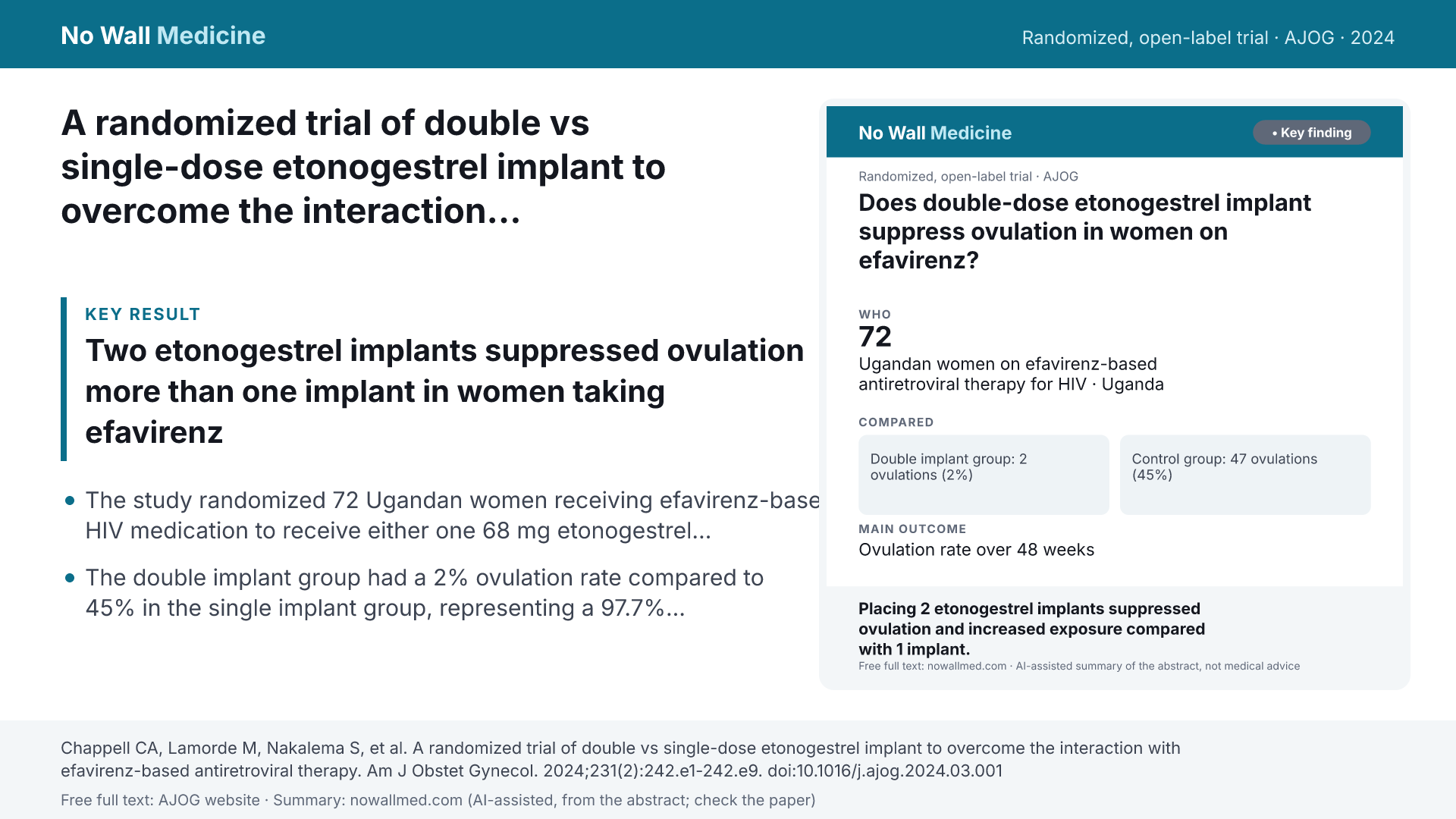
Two etonogestrel implants suppressed ovulation more than one implant in women taking efavirenz
A randomized trial of double vs single-dose etonogestrel implant to overcome the interaction with efavirenz-based antiretroviral therapy
Randomized, open-label trialKey finding
Does double-dose etonogestrel implant suppress ovulation in women on efavirenz?
Who
72
Ugandan women on efavirenz-based antiretroviral therapy for HIV · Uganda
Compared
Double implant group: 2 ovulations (2%)
Control group: 47 ovulations (45%)
Main outcome
Ovulation rate over 48 weeks
Result: odds of ovulation reduced by 97.7% (95% confidence interval, 90.1-99.5)
Bottom line: Placing 2 etonogestrel implants suppressed ovulation and increased exposure compared with 1 implant.
AJOG · 2024-03-07 · Save PNG
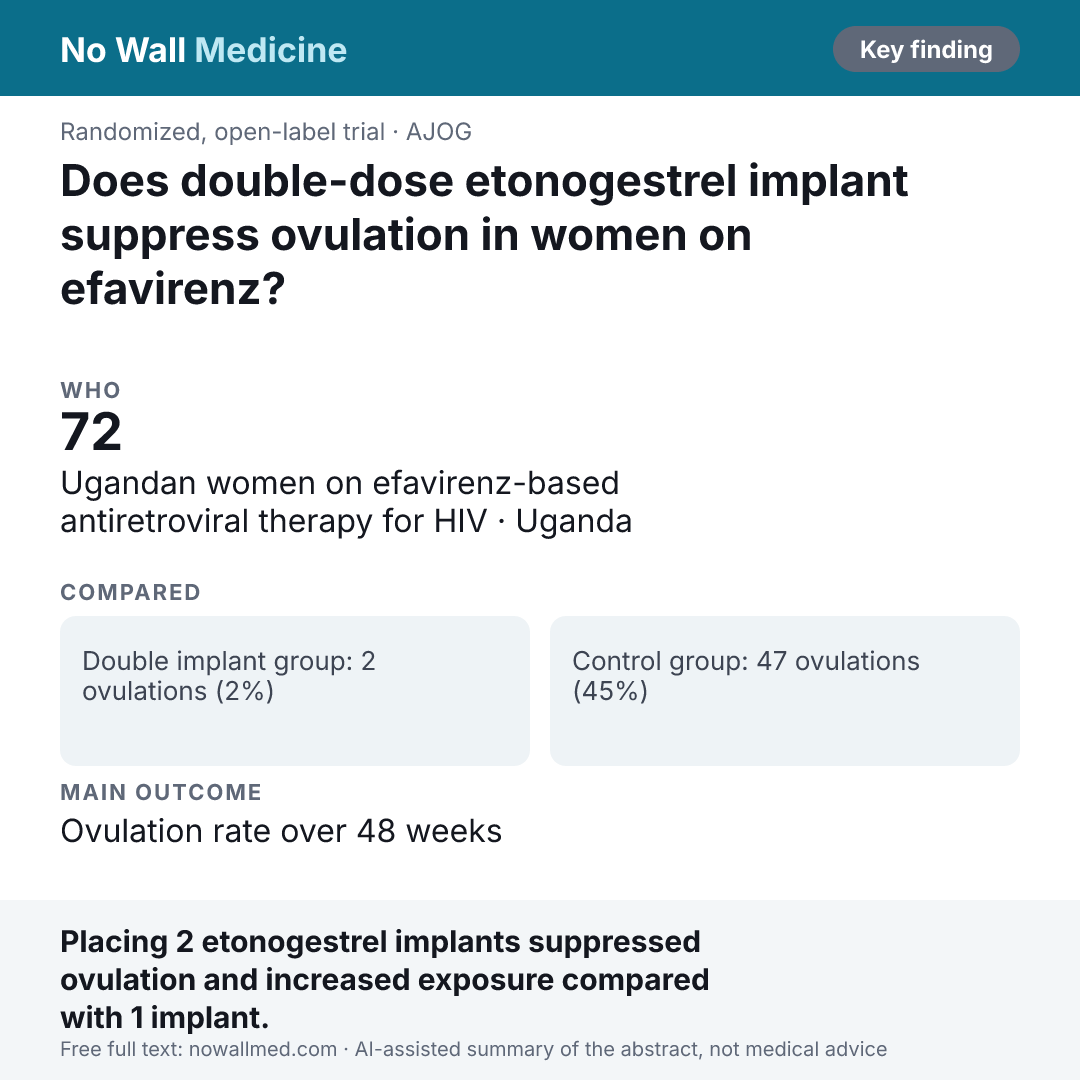
Clinical question: Does double-dose etonogestrel implant suppress ovulation in women on efavirenz?
Why it matters: Efavirenz-based HIV medication is associated with an 82% lower exposure to the contraceptive hormone etonogestrel, which may lead to higher rates of unintended pregnancy.
Key points
- The study randomized 72 Ugandan women receiving efavirenz-based HIV medication to receive either one 68 mg etonogestrel implant or two 136 mg implants.
- The double implant group had a 2% ovulation rate compared to 45% in the single implant group, representing a 97.7% reduction in the odds of ovulation.
- Etonogestrel concentrations were more than 2-fold higher in the double implant group than in the control group at all measured time points.
Headline and key points written with AI from the paper’s abstract, with every number checked against it. Read the paper before relying on them.
Was this summary helpful?
Subject terms
Headline, design, result, key points, caveat and citation as plain text.
Cite this article
Chappell CA, Lamorde M, Nakalema S, et al. A randomized trial of double vs single-dose etonogestrel implant to overcome the interaction with efavirenz-based antiretroviral therapy. Am J Obstet Gynecol. 2024;231(2):242.e1-242.e9. doi:10.1016/j.ajog.2024.03.001
Spotted a mistake? Suggest a correction