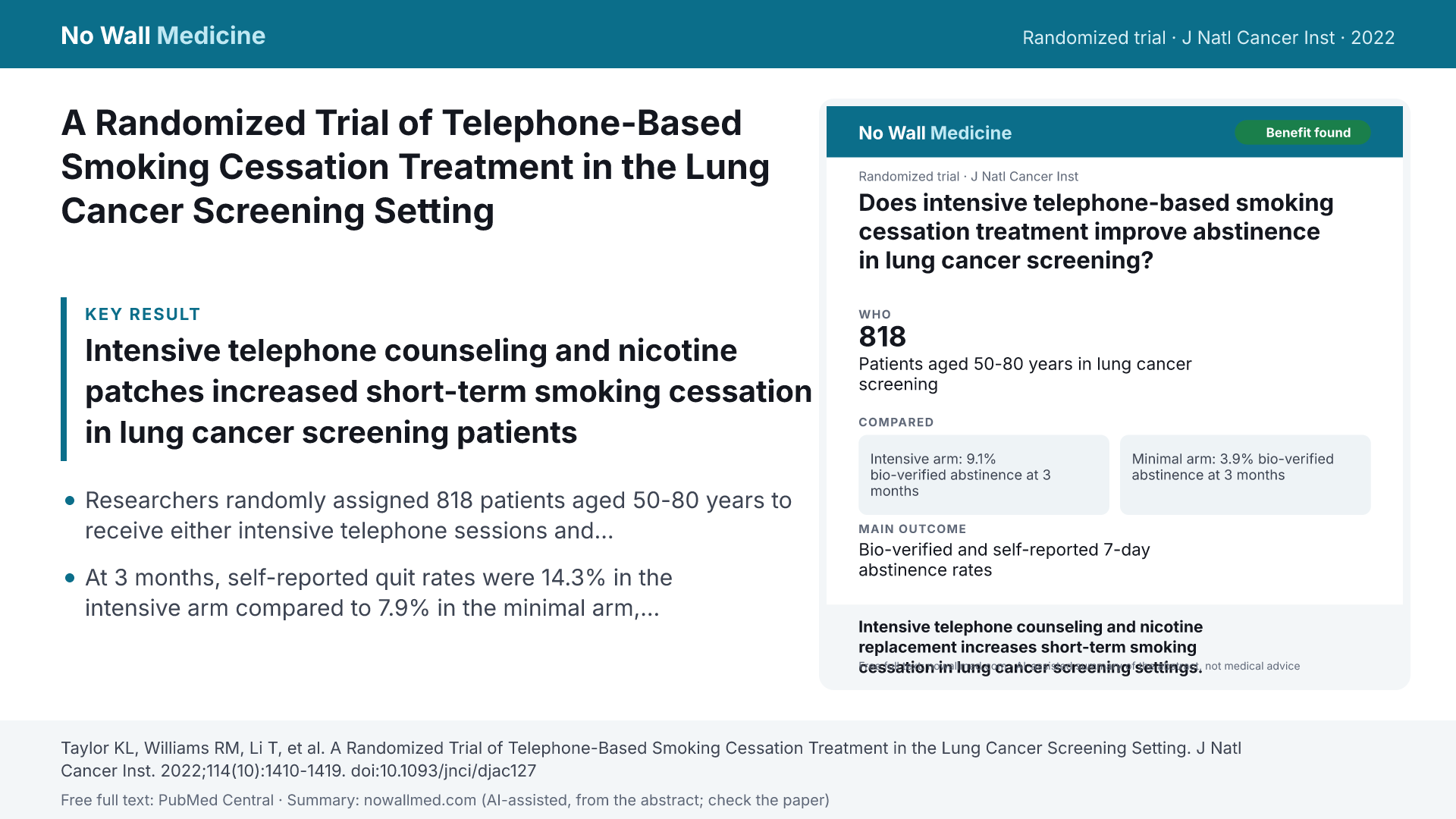
Intensive telephone counseling and nicotine patches increased short-term smoking cessation in lung cancer screening patients
A Randomized Trial of Telephone-Based Smoking Cessation Treatment in the Lung Cancer Screening Setting
Randomized trialBenefit found
Does intensive telephone-based smoking cessation treatment improve abstinence in lung cancer screening?
Who
818
Patients aged 50-80 years in lung cancer screening
Compared
Intensive arm: 9.1% bio-verified abstinence at 3 months
Minimal arm: 3.9% bio-verified abstinence at 3 months
Main outcome
Bio-verified and self-reported 7-day abstinence rates
Result: odds ratio 2.70 (95% CI 1.44 to 5.08)
Bottom line: Intensive telephone counseling and nicotine replacement increases short-term smoking cessation in lung cancer screening settings.
J Natl Cancer Inst · 2022-07-13 · Save PNG
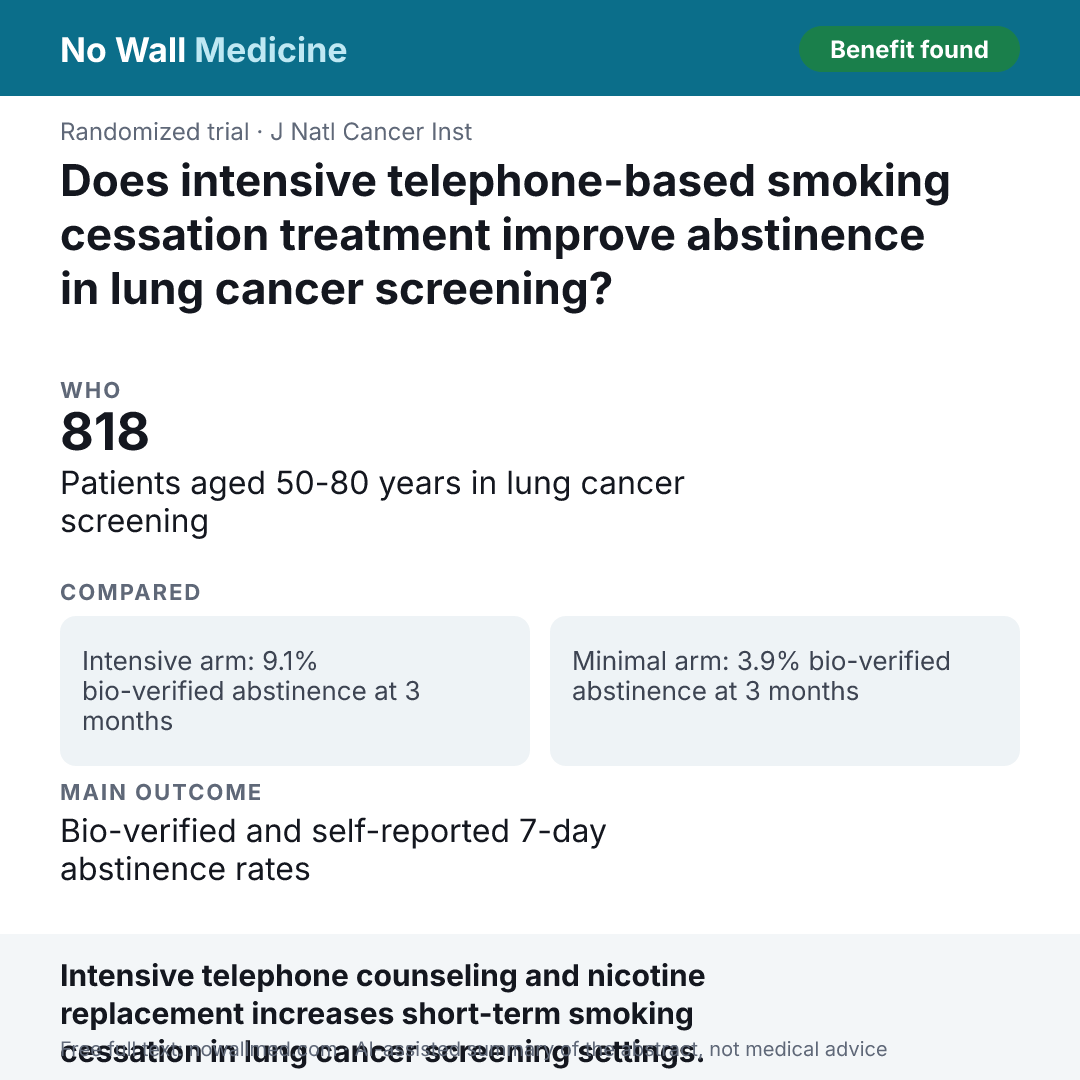
Clinical question: Does intensive telephone-based smoking cessation treatment improve abstinence in lung cancer screening?
Key points
- Researchers randomly assigned 818 patients aged 50-80 years to receive either intensive telephone sessions and nicotine patches or minimal telephone sessions and nicotine patches.
- At 3 months, self-reported quit rates were 14.3% in the intensive arm compared to 7.9% in the minimal arm, while bio-verified abstinence was 9.1% versus 3.9%.
- The difference in abstinence rates between the two groups was not statistically significant at 6 months or 12 months post-randomization.
Headline and key points written with AI from the paper’s abstract, with every number checked against it. Read the paper before relying on them.
Was this summary helpful?
Subject terms
Headline, design, result, key points, caveat and citation as plain text.
Cite this article
Taylor KL, Williams RM, Li T, et al. A Randomized Trial of Telephone-Based Smoking Cessation Treatment in the Lung Cancer Screening Setting. J Natl Cancer Inst. 2022;114(10):1410-1419. doi:10.1093/jnci/djac127
Spotted a mistake? Suggest a correction