Liberal red blood cell transfusion strategy shows no significant difference in neurological outcomes for brain hemorrhage patients
A Restrictive Versus a Liberal Transfusion Strategy in Patients With Spontaneous Intracerebral Hemorrhage: A Secondary Analysis of TRAIN Randomized Clinical Trial
Randomized clinical trial secondary analysisMixed results
Does a restrictive versus liberal transfusion strategy affect neurological outcome in spontaneous intracerebral hemorrhage?
Who
144
Anemic critically ill patients with spontaneous intracerebral hemorrhage · 72 intensive care units across 22 countries
Compared
84.7%Restrictive strategy
71.8%Liberal strategy
Main outcome
Unfavorable neurological outcome at 180 days
Result: risk ratio 0.85 (95% CI 0.71-1.01)
Bottom line: Liberal transfusion strategy reduced mortality and organ failure but did not significantly improve unfavorable neurological outcomes.
Limitation: The study cohort might have been underpowered to detect clinically relevant differences.
Stroke · 2025-06-17Download image
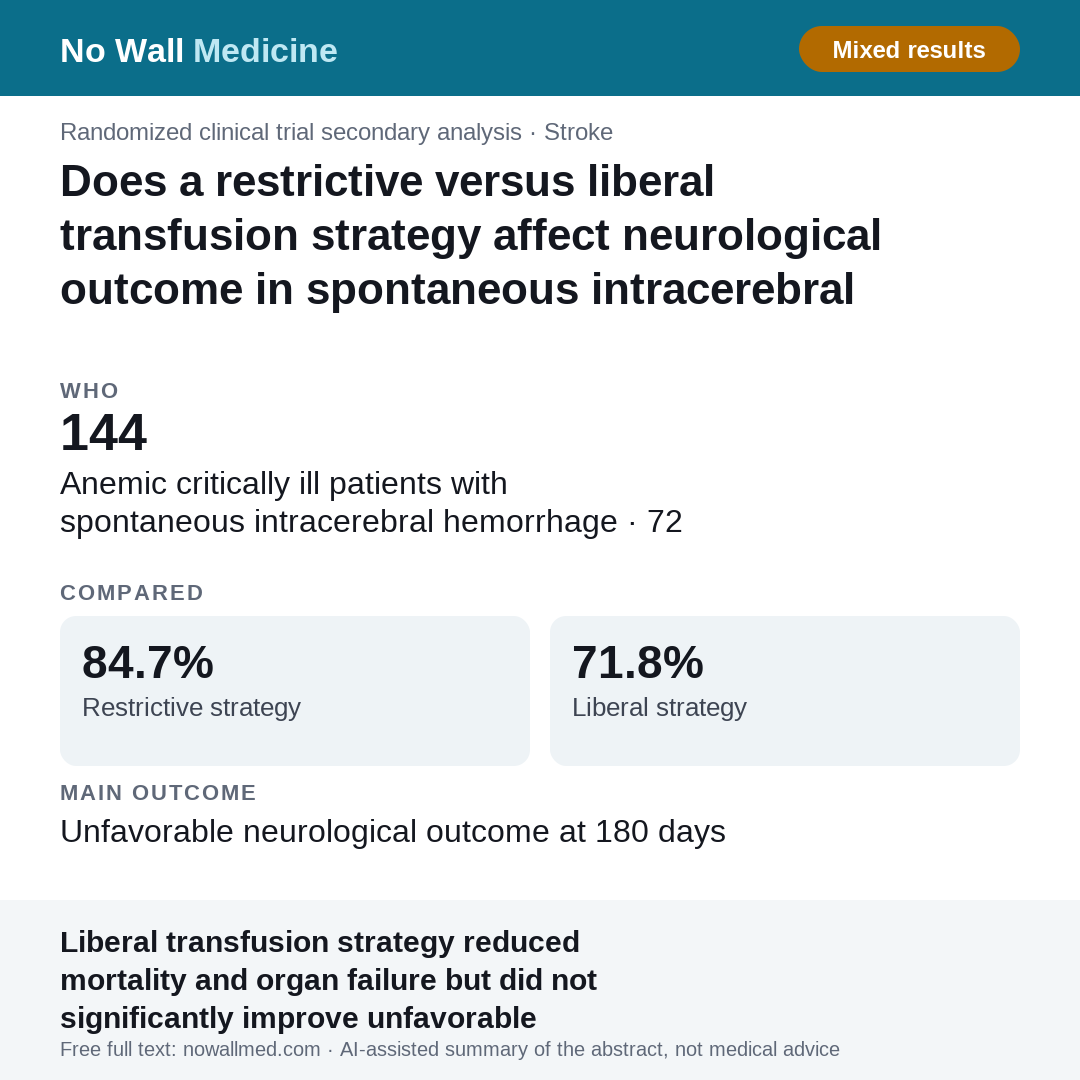
Clinical question: Does a restrictive versus liberal transfusion strategy affect neurological outcome in spontaneous intracerebral hemorrhage?
Why it matters: The optimal hemoglobin threshold to initiate red blood cell transfusions in patients with spontaneous intracerebral hemorrhage is uncertain.
Key points
- Researchers analyzed 144 patients with spontaneous intracerebral hemorrhage, comparing a restrictive strategy (transfusion at hemoglobin ≤7 g/dL) to a liberal strategy (transfusion at hemoglobin ≤9 g/dL).
- The liberal strategy was associated with a nonsignificant decrease in unfavorable neurological outcomes at 180 days, with 71.8% versus 84.7% of patients experiencing these outcomes.
- The liberal group had a significantly lower occurrence of mortality and organ failure at 28 days, with 71.8% versus 87.7% of patients experiencing this composite outcome.
Headline and key points written with AI from the paper’s abstract, with every number checked against it. Read the paper before relying on them.
Was this summary helpful?
Subject terms
Cite this article
Faso C, Gouvea Bogossian E, Bittencourt Rynkowski C, Moller K, Lormans P, Quintana Diaz M. A Restrictive Versus a Liberal Transfusion Strategy in Patients With Spontaneous Intracerebral Hemorrhage: A Secondary Analysis of TRAIN Randomized Clinical Trial. Stroke. 2025. doi:10.1161/STROKEAHA.125.050729
Spotted a mistake? Suggest a correction
Top studies every Monday
The week’s key trials and guidelines in your specialties, plus any topics you follow. By email, free.
Get the weekly digest