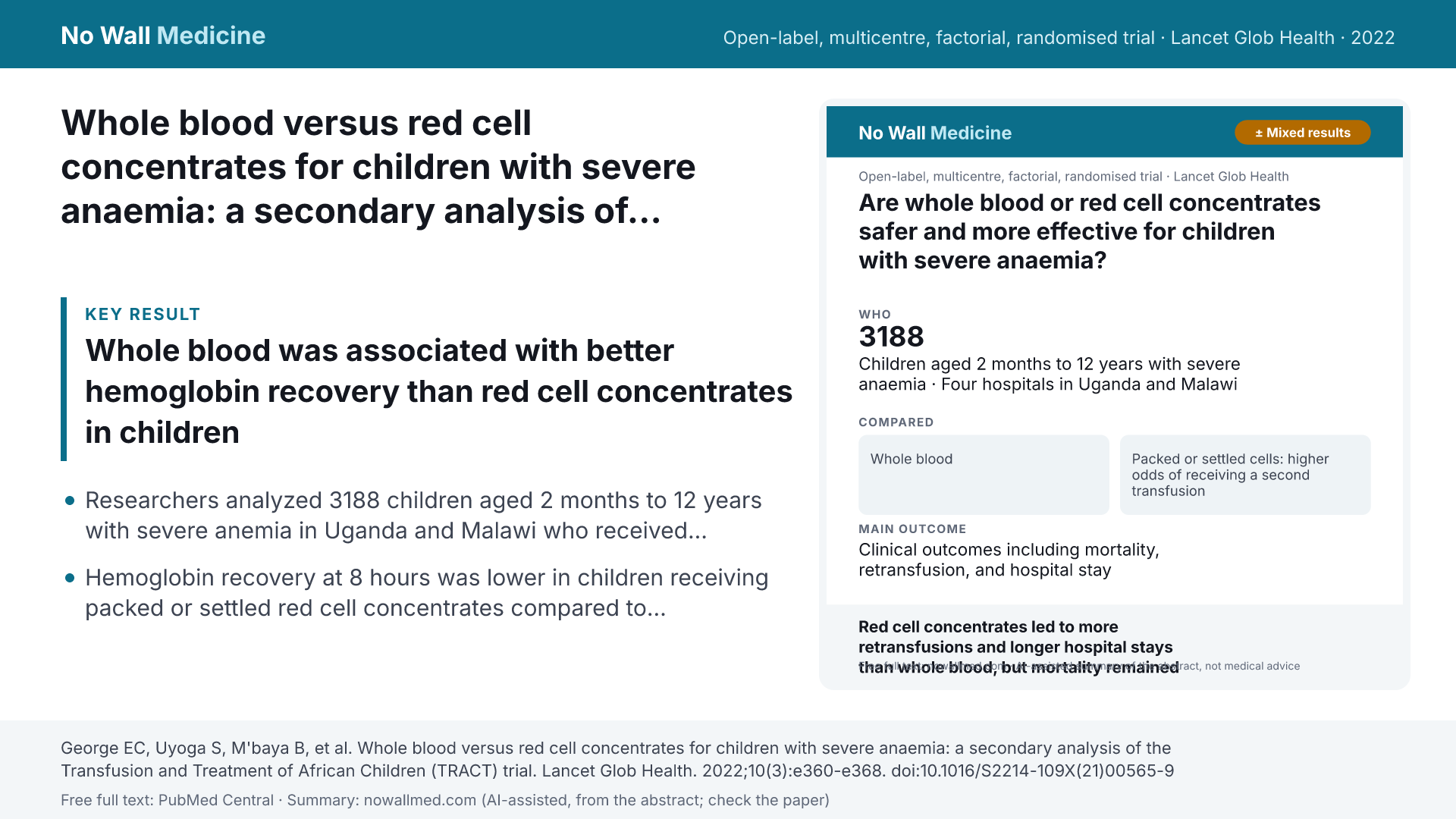
Whole blood was associated with better hemoglobin recovery than red cell concentrates in children
Whole blood versus red cell concentrates for children with severe anaemia: a secondary analysis of the Transfusion and Treatment of African Children (TRACT) trial
Secondary analysis of a trialMixed results
Are whole blood or red cell concentrates safer and more effective for children with severe anaemia?
Who
3188
Children aged 2 months to 12 years with severe anaemia · Four hospitals in Uganda and Malawi
Compared
Whole blood
Packed or settled cells: higher odds of receiving a second transfusion
Main outcome
Clinical outcomes including mortality, retransfusion, and hospital stay
Result: odds ratio 2.32 (95% CI 1.30 to 4.12) for packed cells
Bottom line: Red cell concentrates led to more retransfusions and longer hospital stays than whole blood, but mortality remained unchanged.
Funded by: UK Medical Research Council and Department for International Development
Lancet Glob Health · 2022-02-19Download image
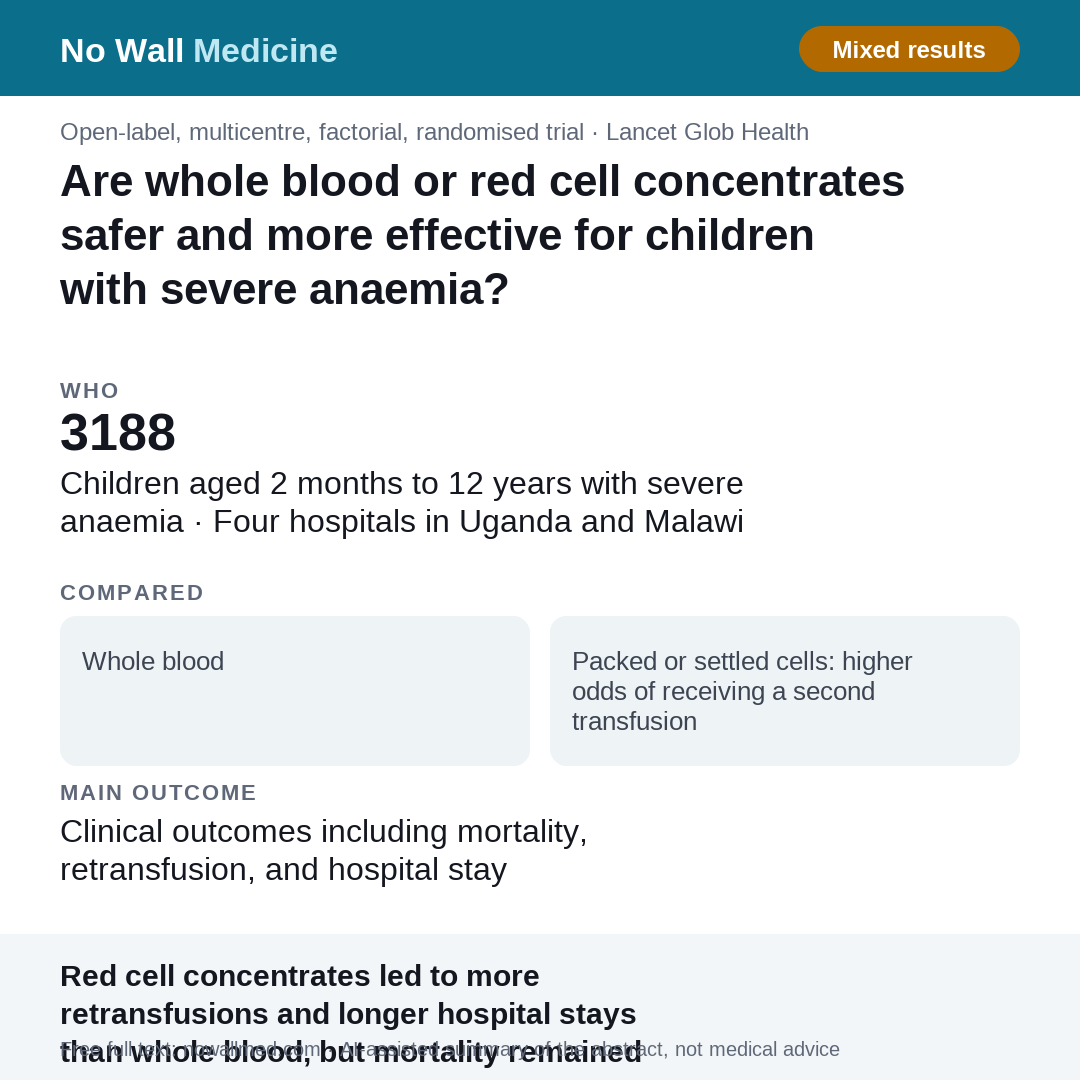
Clinical question: Are whole blood or red cell concentrates safer and more effective for children with severe anaemia?
Why it matters: Data regarding the safety and efficacy of using whole blood versus red cell concentrates for treating severe anemia in children are scarce.
Key points
- Researchers analyzed 3188 children aged 2 months to 12 years with severe anemia in Uganda and Malawi who received immediate transfusions.
- Hemoglobin recovery at 8 hours was lower in children receiving packed or settled red cell concentrates compared to whole blood.
- Children receiving red cell concentrates had higher odds of needing a second transfusion and longer hospital stays than those receiving whole blood.
Headline and key points written with AI from the paper’s abstract, with every number checked against it. Read the paper before relying on them.
Was this summary helpful?
Abstract
Background
The TRACT trial established the timing of transfusion in children with uncomplicated anaemia (haemoglobin 4-6 g/dL) and the optimal volume (20 vs 30 mL/kg whole blood or 10 vs 15 mL/kg red cell concentrates) for transfusion in children admitted to hospital with severe anaemia (haemoglobin <6 g/dL) on day 28 mortality (primary endpoint). Because data on the safety of blood components are scarce, we conducted a secondary analysis to examine the safety and efficacy of different pack types (whole blood vs red cell concentrates) on clinical outcomes. Methods
This study is a secondary analysis of the TRACT trial data restricted to those who received an immediate transfusion (using whole blood or red cell concentrates). TRACT was an open-label, multicentre, factorial, randomised trial conducted in three hospitals in Uganda (Soroti, Mbale, and Mulago) and one hospital in Malawi (Blantyre). The trial enrolled children aged between 2 months and 12 years admitted to hospital with severe anaemia (haemoglobin <6 g/dL). The pack type used (supplied by blood banks) was based only on availability at the time. The outcomes were haemoglobin recovery at 8 h and 180 days, requirement for retransfusion, length of hospital stay, changes in heart and respiratory rates until day 180, and the main clinical endpoints (mortality until day 28 and day 180, and readmission until day 180), measured using multivariate regression models. Findings
Between Sept 17, 2014, and May 15, 2017, 3199 children with severe anaemia were enrolled into the TRACT trial. 3188 children were considered in our secondary analysis. The median age was 37 months (IQR 18-64). Whole blood was the first pack provided for 1632 (41%) of 3992 transfusions. Haemoglobin recovery at 8 h was significantly lower in those who received packed cells or settled cells than those who received whole blood, with a mean of 1·4 g/dL (95% CI -1·6 to -1·1) in children who received 30 mL/kg and -1·3 g/dL (-1·5 to -1·0) in those who received 20 mL/kg packed cells versus whole blood, and -1·5 g/dL (-1·7 to -1·3) in those who received 30 mL/kg and -1·0 g/dL (-1·2 to -0·9) in those who received 20 mL/kg settled cells versus whole blood (overall p<0·0001). Compared to whole blood, children who received blood as packed or settled cells in their first transfusion had higher odds of receiving a second transfusion (odds ratio 2·32 [95% CI 1·30 to 4·12] for packed cells and 2·97 [2·18 to 4·05] for settled cells; p<0·001) and longer hospital stays (hazard ratio 0·94 [95% CI 0·81 to 1·10] for packed cells and 0·86 [0·79 to 0·94] for settled cells; p=0·0024). There was no association between the type of blood supplied for the first transfusion and mortality at 28 days or 180 days, or readmission to hospital for any cause. 823 (26%) of 3188 children presented with severe tachycardia and 2077 (65%) with tachypnoea, but these complications resolved over time. No child developed features of confirmed cardiopulmonary overload. Interpretation
Our study suggests that the use of packed or settled cells rather than whole blood leads to additional transfusions, increasing the use of a scarce resource in most of sub-Saharan Africa. These findings have substantial cost implications for blood transfusion and health services. Nevertheless, a clinical trial comparing whole blood transfusion with red cell concentrates might be needed to inform policy makers. Funding
UK Medical Research Council (MRC) and the Department for International Development. Translation
For the French translation of the abstract see Supplementary Materials section.
Abstract reproduced under the article’s CC BY licence.
Subject terms
Cite this article
George EC, Uyoga S, M'baya B, et al. Whole blood versus red cell concentrates for children with severe anaemia: a secondary analysis of the Transfusion and Treatment of African Children (TRACT) trial. Lancet Glob Health. 2022;10(3):e360-e368. doi:10.1016/S2214-109X(21)00565-9
Spotted a mistake? Suggest a correction