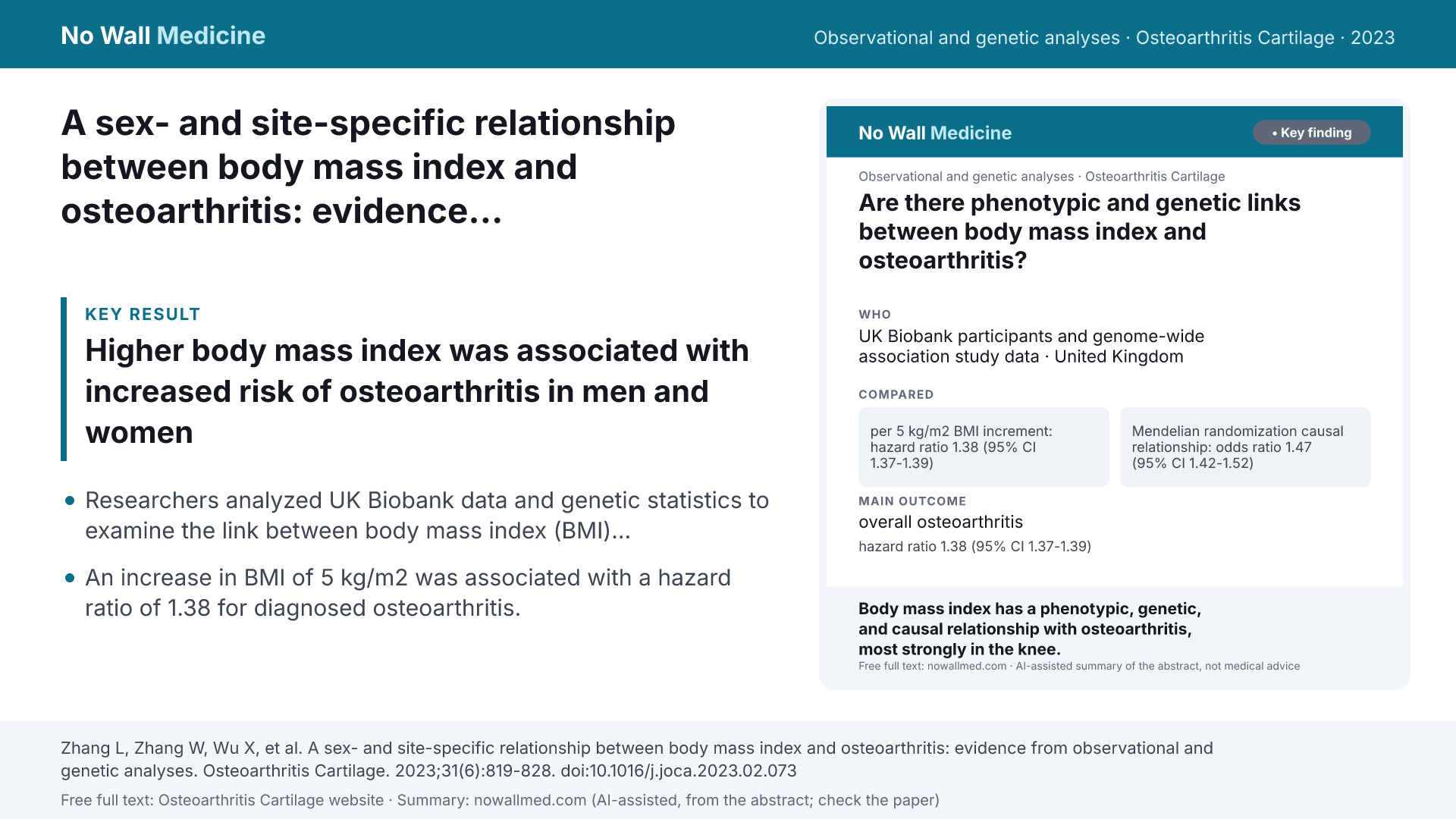
Higher body mass index was associated with increased risk of osteoarthritis in men and women
A sex- and site-specific relationship between body mass index and osteoarthritis: evidence from observational and genetic analyses
Observational and genetic analysesKey finding
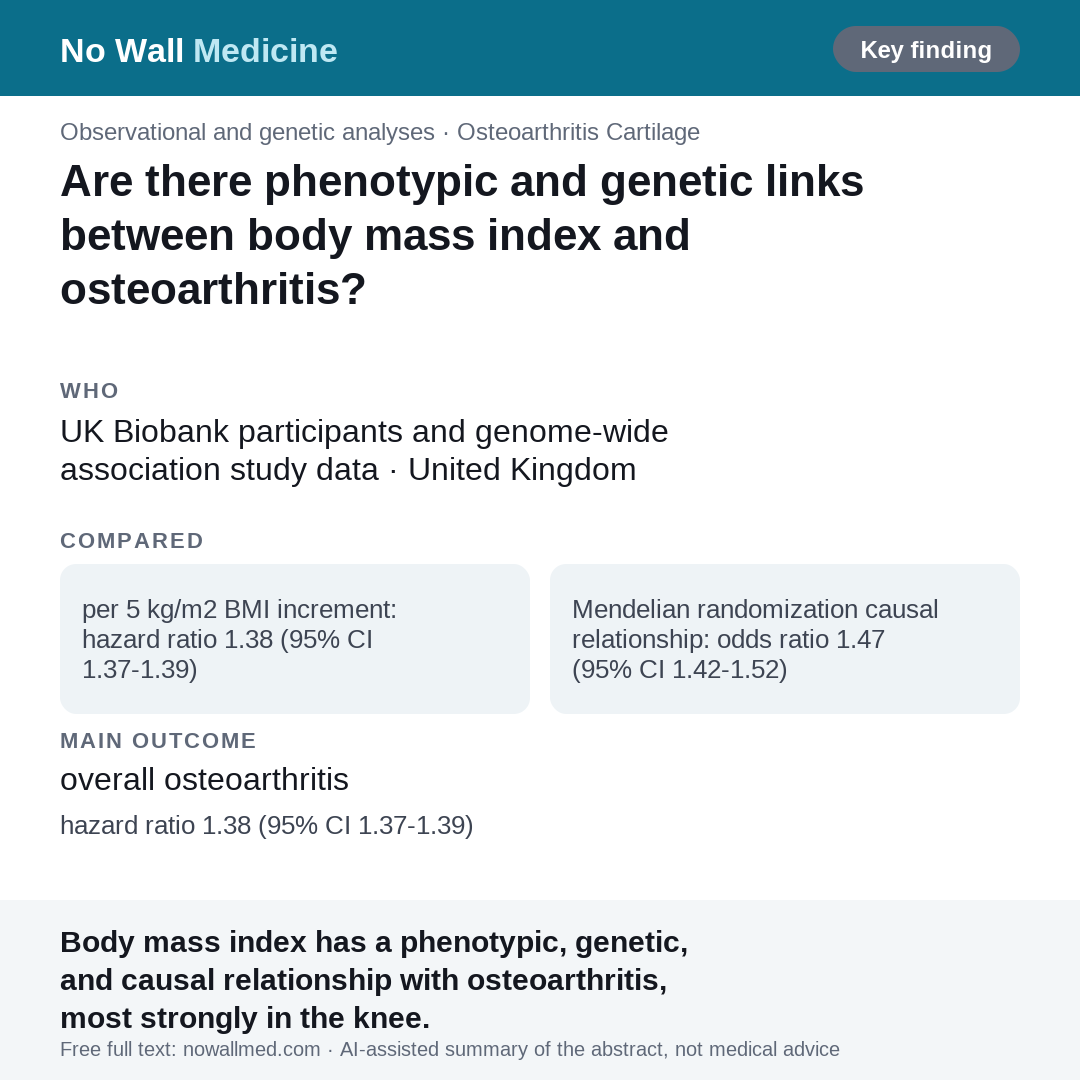
Are there phenotypic and genetic links between body mass index and osteoarthritis?
Who
UK Biobank participants and genome-wide association study data · United Kingdom
Compared
per 5 kg/m2 BMI increment: hazard ratio 1.38 (95% CI 1.37-1.39)
Mendelian randomization causal relationship: odds ratio 1.47 (95% CI 1.42-1.52)
Main outcome
overall osteoarthritis
Result: hazard ratio 1.38 (95% CI 1.37-1.39)
Bottom line: Body mass index has a phenotypic, genetic, and causal relationship with osteoarthritis, most strongly in the knee.
Osteoarthritis Cartilage · 2023-03-06Download image
Clinical question: Are there phenotypic and genetic links between body mass index and osteoarthritis?
Key points
- Researchers analyzed UK Biobank data and genetic statistics to examine the link between body mass index (BMI) and osteoarthritis (OA) across sexes and joint sites.
- An increase in BMI of 5 kg/m2 was associated with a hazard ratio of 1.38 for diagnosed osteoarthritis.
- Mendelian randomization, a method used to estimate causal links, showed an odds ratio of 1.47 for the relationship between BMI and osteoarthritis.
Headline and key points written with AI from the paper’s abstract, with every number checked against it. Read the paper before relying on them.
Was this summary helpful?
Subject terms
Cite this article
Zhang L, Zhang W, Wu X, et al. A sex- and site-specific relationship between body mass index and osteoarthritis: evidence from observational and genetic analyses. Osteoarthritis Cartilage. 2023. doi:10.1016/j.joca.2023.02.073
Spotted a mistake? Suggest a correction