Short-term infusion of Ruminococcus torques bacteria showed no effect on insulin sensitivity in humans
A short-term randomized clinical trial testing feasibility of and physiological responses to a Ruminococcus torques strain in healthy overweight humans
Double blind placebo-controlled randomized cross-over trialNo clear difference
Does Ruminococcus torques infusion affect physiological responses in healthy overweight humans?
Who
32
Healthy overweight adults · Herlev and Gentofte Hospital, Denmark
Compared
Ruminococcus torques strain
Placebo
Main outcome
Matsuda Insulin Sensitivity Index
Bottom line: Short-term Ruminococcus torques infusion was well tolerated but had no effect on insulin sensitivity.
Genome Med · 2026-07-16Download image
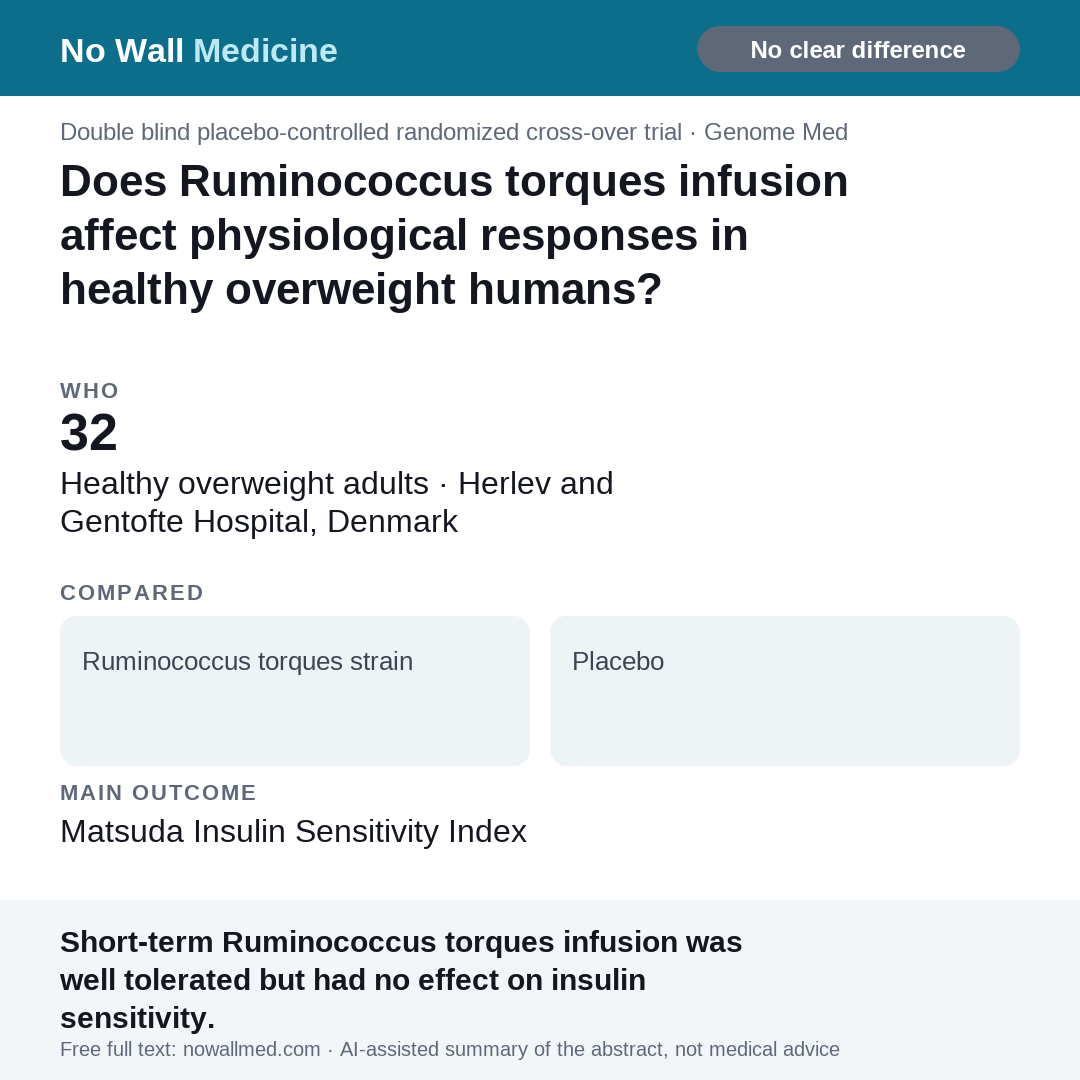
Clinical question: Does Ruminococcus torques infusion affect physiological responses in healthy overweight humans?
Why it matters: Researchers wanted to see if a bacterial strain that improved metabolism in rodents would produce similar physiological responses in humans.
Key points
- Researchers studied 32 healthy overweight adults by infusing either a Ruminococcus torques bacterial strain or a placebo into the duodenum, the first part of the small intestine.
- The bacterial infusion did not change the primary endpoint of insulin sensitivity, measured by the Matsuda Insulin Sensitivity Index.
- The infusion caused relative changes in intestinal hormones, including rises in glucagon-like-peptide-1 and peptide YY and a decline in gastric inhibitory polypeptide.
Headline and key points written with AI from the paper’s abstract, with every number checked against it. Read the paper before relying on them.
Topics
Cite this article
Gæde J, Fan Y, Lyu L, Stankevic E, Gasbjerg LS, Rossing P. A short-term randomized clinical trial testing feasibility of and physiological responses to a Ruminococcus torques strain in healthy overweight humans. Genome Med. 2026. doi:10.1186/s13073-026-01708-9
Spotted a mistake? Suggest a correction