Smartphone intervention for serious mental illness showed improvements in depression, anxiety, and disability
A Smartphone Intervention for People With Serious Mental Illness: Fully Remote Randomized Controlled Trial of CORE
Fully remote randomized waitlist-controlled trialBenefit found
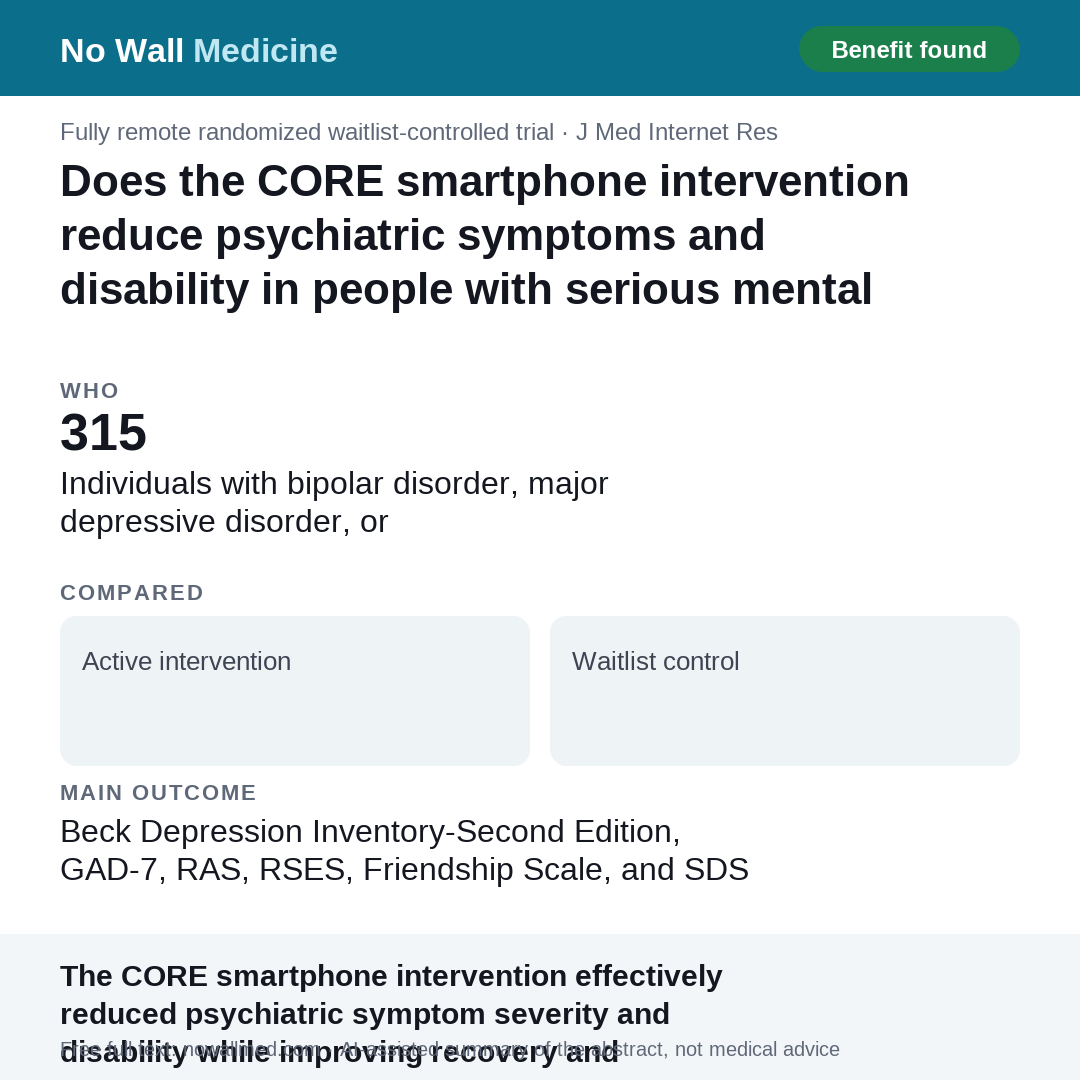
Does the CORE smartphone intervention reduce psychiatric symptoms and disability in people with serious mental illness?
Who
315
Individuals with bipolar disorder, major depressive disorder, or schizophrenia/schizoaffective disorder · 45 states, via the web
Compared
Active intervention
Waitlist control
Main outcome
Beck Depression Inventory-Second Edition, GAD-7, RAS, RSES, Friendship Scale, and SDS
Result: BDI-II d=0.58, RAS d=0.61, RSES d=0.64, SDS d=0.44, GAD-7 d=0.20
Bottom line: The CORE smartphone intervention effectively reduced psychiatric symptom severity and disability while improving recovery and self-esteem.
Limitation: Study retention remains challenging.
J Med Internet Res · 2021-11-12Download image
Clinical question: Does the CORE smartphone intervention reduce psychiatric symptoms and disability in people with serious mental illness?
Why it matters: People with serious mental illness have significant unmet mental health needs and digital interventions for this population require testing.
Key points
- The study included 315 individuals with bipolar disorder, major depressive disorder, or schizophrenia or schizoaffective disorder in a remote randomized trial.
- Participants using the CORE smartphone intervention showed significant changes in depression, anxiety, recovery, self-esteem, and disability scores.
- The active group had a 41.5% (64/154) retention rate at 30 days and 33.1% (51/154) at 60 days.
Limitation the authors note: Study retention remains challenging.
Headline and key points written with AI from the paper’s abstract, with every number checked against it. Read the paper before relying on them.
Was this summary helpful?
Subject terms
Cite this article
Ben-Zeev D, Chander A, Tauscher J, Buck B, Nepal S, Campbell A. A Smartphone Intervention for People With Serious Mental Illness: Fully Remote Randomized Controlled Trial of CORE. J Med Internet Res. 2021. doi:10.2196/29201
Spotted a mistake? Suggest a correction
Top studies every Monday
The week’s key trials and guidelines in your specialties, plus any topics you follow. By email, free.
Get the weekly digest