Surgical safety checklist linked to lower death and complication rates in global hospitals
A surgical safety checklist to reduce morbidity and mortality in a global population
Why it matters: A simple checklist was followed by fewer surgical complications and deaths across eight countries.
Context written by the No Wall Medicine team.
Trial at a glance
Bottom line: The checklist reduced death rates from 1.5% to 0.8% and complications from 11.0% to 7.0%.
Clinical question
Does a surgical safety checklist reduce morbidity and mortality?
Design
Prospective study. Eight hospitals in eight cities, 2007-2008
Who was studied
3733 then 3955 patients, 16 years or older, undergoing noncardiac surgery
Key inclusion criteria
- 16 years of age or older
- undergoing noncardiac surgery
Interventions
- intervention group: 19-item surgical safety checklist
Primary outcome
rate of complications, including death. declined from 1.5% to 0.8% for death and from 11.0% to 7.0% for complications
Written with AI from the abstract; every number was checked against it. Details such as eligibility criteria may be missing because the abstract does not give them. Read the paper before relying on it.
Key points
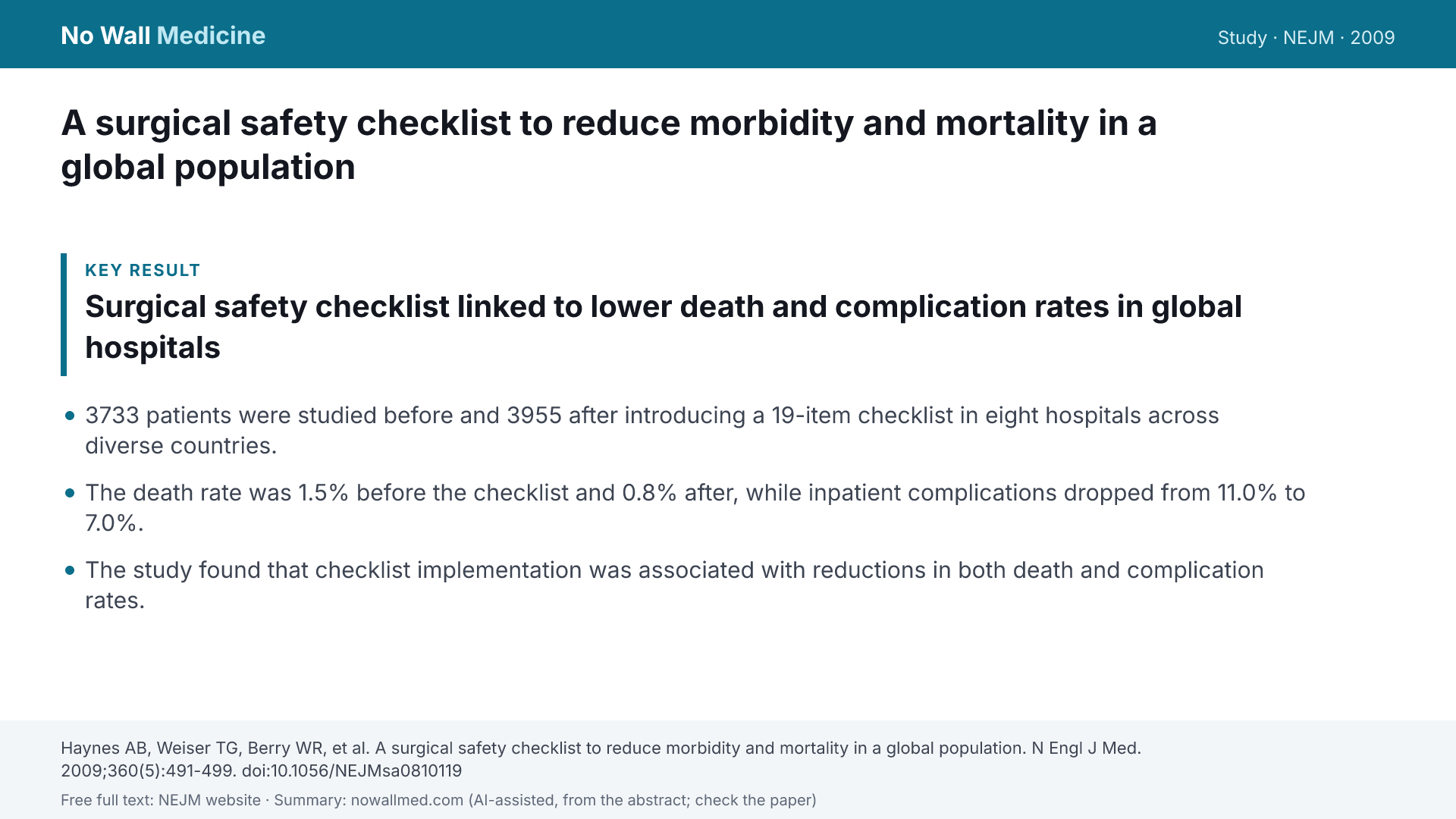
- 3733 patients were studied before and 3955 after introducing a 19-item checklist in eight hospitals across diverse countries.
- The death rate was 1.5% before the checklist and 0.8% after, while inpatient complications dropped from 11.0% to 7.0%.
- The study found that checklist implementation was associated with reductions in both death and complication rates.
Study type: Observational study: it can show a link, but not prove that one thing causes another.
Headline and key points written with AI from the paper’s abstract, with every number checked against it. Read the paper before relying on them.
Was this summary helpful?
Subject terms
Headline, design, result, key points, caveat and citation as plain text.
Cite this article
Haynes AB, Weiser TG, Berry WR, et al. A surgical safety checklist to reduce morbidity and mortality in a global population. N Engl J Med. 2009;360(5):491-499. doi:10.1056/NEJMsa0810119
Spotted a mistake? Suggest a correction