Interleukin-6 pathway inhibition shows effectiveness across various inflammatory diseases with comparable safety profiles
A systematic literature review informing the consensus statement on efficacy and safety of pharmacological treatment with interleukin-6 pathway inhibition with biological DMARDs in immune-mediated inflammatory diseases
Systematic literature reviewMixed results
What are the efficacy and safety of interleukin-6 pathway inhibition in inflammatory diseases?
Who
Patients with immune-mediated inflammatory diseases · International
Compared
Interleukin-6 inhibition
Other biological disease-modifying antirheumatic drugs
Main outcome
Efficacy and safety of interleukin-6 pathway inhibition
Bottom line: Interleukin-6 inhibition is effective for several diseases but lacks benefit in psoriatic arthritis and ankylosing spondylitis.
RMD Open · 2022-10-19Download image
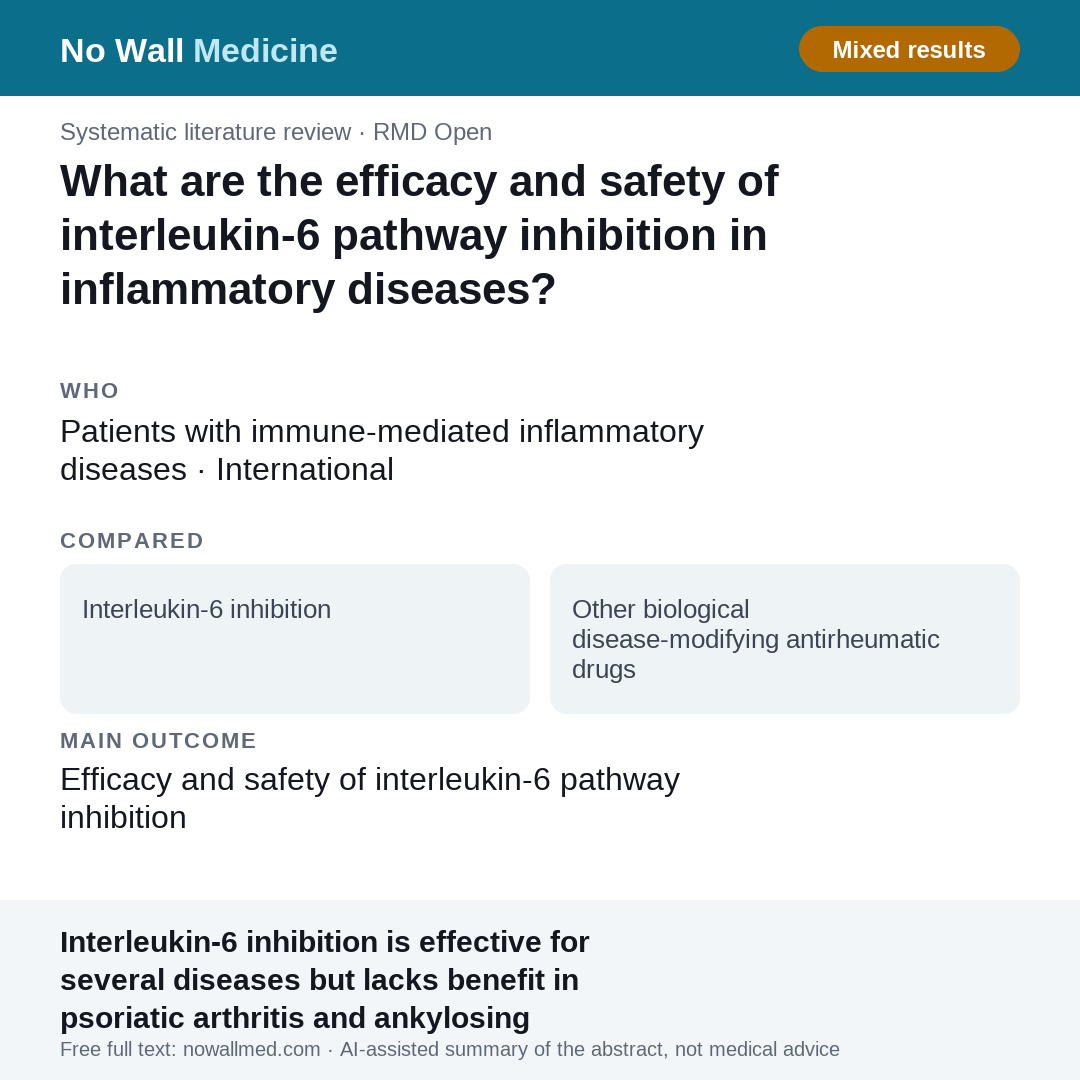
Clinical question: What are the efficacy and safety of interleukin-6 pathway inhibition in inflammatory diseases?
Why it matters: An updated consensus statement was needed to clarify the efficacy and safety of drugs targeting the interleukin-6 pathway for various immune-mediated inflammatory diseases.
Key points
- Researchers reviewed 187 articles published between January 2012 and December 2020 regarding biological disease-modifying antirheumatic drugs that target the interleukin-6 pathway.
- Interleukin-6 inhibition was associated with positive effects in rheumatoid arthritis, giant cell arteritis, and advanced COVID-19, but not in psoriatic arthritis or ankylosing spondylitis.
- Safety outcomes were similar to other biological drugs, though higher risks of diverticulitis and lower gastrointestinal perforations were noted.
Headline and key points written with AI from the paper’s abstract, with every number checked against it. Read the paper before relying on them.
Was this summary helpful?
Abstract
Objectives
Informing an international task force updating the consensus statement on efficacy and safety of biological disease-modifying antirheumatic drugs (bDMARDs) selectively targeting interleukin-6 (IL-6) pathway in the context of immune-mediated inflammatory diseases. Methods
A systematic literature research of all publications on IL-6 axis inhibition with bDMARDs published between January 2012 and December 2020 was performed using MEDLINE, EMBASE and Cochrane CENTRAL databases. Efficacy and safety outcomes were assessed in clinical trials including their long-term extensions and observational studies. Meeting abstracts from ACR, EULAR conferences and results on clinicaltrials.gov were taken into consideration. Results
187 articles fulfilled the inclusion criteria. Evidence for positive effect of IL-6 inhibition was available in various inflammatory diseases such as rheumatoid arthritis, juvenile idiopathic arthritis, giant cell arteritis, Takayasu arteritis, adult-onset Still's disease, cytokine release syndrome due to chimeric antigen receptor T cell therapy and systemic sclerosis-associated interstitial lung disease. Newcomers like satralizumab and anti-IL-6 ligand antibody siltuximab have expanded therapeutic approaches for Castleman's disease and neuromyelitis optica, respectively. IL-6 inhibition did not provide therapeutic benefits in psoriatic arthritis, ankylosing spondylitis and certain connective tissue diseases. In COVID-19, tocilizumab (TCZ) has proven to be therapeutic in advanced disease. Safety outcomes did not differ from other bDMARDs, except higher risks of diverticulitis and lower gastrointestinal perforations. Inconsistent results were observed in several studies investigating the risk for infections when comparing TCZ to TNF-inhibitors. Conclusion
IL-6 inhibition is effective for treatment of several inflammatory diseases with a safety profile that is widely comparable to other bDMARDs.
Abstract reproduced under the article’s CC BY licence.
Subject terms
Cite this article
Kastrati K, Aletaha D, Burmester GR, Chwala E, Dejaco C, Dougados M. A systematic literature review informing the consensus statement on efficacy and safety of pharmacological treatment with interleukin-6 pathway inhibition with biological DMARDs in immune-mediated inflammatory diseases. RMD Open. 2022. doi:10.1136/rmdopen-2022-002359
Spotted a mistake? Suggest a correction
Top studies every Monday
The week’s key trials and guidelines in your specialties, plus any topics you follow. By email, free.
Get the weekly digest