Review informs recommendations for infection screening and prevention in adults with autoimmune rheumatic diseases
Systematic literature review informing the 2022 EULAR recommendations for screening and prophylaxis of chronic and opportunistic infections in adults with autoimmune inflammatory rheumatic diseases
Systematic literature reviewMixed results
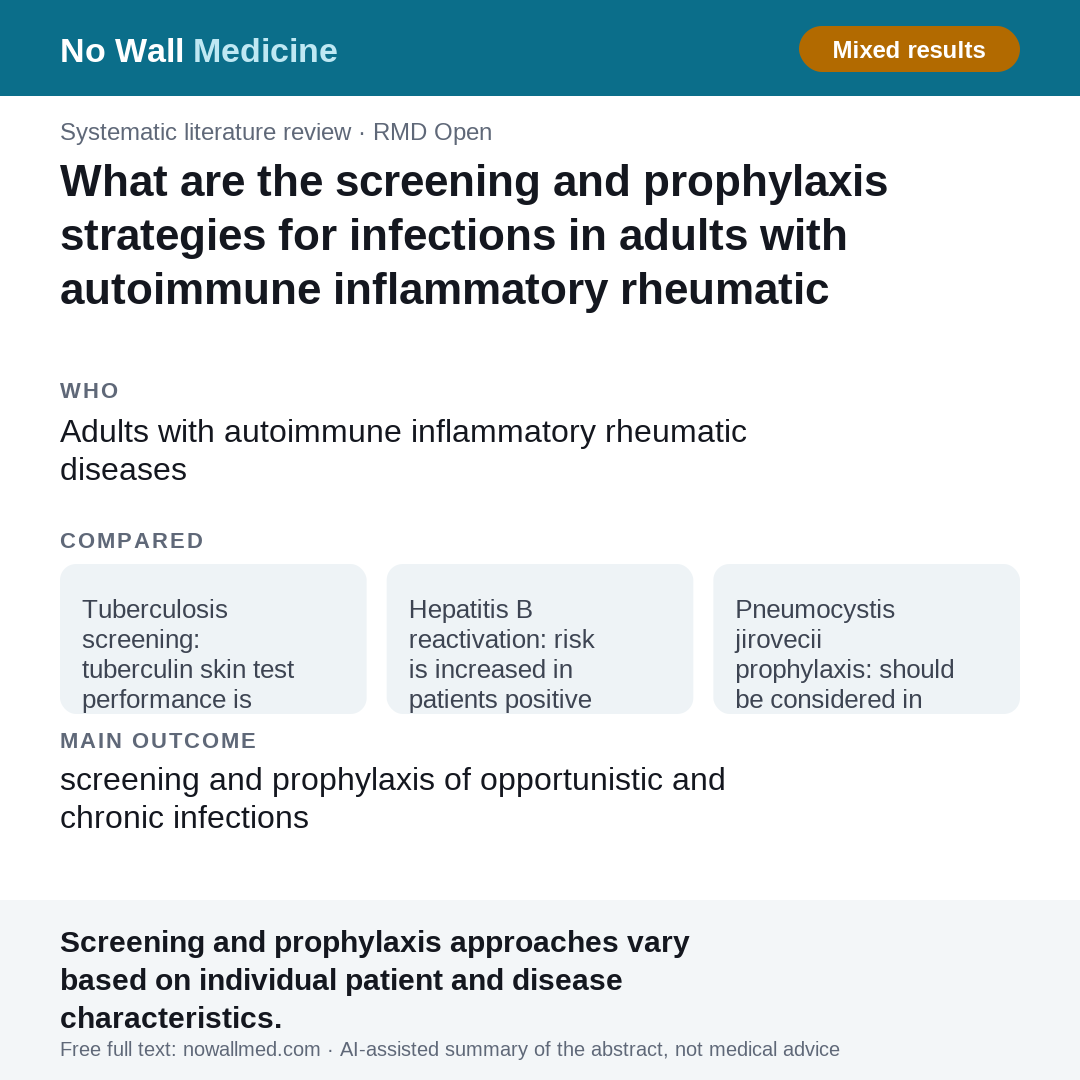
What are the screening and prophylaxis strategies for infections in adults with autoimmune inflammatory rheumatic diseases?
Who
Adults with autoimmune inflammatory rheumatic diseases
Compared
Tuberculosis screening: tuberculin skin test performance is inferior to interferon gamma release assay
Hepatitis B reactivation: risk is increased in patients positive for hepatitis B surface antigen
Pneumocystis jirovecii prophylaxis: should be considered in patients treated with prednisolone ≥15-30 mg/day
Main outcome
screening and prophylaxis of opportunistic and chronic infections
Bottom line: Screening and prophylaxis approaches vary based on individual patient and disease characteristics.
RMD Open · 2022-11-02Download image
Clinical question: What are the screening and prophylaxis strategies for infections in adults with autoimmune inflammatory rheumatic diseases?
Why it matters: Different screening and prevention approaches exist for opportunistic and chronic infections in patients with autoimmune inflammatory rheumatic diseases.
Key points
- Researchers reviewed 194 articles to evaluate screening and prevention methods for infections in adults with autoimmune inflammatory rheumatic diseases.
- Tuberculin skin tests for tuberculosis are affected by glucocorticoids and conventional synthetic disease modifying anti-rheumatic drugs, performing worse than interferon gamma release assays.
- Prophylaxis for Pneumocystis jirovecii should be considered for patients taking prednisolone at doses of 15-30 mg/day or more for longer than 2-4 weeks.
Headline and key points written with AI from the paper’s abstract, with every number checked against it. Read the paper before relying on them.
Was this summary helpful?
Abstract
Objective
To conduct a systematic literature review (SLR) on the screening and prophylaxis of opportunistic and chronic infections in autoimmune inflammatory rheumatic diseases (AIIRD). Methods
SLR (inception-12/2021) based on the following search domains: (1) infectious agents, (2) AIIRD, (3) immunosuppressives/immunomodulators used in rheumatology, (4) screening terms and (5) prophylaxis terms. Articles were retrieved having the terms from (1) AND (2) AND (3) plus terms from (4) OR(5). Databases searched: PubMed, Embase and Cochrane Library. Exclusion criteria
studies on postoperative infections, paediatric AIIRD, COVID-19, vaccinations and non-Εnglish literature. Study quality was assessed with Newcastle-Ottawa scale for non-randomised controlled trials (RCTs), RoB-Cochrane for RCTs, AMSTAR2 for SLRs. Results
From 5641 studies were retrieved, 568 full-text articles were assessed for eligibility, with 194 articles finally included. For tuberculosis, tuberculin skin test (TST) is affected by treatment with glucocorticoids and conventional synthetic disease modifying anti-rheumatic drugs (DMARDs) and its performance is inferior to interferon gamma release assay (IGRA). Agreement between TST and IGRA is moderate to low. For hepatitis B virus (HBV): risk of reactivation is increased in patients positive for hepatitis B surface antigen. Anti-HBcore positive patients are at low risk for reactivation but should be monitored periodically with liver function tests and/or HBV-viral load. Risk for Hepatitis C reactivation is existing but low in patients treated with biological DMARDs. For Pneumocystis jirovecii, prophylaxis treatment should be considered in patients treated with prednisolone ≥15-30 mg/day for >2-4 weeks. Conclusions
Different screening and prophylaxis approaches are described in the literature, partly determined by individual patient and disease characteristics.
Abstract reproduced under the article’s CC BY NC licence.
Subject terms
Cite this article
Fragoulis GE, Dey M, Zhao S, Schoones J, Courvoisier D, Galloway J. Systematic literature review informing the 2022 EULAR recommendations for screening and prophylaxis of chronic and opportunistic infections in adults with autoimmune inflammatory rheumatic diseases. RMD Open. 2022. doi:10.1136/rmdopen-2022-002726
Spotted a mistake? Suggest a correction
Top studies every Monday
The week’s key trials and guidelines in your specialties, plus any topics you follow. By email, free.
Get the weekly digest