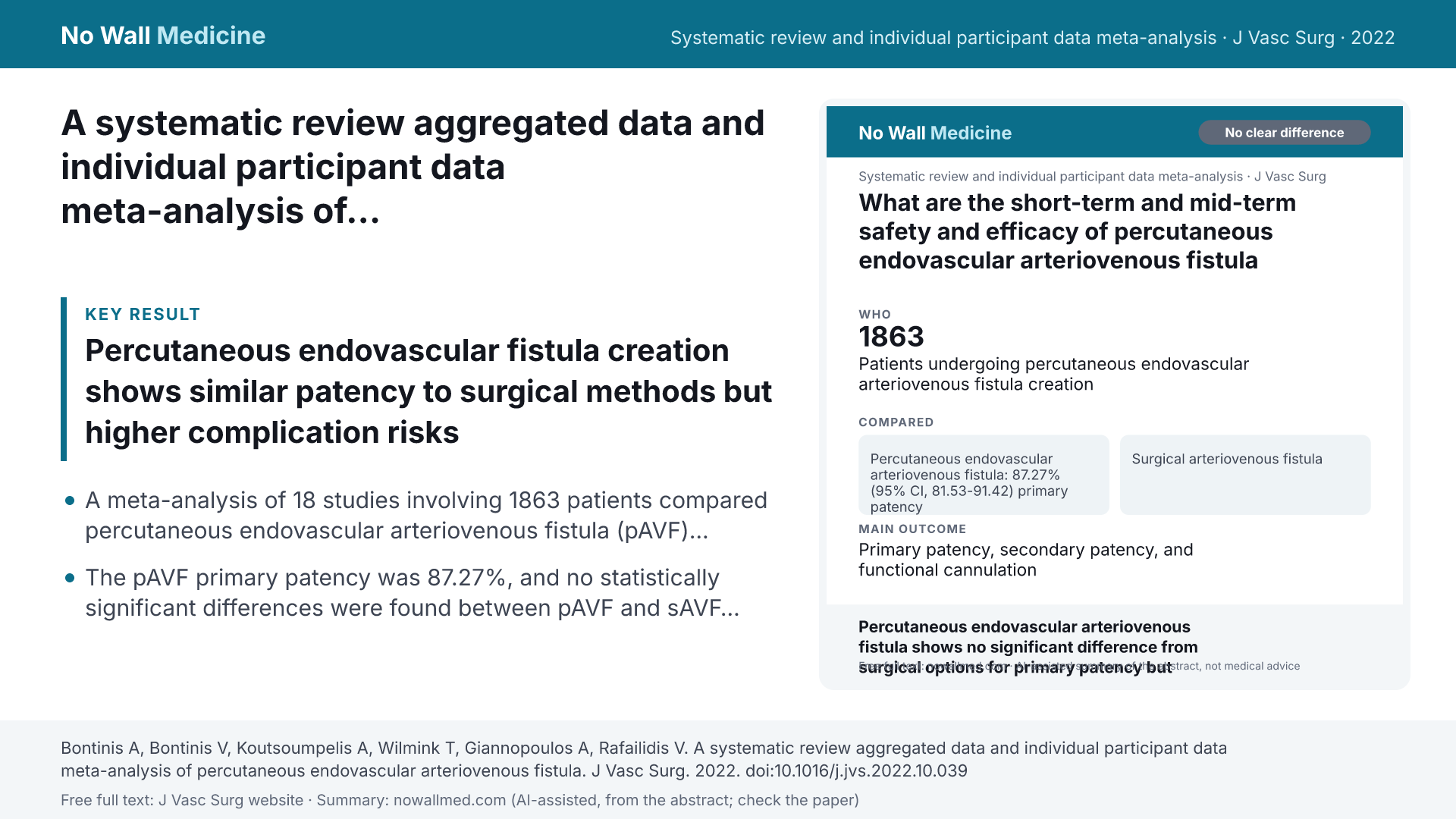
Percutaneous endovascular fistula creation shows similar patency to surgical methods but higher complication risks
A systematic review aggregated data and individual participant data meta-analysis of percutaneous endovascular arteriovenous fistula
Systematic review and individual participant data meta-analysisNo clear difference
What are the short-term and mid-term safety and efficacy of percutaneous endovascular arteriovenous fistula creation?
Who
1863
Patients undergoing percutaneous endovascular arteriovenous fistula creation
Compared
Percutaneous endovascular arteriovenous fistula: 87.27% (95% CI, 81.53-91.42) primary patency
Surgical arteriovenous fistula
Main outcome
Primary patency, secondary patency, and functional cannulation
Result: hazard ratio 1.27 (95% CI 0.61-2.67) for primary patency
Bottom line: Percutaneous endovascular arteriovenous fistula shows no significant difference from surgical options for primary patency but carries higher steal syndrome risk.
J Vasc Surg · 2022-10-31Download image
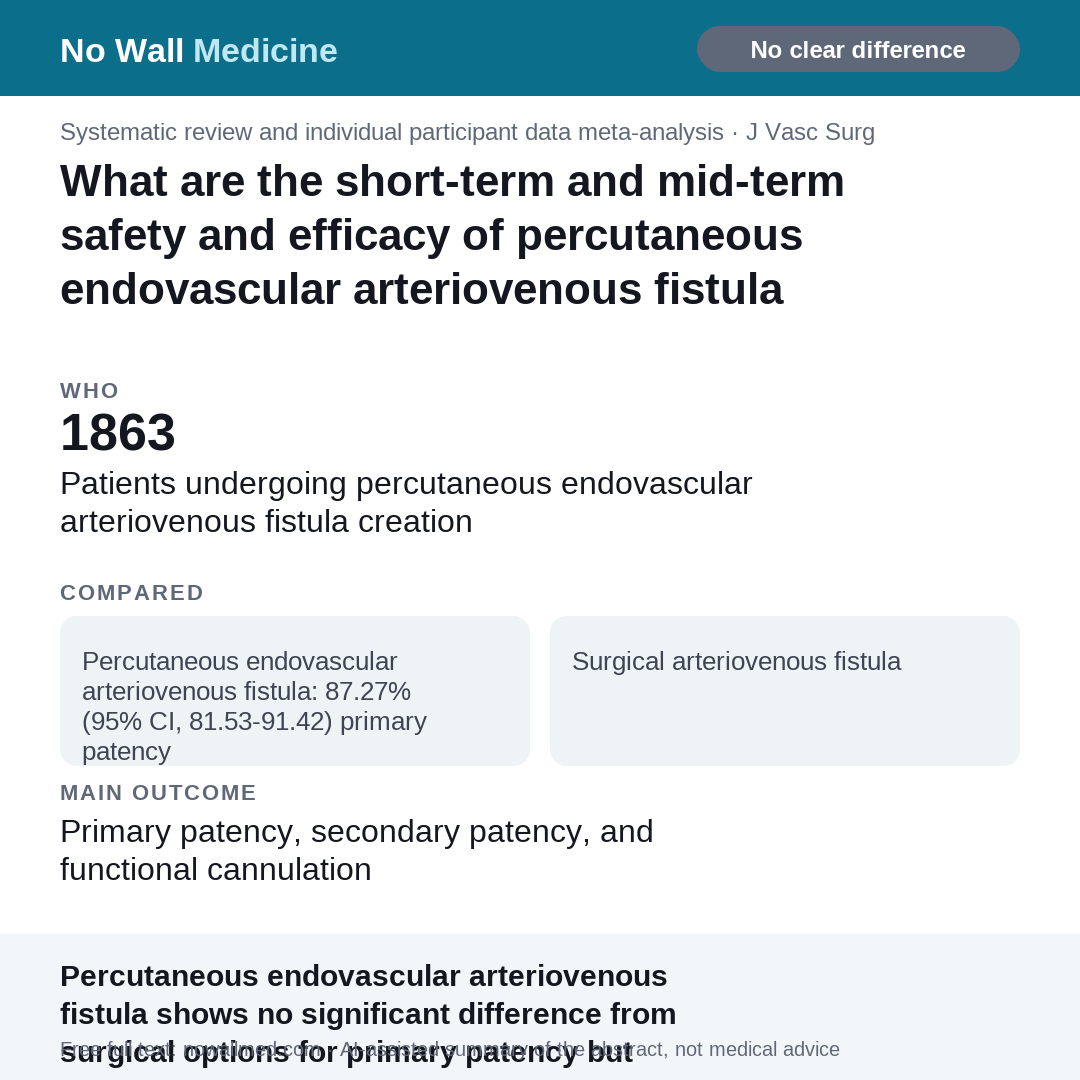
Clinical question: What are the short-term and mid-term safety and efficacy of percutaneous endovascular arteriovenous fistula creation?
Why it matters: The short-term and mid-term safety and efficacy of percutaneous endovascular arteriovenous fistula creation compared to surgical methods are not fully established.
Key points
- A meta-analysis of 18 studies involving 1863 patients compared percutaneous endovascular arteriovenous fistula (pAVF) to surgical arteriovenous fistula (sAVF).
- The pAVF primary patency was 87.27%, and no statistically significant differences were found between pAVF and sAVF for primary or secondary patency.
- PAVF was associated with a higher risk of steal syndrome (relative risk 5.91) and wound infections (relative risk 4.19) compared to sAVF.
Headline and key points written with AI from the paper’s abstract, with every number checked against it. Read the paper before relying on them.
Was this summary helpful?
Subject terms
Cite this article
Bontinis A, Bontinis V, Koutsoumpelis A, Wilmink T, Giannopoulos A, Rafailidis V. A systematic review aggregated data and individual participant data meta-analysis of percutaneous endovascular arteriovenous fistula. J Vasc Surg. 2022. doi:10.1016/j.jvs.2022.10.039
Spotted a mistake? Suggest a correction
Top studies every Monday
The week’s key trials and guidelines in your specialties, plus any topics you follow. By email, free.
Get the weekly digest