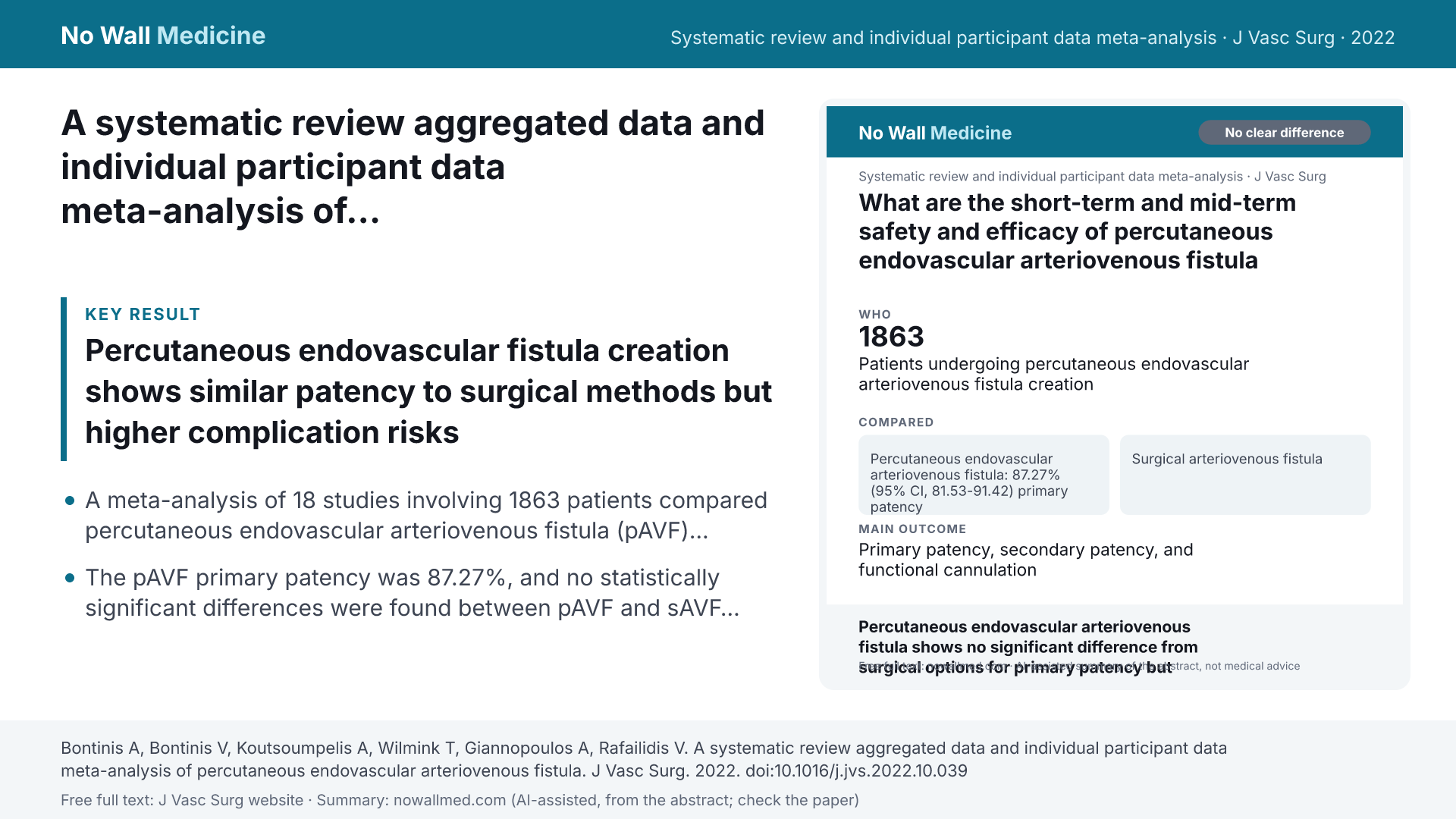
A systematic review aggregated data and individual participant data meta-analysis of percutaneous endovascular arteriovenous fistula
Key result: Percutaneous endovascular fistula creation shows similar patency to surgical methods but higher complication risks
Key points
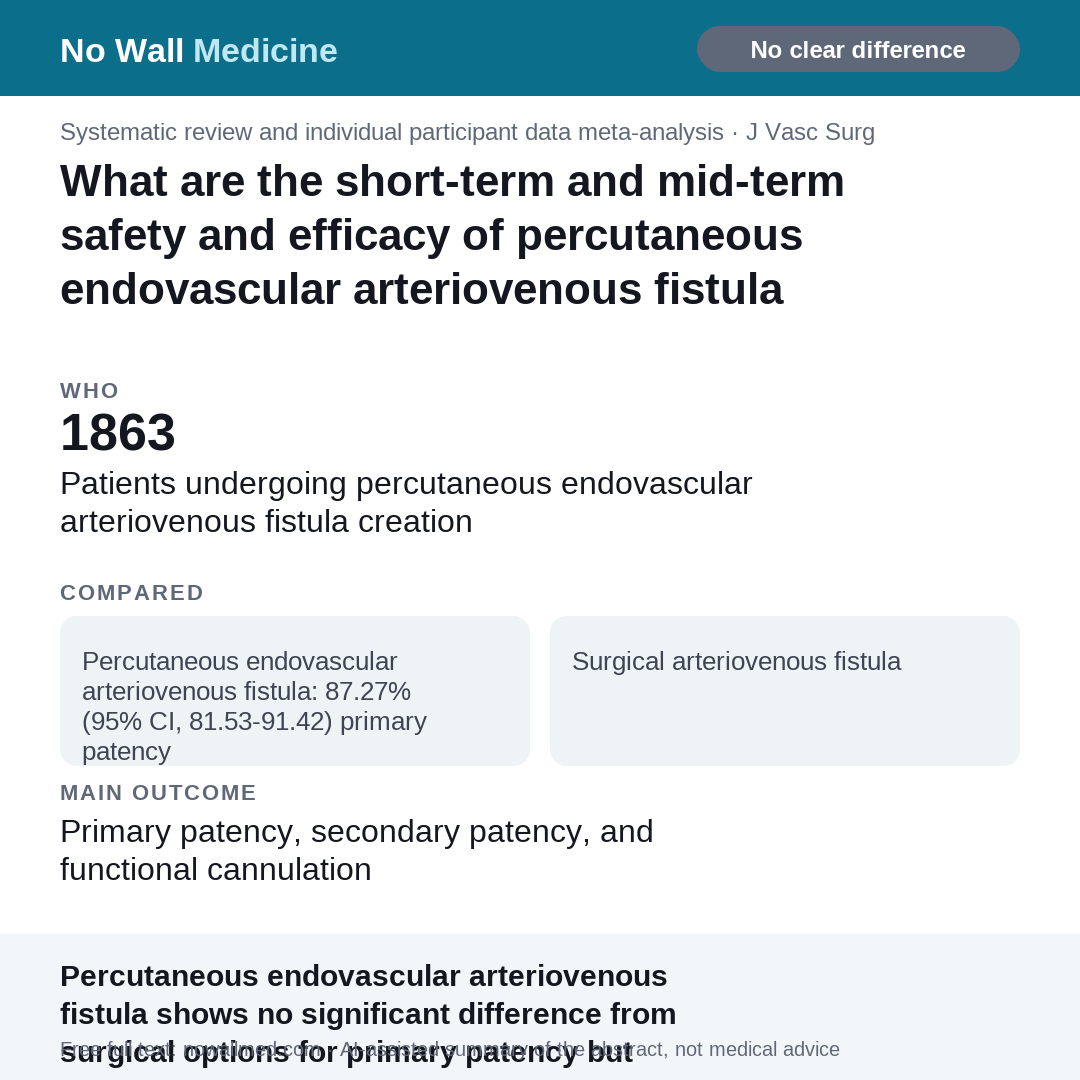
- A meta-analysis of 18 studies involving 1863 patients compared percutaneous endovascular arteriovenous fistula (pAVF) to surgical arteriovenous fistula (sAVF).
- The pAVF primary patency was 87.27%, and no statistically significant differences were found between pAVF and sAVF for primary or secondary patency.
- PAVF was associated with a higher risk of steal syndrome (relative risk 5.91) and wound infections (relative risk 4.19) compared to sAVF.
Why it matters: The short-term and mid-term safety and efficacy of percutaneous endovascular arteriovenous fistula creation compared to surgical methods are not fully established.
Discussion prompts
- Would these patients look like yours? Who was left out?
- Is the main outcome one that matters to patients?
- Is the difference large enough to change what you do?
Cite: Bontinis A, Bontinis V, Koutsoumpelis A, Wilmink T, Giannopoulos A, Rafailidis V. A systematic review aggregated data and individual participant data meta-analysis of percutaneous endovascular arteriovenous fistula. J Vasc Surg. 2022. doi:10.1016/j.jvs.2022.10.039
Free full text: J Vasc Surg website · Summary and visual abstract: nowallmed.com/a/a-systematic-review-aggregated-data-and-individual-participant-data-vbc4zb/ (AI-assisted from the abstract; check the paper before relying on it).