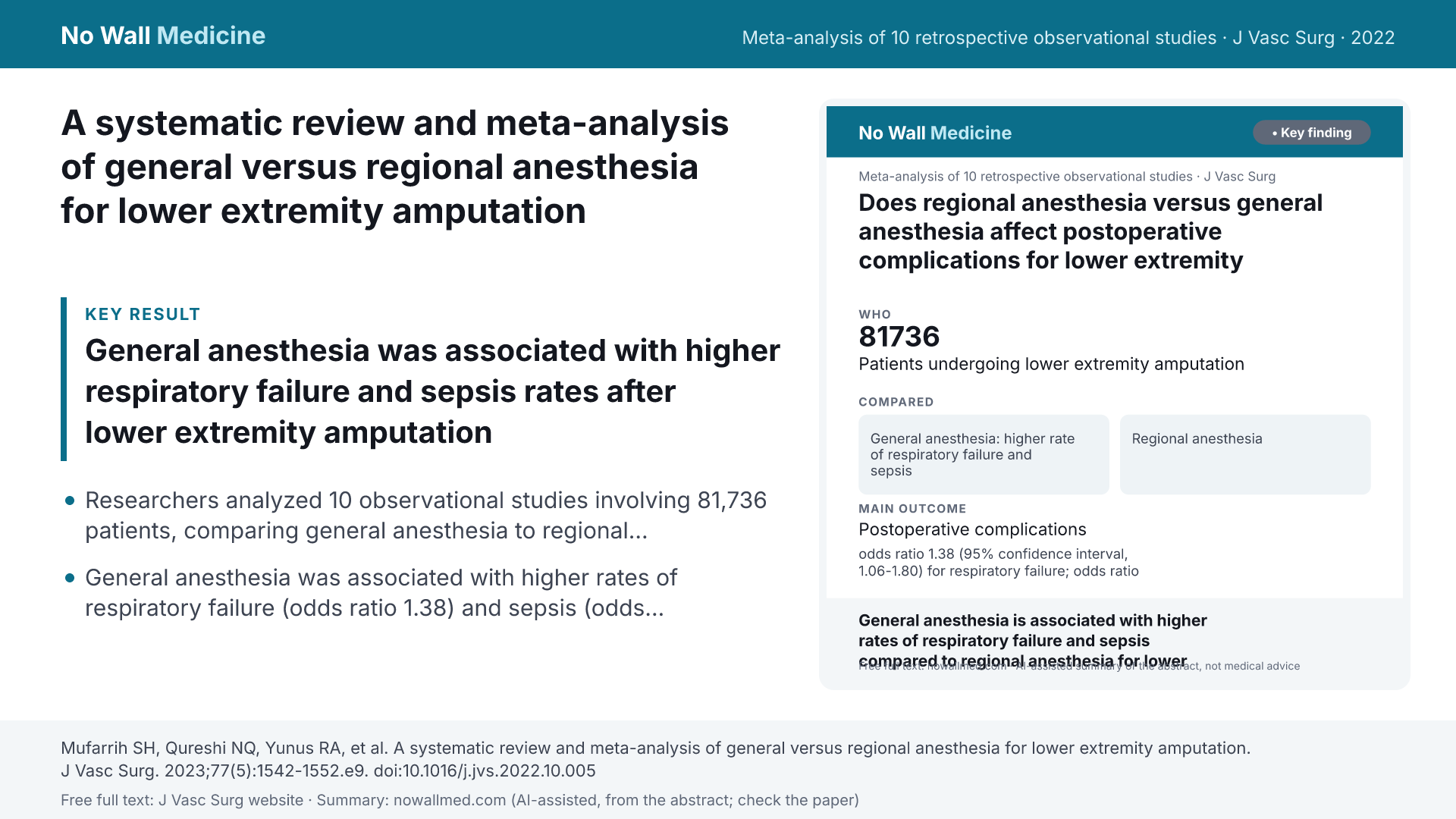
General anesthesia was associated with higher respiratory failure and sepsis rates after lower extremity amputation
A systematic review and meta-analysis of general versus regional anesthesia for lower extremity amputation
Meta-analysis of 10 retrospective observational studiesKey finding
Does regional anesthesia versus general anesthesia affect postoperative complications for lower extremity amputation?
Who
81736
Patients undergoing lower extremity amputation
Compared
General anesthesia: higher rate of respiratory failure and sepsis
Regional anesthesia
Main outcome
Postoperative complications
Result: odds ratio 1.38 (95% confidence interval, 1.06-1.80) for respiratory failure; odds ratio 1.21 (95% confidence interval, 1.11-1.33) for sepsis
Bottom line: General anesthesia is associated with higher rates of respiratory failure and sepsis compared to regional anesthesia for lower extremity amputation.
J Vasc Surg · 2022-10-13 · Save PNG
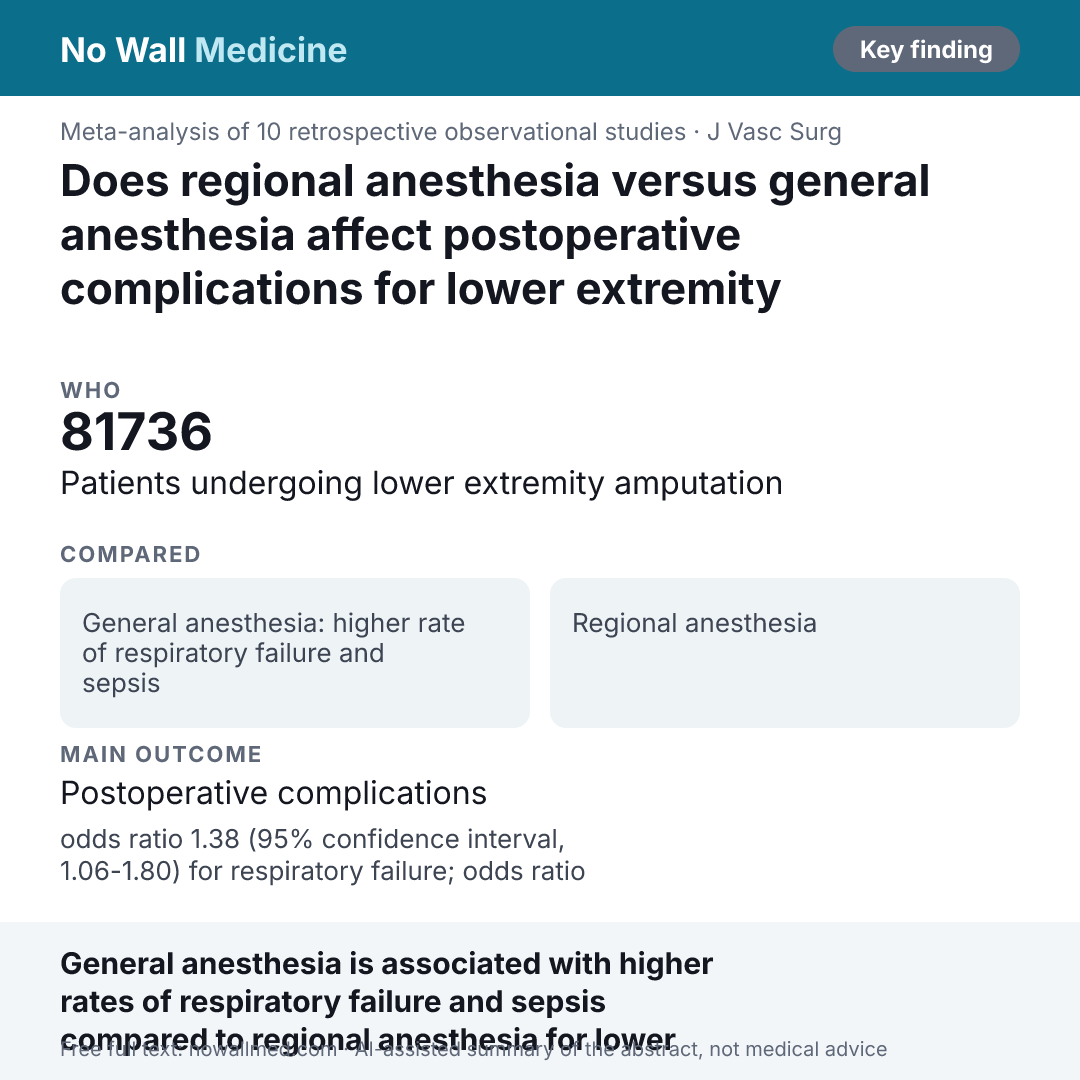
Clinical question: Does regional anesthesia versus general anesthesia affect postoperative complications for lower extremity amputation?
Why it matters: Studies investigating how the type of anesthesia used during lower extremity amputation affects postoperative complications have yielded conflicting results.
Key points
- Researchers analyzed 10 observational studies involving 81,736 patients, comparing general anesthesia to regional anesthesia like nerve blocks or spinal anesthesia.
- General anesthesia was associated with higher rates of respiratory failure (odds ratio 1.38) and sepsis (odds ratio 1.21) compared to regional anesthesia.
- No differences were found between the two groups regarding 30-day mortality, surgical site infection, cardiac complications, urinary tract infection, renal failure, venous thrombosis, pneumonia, or myocardial infarction.
Limitation the authors note: The meta-analysis was based on 10 retrospective observational studies.
Headline and key points written with AI from the paper’s abstract, with every number checked against it. Read the paper before relying on them.
Was this summary helpful?
Subject terms
Headline, design, result, key points, caveat and citation as plain text.
Cite this article
Mufarrih SH, Qureshi NQ, Yunus RA, et al. A systematic review and meta-analysis of general versus regional anesthesia for lower extremity amputation. J Vasc Surg. 2023;77(5):1542-1552.e9. doi:10.1016/j.jvs.2022.10.005
Spotted a mistake? Suggest a correction