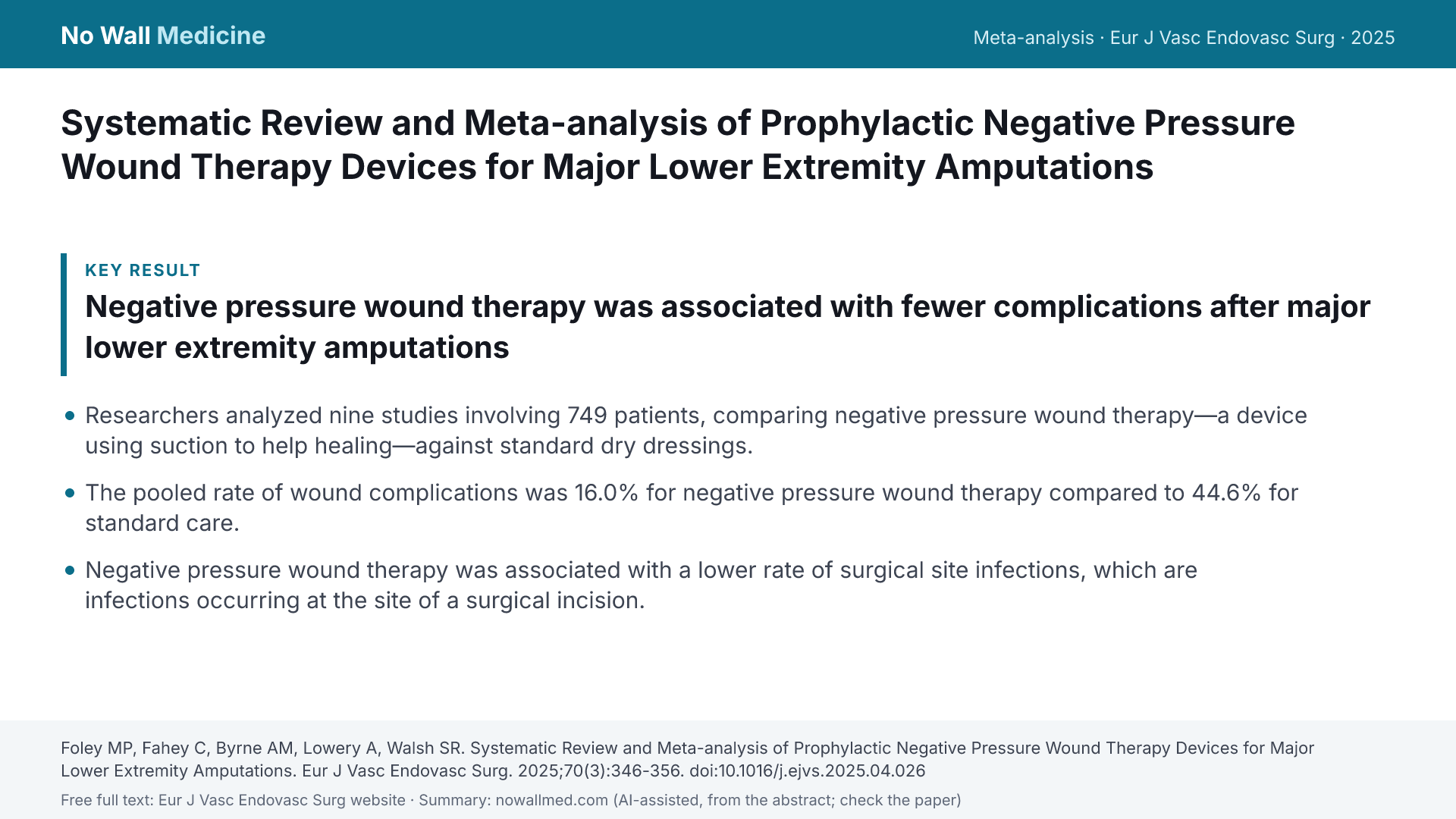
Negative pressure wound therapy was associated with fewer complications after major lower extremity amputations
Systematic Review and Meta-analysis of Prophylactic Negative Pressure Wound Therapy Devices for Major Lower Extremity Amputations
Why it matters: It is unknown if using negative pressure wound therapy routinely or selectively is beneficial for patients undergoing major lower extremity amputations.
Key points
- Researchers analyzed nine studies involving 749 patients, comparing negative pressure wound therapy—a device using suction to help healing—against standard dry dressings.
- The pooled rate of wound complications was 16.0% for negative pressure wound therapy compared to 44.6% for standard care.
- Negative pressure wound therapy was associated with a lower rate of surgical site infections, which are infections occurring at the site of a surgical incision.
Limitation the authors note: The overall study quality was moderate to poor, and the certainty of the outcomes was very low.
Headline and key points written with AI from the paper’s abstract, with every number checked against it. Read the paper before relying on them.
Was this summary helpful?
Subject terms
Cite this article
Foley MP, Fahey C, Byrne AM, Lowery A, Walsh SR. Systematic Review and Meta-analysis of Prophylactic Negative Pressure Wound Therapy Devices for Major Lower Extremity Amputations. Eur J Vasc Endovasc Surg. 2025. doi:10.1016/j.ejvs.2025.04.026
Spotted a mistake? Suggest a correction