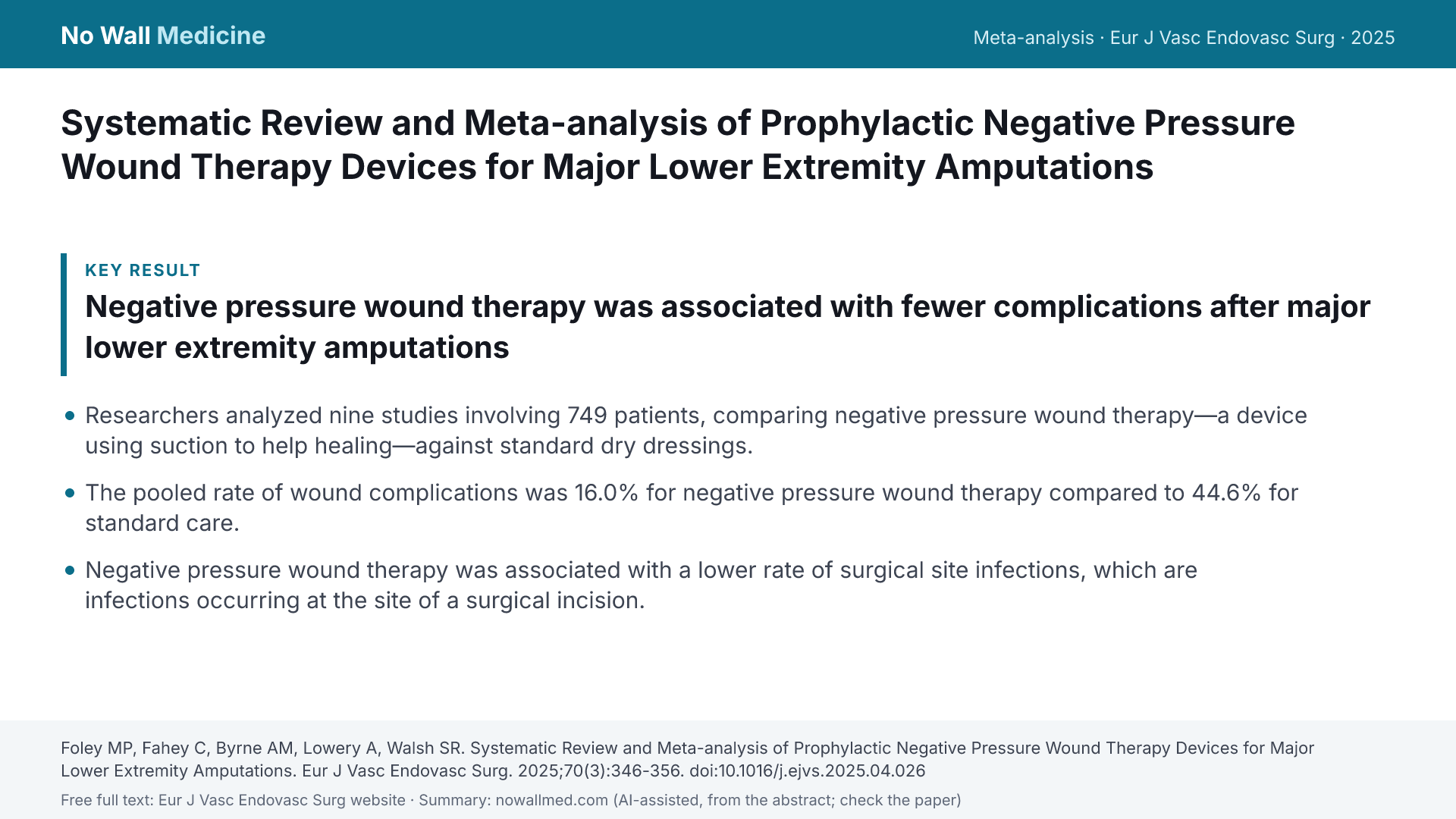
Systematic Review and Meta-analysis of Prophylactic Negative Pressure Wound Therapy Devices for Major Lower Extremity Amputations
Key result: Negative pressure wound therapy was associated with fewer complications after major lower extremity amputations
Key points
- Researchers analyzed nine studies involving 749 patients, comparing negative pressure wound therapy—a device using suction to help healing—against standard dry dressings.
- The pooled rate of wound complications was 16.0% for negative pressure wound therapy compared to 44.6% for standard care.
- Negative pressure wound therapy was associated with a lower rate of surgical site infections, which are infections occurring at the site of a surgical incision.
Limitation the authors note: The overall study quality was moderate to poor, and the certainty of the outcomes was very low.
Discussion prompts
- Would these patients look like yours? Who was left out?
- Is the main outcome one that matters to patients?
- Is the difference large enough to change what you do?
Cite: Foley MP, Fahey C, Byrne AM, Lowery A, Walsh SR. Systematic Review and Meta-analysis of Prophylactic Negative Pressure Wound Therapy Devices for Major Lower Extremity Amputations. Eur J Vasc Endovasc Surg. 2025;70(3):346-356. doi:10.1016/j.ejvs.2025.04.026
Free full text: Eur J Vasc Endovasc Surg website · Summary and visual abstract: nowallmed.com/a/systematic-review-and-meta-analysis-of-prophylactic-negative-pressure-1uawvxu/ (AI-assisted from the abstract; check the paper before relying on it).