A systematic review and meta-analysis of pharmacological methods to manipulate experimentally induced secondary hypersensitivity
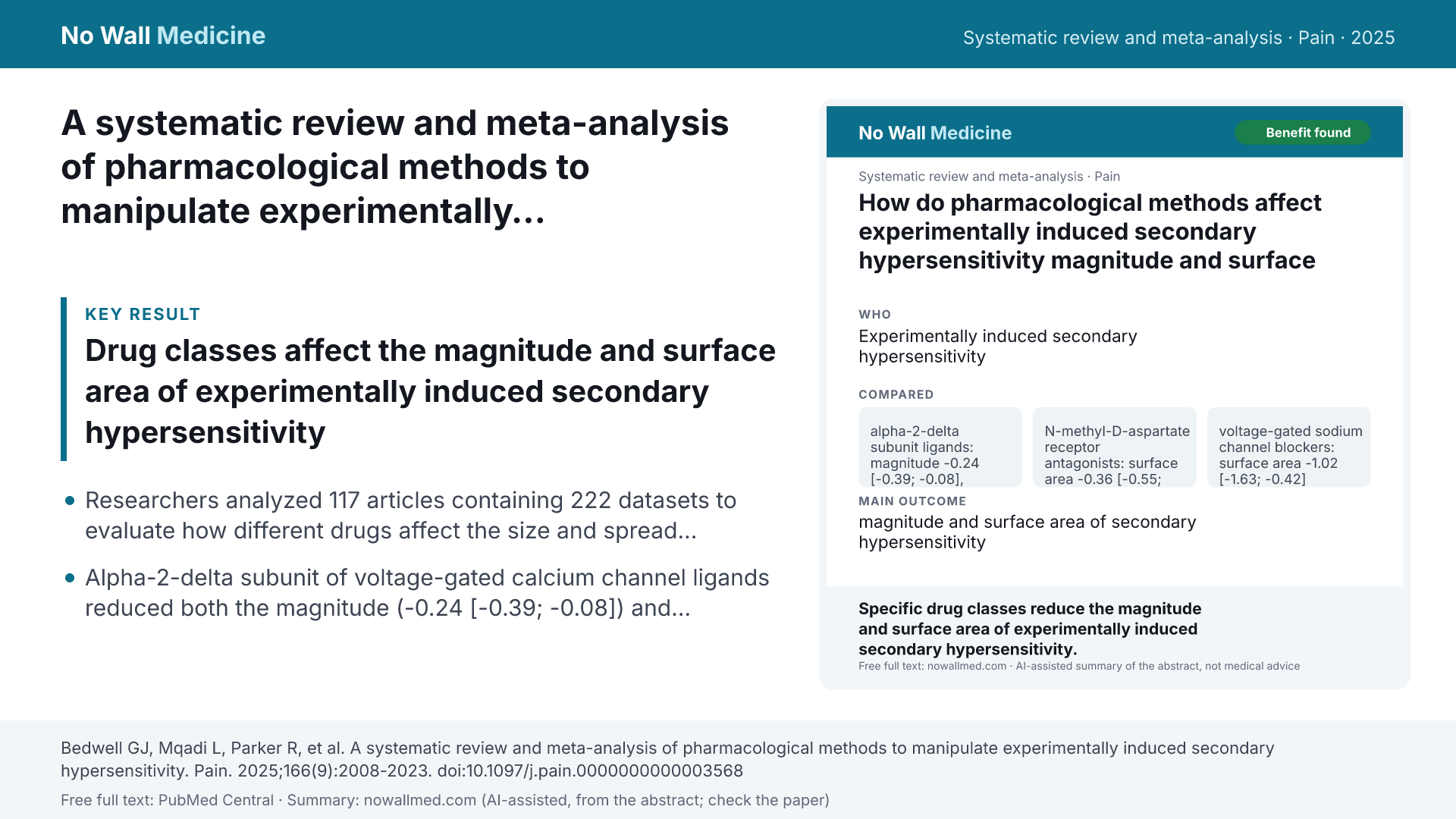
Key result: Drug classes affect the magnitude and surface area of experimentally induced secondary hypersensitivity
Systematic review and meta-analysisBenefit found
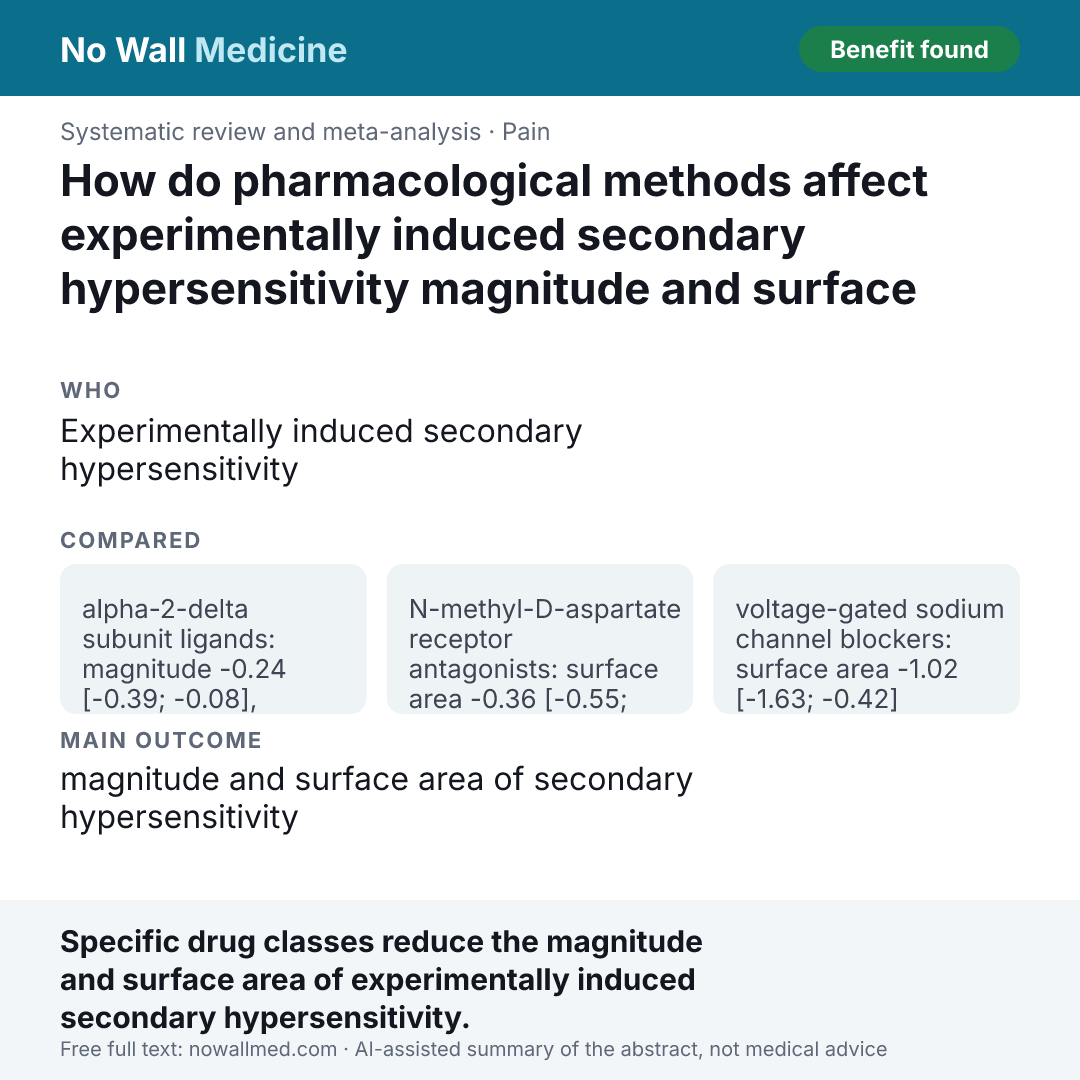
How do pharmacological methods affect experimentally induced secondary hypersensitivity magnitude and surface area?
Who
Experimentally induced secondary hypersensitivity
Compared
alpha-2-delta subunit ligands: magnitude -0.24 [-0.39; -0.08], surface area -0.38 [-0.59; -0.18]
N-methyl-D-aspartate receptor antagonists: surface area -0.36 [-0.55; -0.17]
voltage-gated sodium channel blockers: surface area -1.02 [-1.63; -0.42]
Main outcome
magnitude and surface area of secondary hypersensitivity
Bottom line: Specific drug classes reduce the magnitude and surface area of experimentally induced secondary hypersensitivity.
Limitation: Most datasets had unclear risk of performance and detection bias due to inadequate blinding reporting.
Pain · 2025-04-15 · Save PNG
Key points
- Researchers analyzed 117 articles containing 222 datasets to evaluate how different drugs affect the size and spread of secondary hypersensitivity, which is increased sensitivity to pain in uninjured tissue.
- Alpha-2-delta subunit of voltage-gated calcium channel ligands reduced both the magnitude (-0.24 [-0.39; -0.08]) and surface area (-0.38 [-0.59; -0.18]) of the hypersensitivity.
- N-methyl-D-aspartate receptor antagonists (-0.36 [-0.55; -0.17]) and voltage-gated sodium channel blockers (-1.02 [-1.63; -0.42]) were associated with a reduction in only the surface area.
Limitation the authors note: Most datasets had an unclear risk of performance and detection bias due to inadequate reporting of blinding procedures.
Discussion prompts
- Would these patients look like yours? Who was left out?
- Is the main outcome one that matters to patients?
- Is the difference large enough to change what you do?
Cite: Bedwell GJ, Mqadi L, Parker R, et al. A systematic review and meta-analysis of pharmacological methods to manipulate experimentally induced secondary hypersensitivity. Pain. 2025;166(9):2008-2023. doi:10.1097/j.pain.0000000000003568
Free full text: PubMed Central · Summary and visual abstract: nowallmed.com/a/a-systematic-review-and-meta-analysis-of-pharmacological-methods-to-mil4cs/ (AI-assisted from the abstract; check the paper before relying on it).