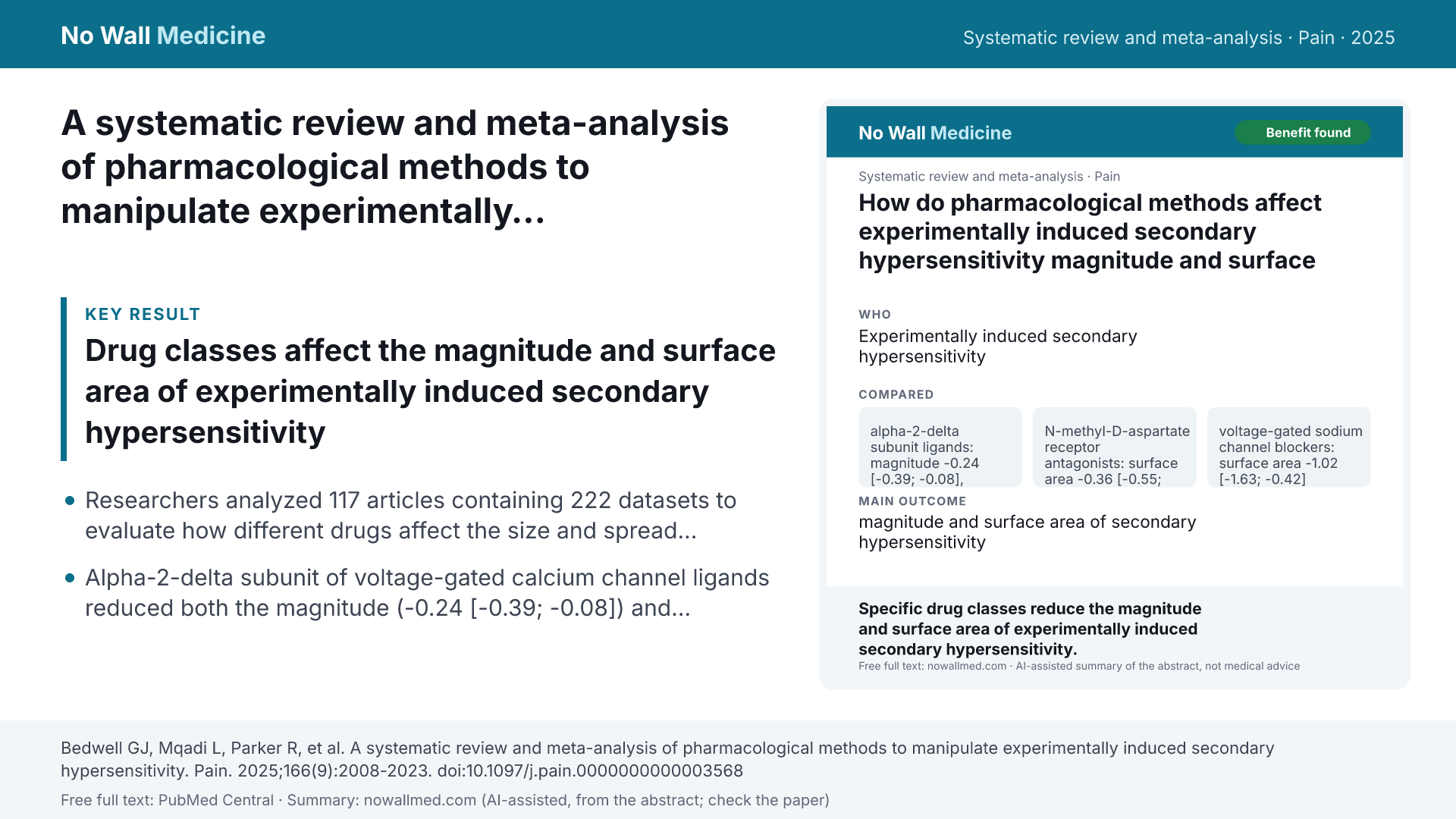
Drug classes affect the magnitude and surface area of experimentally induced secondary hypersensitivity
A systematic review and meta-analysis of pharmacological methods to manipulate experimentally induced secondary hypersensitivity
Systematic review and meta-analysisBenefit found
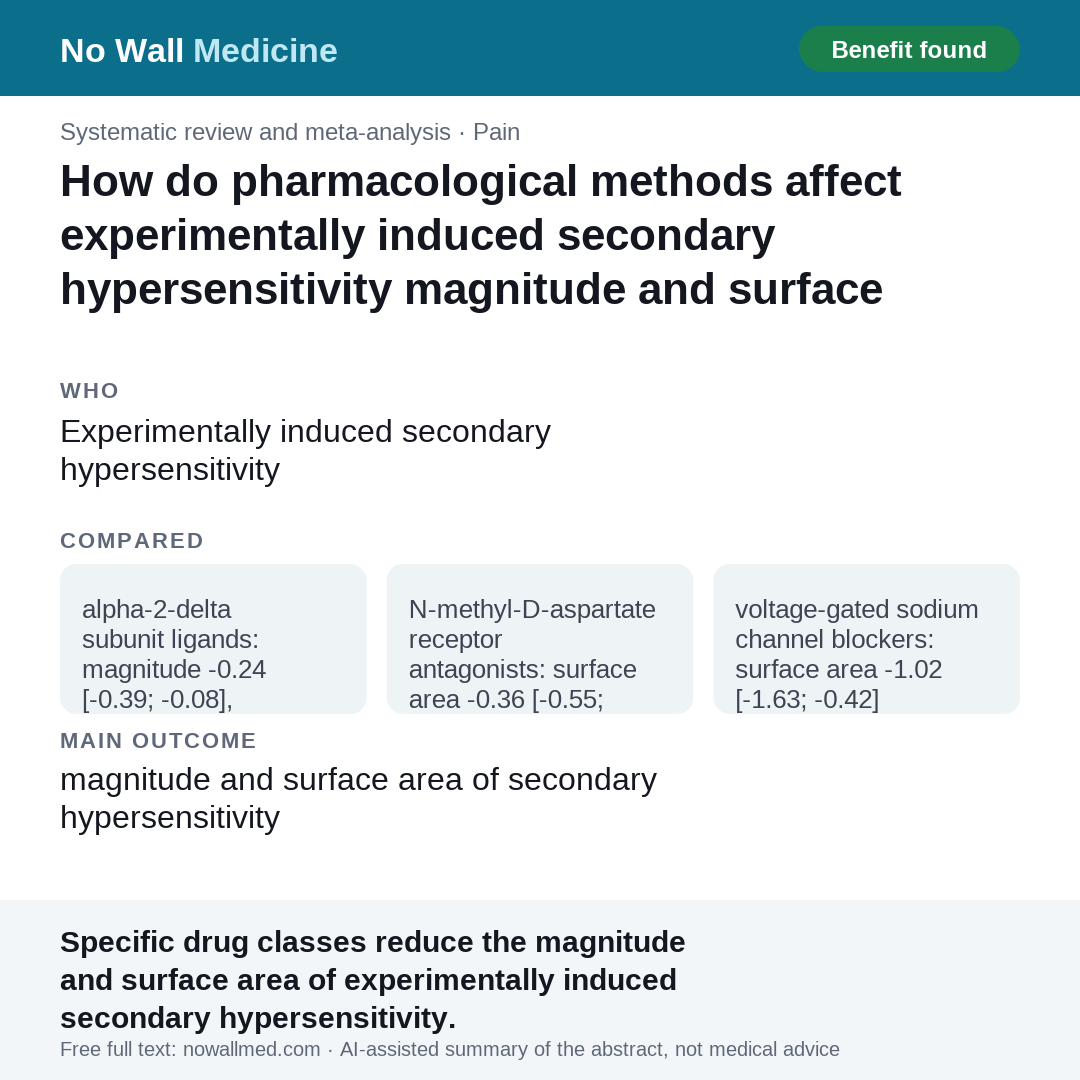
How do pharmacological methods affect experimentally induced secondary hypersensitivity magnitude and surface area?
Who
Experimentally induced secondary hypersensitivity
Compared
alpha-2-delta subunit ligands: magnitude -0.24 [-0.39; -0.08], surface area -0.38 [-0.59; -0.18]
N-methyl-D-aspartate receptor antagonists: surface area -0.36 [-0.55; -0.17]
voltage-gated sodium channel blockers: surface area -1.02 [-1.63; -0.42]
Main outcome
magnitude and surface area of secondary hypersensitivity
Bottom line: Specific drug classes reduce the magnitude and surface area of experimentally induced secondary hypersensitivity.
Limitation: Most datasets had unclear risk of performance and detection bias due to inadequate blinding reporting.
Pain · 2025-04-15Download image
Clinical question: How do pharmacological methods affect experimentally induced secondary hypersensitivity magnitude and surface area?
Why it matters: The physiological mechanisms behind the magnitude and anatomical spread of secondary hypersensitivity are not fully understood.
Key points
- Researchers analyzed 117 articles containing 222 datasets to evaluate how different drugs affect the size and spread of secondary hypersensitivity, which is increased sensitivity to pain in uninjured tissue.
- Alpha-2-delta subunit of voltage-gated calcium channel ligands reduced both the magnitude (-0.24 [-0.39; -0.08]) and surface area (-0.38 [-0.59; -0.18]) of the hypersensitivity.
- N-methyl-D-aspartate receptor antagonists (-0.36 [-0.55; -0.17]) and voltage-gated sodium channel blockers (-1.02 [-1.63; -0.42]) were associated with a reduction in only the surface area.
Limitation the authors note: Most datasets had an unclear risk of performance and detection bias due to inadequate reporting of blinding procedures.
Headline and key points written with AI from the paper’s abstract, with every number checked against it. Read the paper before relying on them.
Was this summary helpful?
Subject terms
Cite this article
Bedwell GJ, Mqadi L, Parker R, Chikezie PC, Moodley P, Kamerman PR. A systematic review and meta-analysis of pharmacological methods to manipulate experimentally induced secondary hypersensitivity. Pain. 2025. doi:10.1097/j.pain.0000000000003568
Spotted a mistake? Suggest a correction