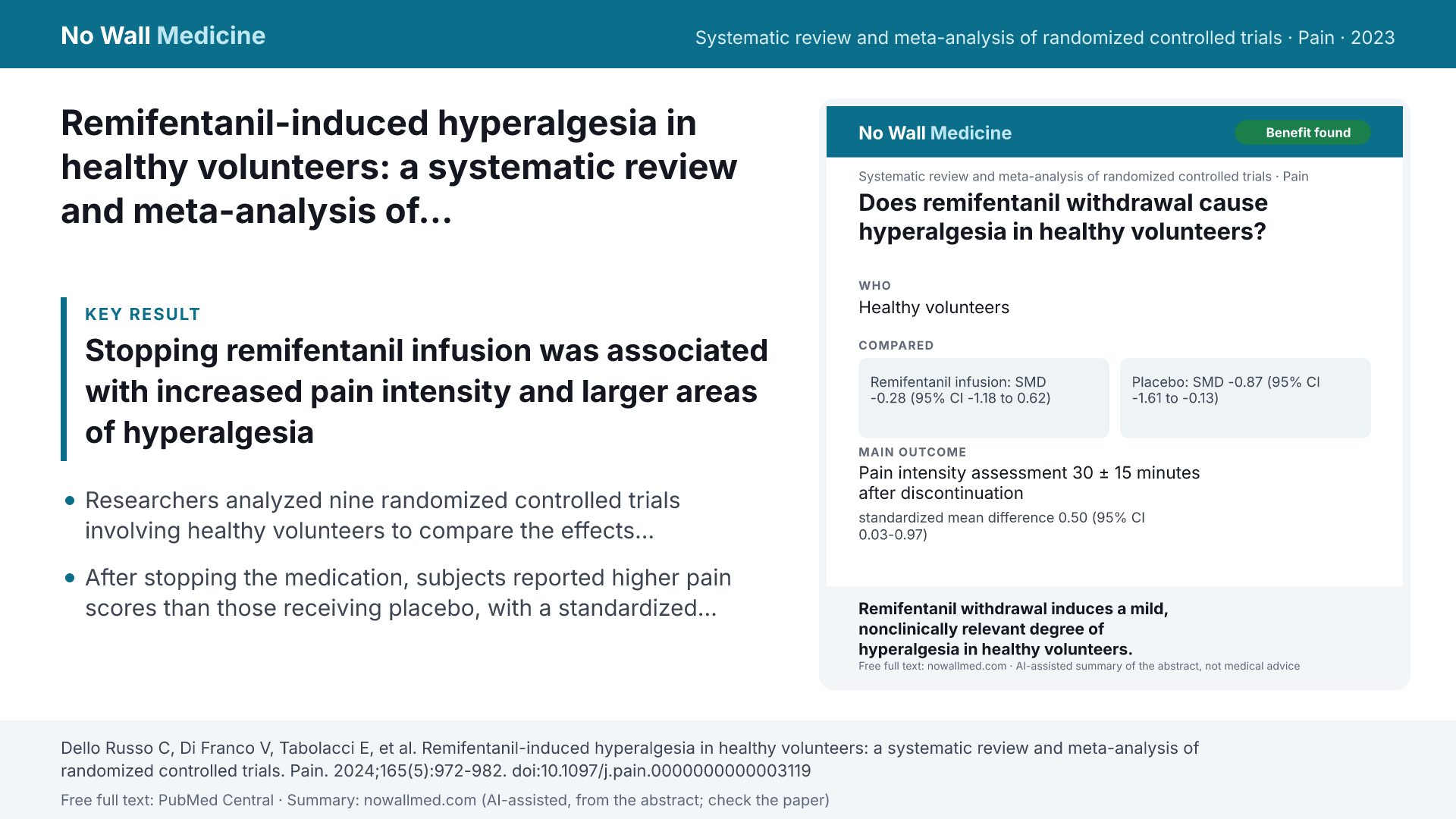
Stopping remifentanil infusion was associated with increased pain intensity and larger areas of hyperalgesia
Remifentanil-induced hyperalgesia in healthy volunteers: a systematic review and meta-analysis of randomized controlled trials
Systematic review and meta-analysis of randomized controlled trialsBenefit found
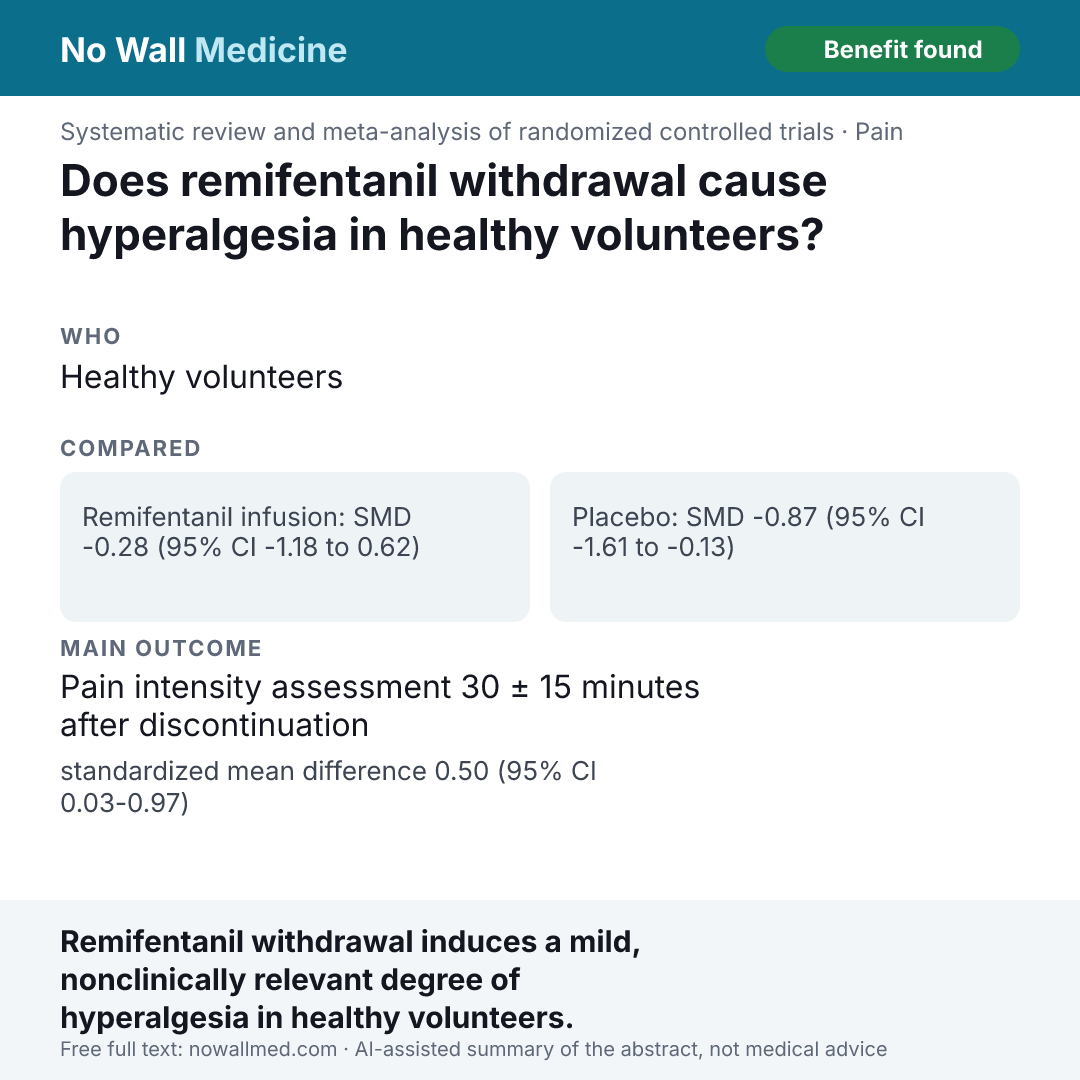
Does remifentanil withdrawal cause hyperalgesia in healthy volunteers?
Who
Healthy volunteers
Compared
Remifentanil infusion: SMD -0.28 (95% CI -1.18 to 0.62)
Placebo: SMD -0.87 (95% CI -1.61 to -0.13)
Main outcome
Pain intensity assessment 30 ± 15 minutes after discontinuation
Result: standardized mean difference 0.50 (95% CI 0.03-0.97)
Bottom line: Remifentanil withdrawal induces a mild, nonclinically relevant degree of hyperalgesia in healthy volunteers.
Pain · 2023-11-30 · Save PNG
Clinical question: Does remifentanil withdrawal cause hyperalgesia in healthy volunteers?
Key points
- Researchers analyzed nine randomized controlled trials involving healthy volunteers to compare the effects of remifentanil, a short-acting opioid, against a saline placebo.
- After stopping the medication, subjects reported higher pain scores than those receiving placebo, with a standardized mean difference of 0.50 (95% CI: 0.03-0.97).
- The area of hyperalgesia, or increased sensitivity to pain, was larger after remifentanil withdrawal with a standardized mean difference of 0.55 (95% CI: 0.27-0.84).
Headline and key points written with AI from the paper’s abstract, with every number checked against it. Read the paper before relying on them.
Was this summary helpful?
Subject terms
Headline, design, result, key points, caveat and citation as plain text.
Cite this article
Dello Russo C, Di Franco V, Tabolacci E, et al. Remifentanil-induced hyperalgesia in healthy volunteers: a systematic review and meta-analysis of randomized controlled trials. Pain. 2024;165(5):972-982. doi:10.1097/j.pain.0000000000003119
Spotted a mistake? Suggest a correction