Remifentanil for tracheal intubation without neuromuscular blocking drugs in adult patients: a systematic review and meta-analysis
Systematic review and meta-analysisNo clear difference
Is remifentanil effective and safe for tracheal intubation compared with neuromuscular blocking drugs?
Who
1945
Adult patients
Compared
Remifentanil
Neuromuscular blocking drugs
Main outcome
Tracheal intubation success rate and adverse events
Result: risk ratio 0.97 (95%CI 0.94-1.01)
Bottom line: Remifentanil may be an alternative for tracheal intubation when neuromuscular blocking drugs should be avoided.
Limitation: Evidence for bradycardia and hypotension was judged to be of very low-certainty.
Anaesthesia · 2024-02-25Download image
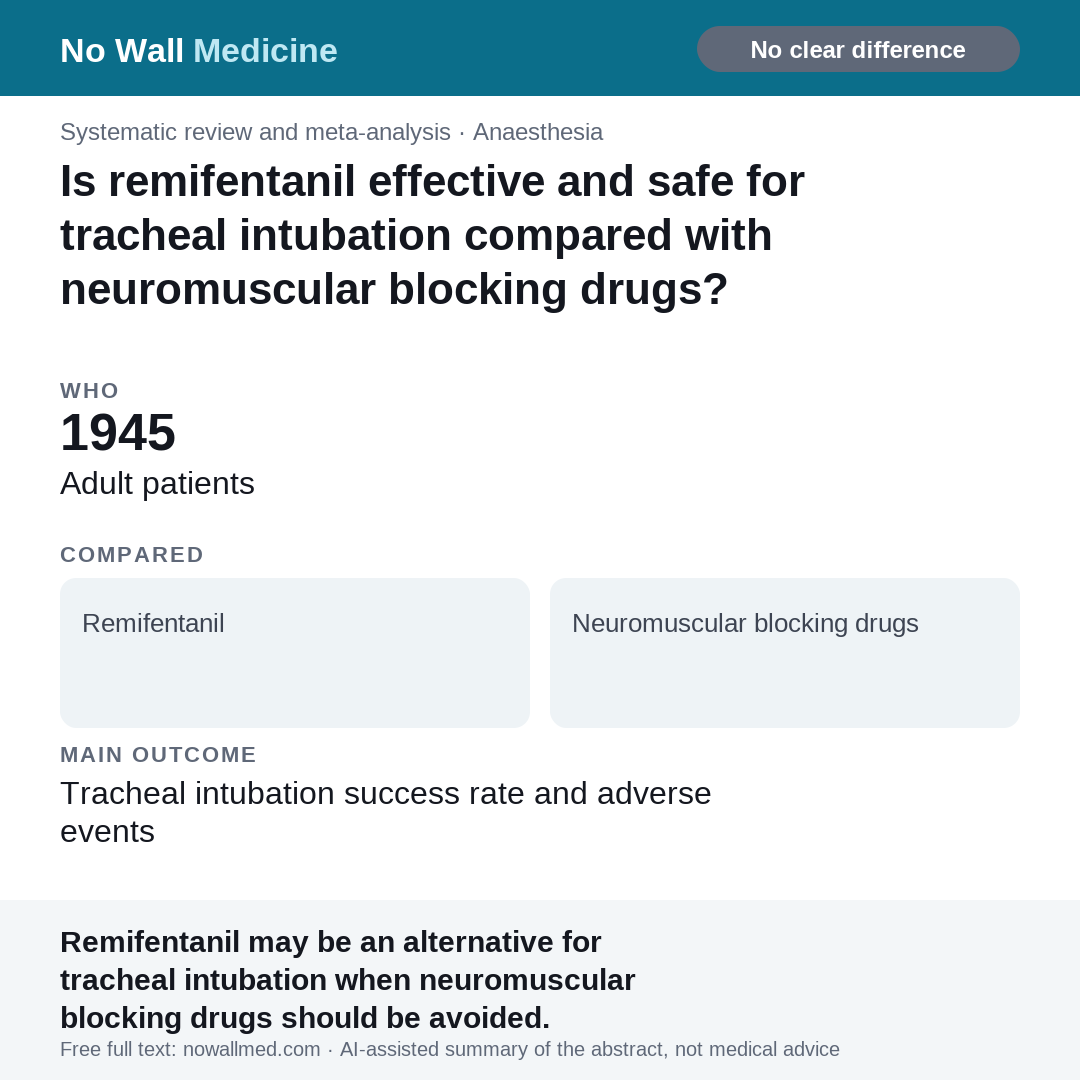
Clinical question: Is remifentanil effective and safe for tracheal intubation compared with neuromuscular blocking drugs?
Abstract
There is increasing interest in the use of short-acting opioids such as remifentanil to facilitate tracheal intubation. The aim of this systematic review was to determine the efficacy and safety of remifentanil for tracheal intubation compared with neuromuscular blocking drugs in adult patients. We conducted a systematic search for randomised controlled trials evaluating remifentanil for tracheal intubation. Primary outcomes included tracheal intubation conditions and adverse events. Twenty-one studies evaluating 1945 participants were included in the analysis. Use of remifentanil (1.5-4.0 μg.kg-1) showed no evidence of a difference in tracheal intubation success rate compared with neuromuscular blocking drugs (risk ratio (95%CI) 0.97 (0.94-1.01); six studies; 1232 participants; I2 28%; p = 0.16; moderate-certainty evidence). Compared with neuromuscular blocking drugs, the use of remifentanil (2.0-4.0 μg.kg-1) makes little to no difference in terms of producing excellent tracheal intubation conditions (risk ratio (95%CI) 1.16 (0.72-1.87); two studies; 121 participants; I2 31%, p = 0.54; moderate-certainty of evidence). There was no evidence of an effect between remifentanil (2.0-4.0 μg.kg-1) and neuromuscular blocking drugs for bradycardia (risk ratio (95%CI) 0.44 (0.01-13.90); two studies; 997 participants; I2 81%; p = 0.64) and hypotension (risk ratio (95%CI) 1.05 (0.44-2.49); three studies; 1071 participants; I2 92%; p = 0.92). However, the evidence for these two outcomes was judged to be of very low-certainty. We conclude that remifentanil may be used as an alternative drug for tracheal intubation in cases where neuromuscular blocking drugs are best avoided, but more studies are required to evaluate the haemodynamic adverse events of remifentanil at different doses.
Subject terms
Cite this article
Santos L, Zheng H, Singhal S, Wong M. Remifentanil for tracheal intubation without neuromuscular blocking drugs in adult patients: a systematic review and meta-analysis. Anaesthesia. 2024. doi:10.1111/anae.16255
Spotted a mistake? Suggest a correction
Top studies every Monday
The week’s key trials and guidelines in your specialties, plus any topics you follow. By email, free.
Get the weekly digest