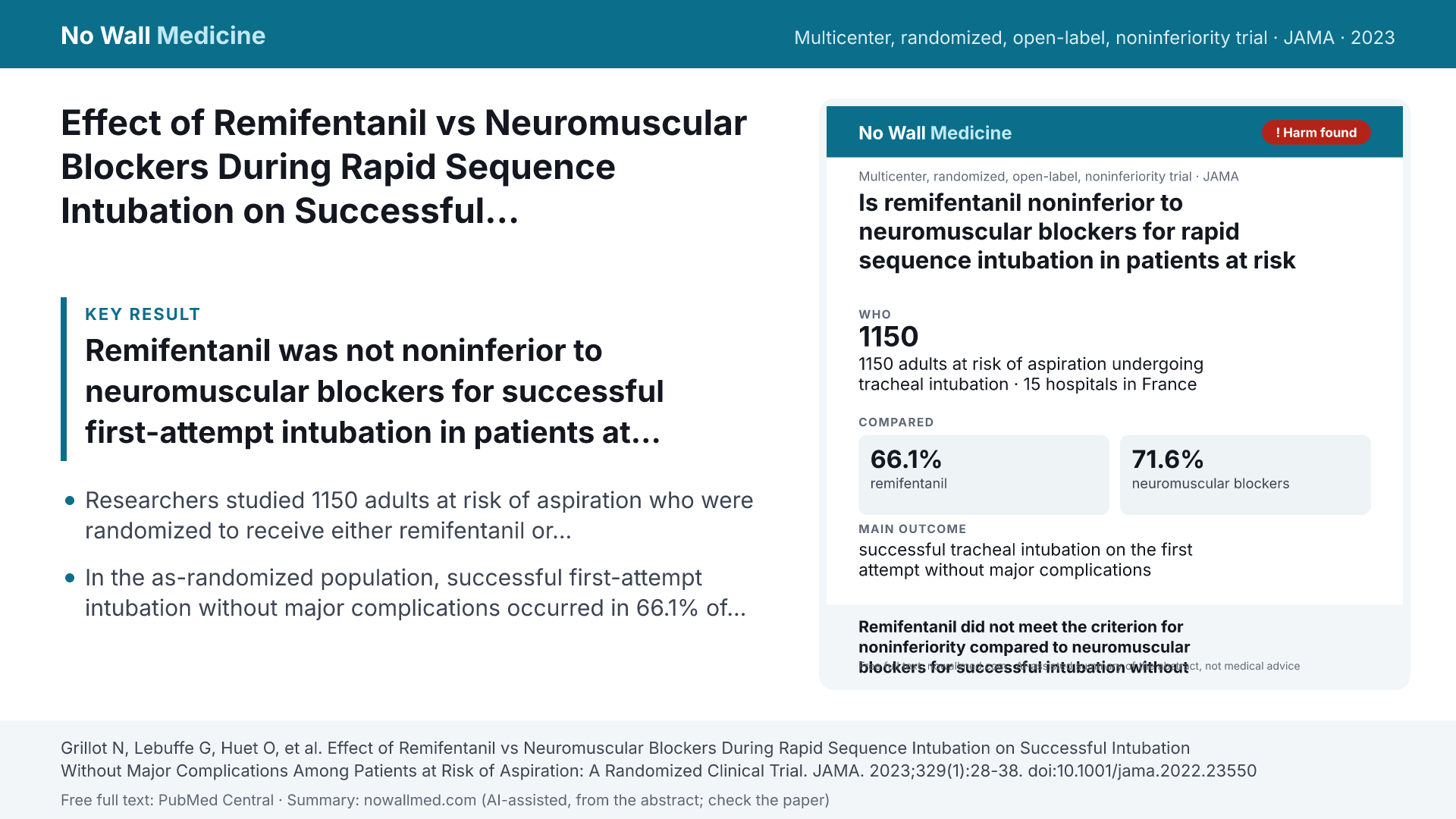
Remifentanil was not noninferior to neuromuscular blockers for successful first-attempt intubation in patients at risk of aspiration
Effect of Remifentanil vs Neuromuscular Blockers During Rapid Sequence Intubation on Successful Intubation Without Major Complications Among Patients at Risk of Aspiration: A Randomized Clinical Trial
Multicenter, randomized, open-label, noninferiority trialHarm found
Is remifentanil noninferior to neuromuscular blockers for rapid sequence intubation in patients at risk of aspiration?
Who
1150
1150 adults at risk of aspiration undergoing tracheal intubation · 15 hospitals in France
Compared
66.1%remifentanil (374/575)
71.6%neuromuscular blockers (408/575)
Main outcome
successful tracheal intubation on the first attempt without major complications
Result: -6.1%; 95% CI, -11.6% to -0.5%
Bottom line: Remifentanil did not meet the criterion for noninferiority compared to neuromuscular blockers for successful intubation without major complications.
JAMA · 2023-01-03 · Save PNG
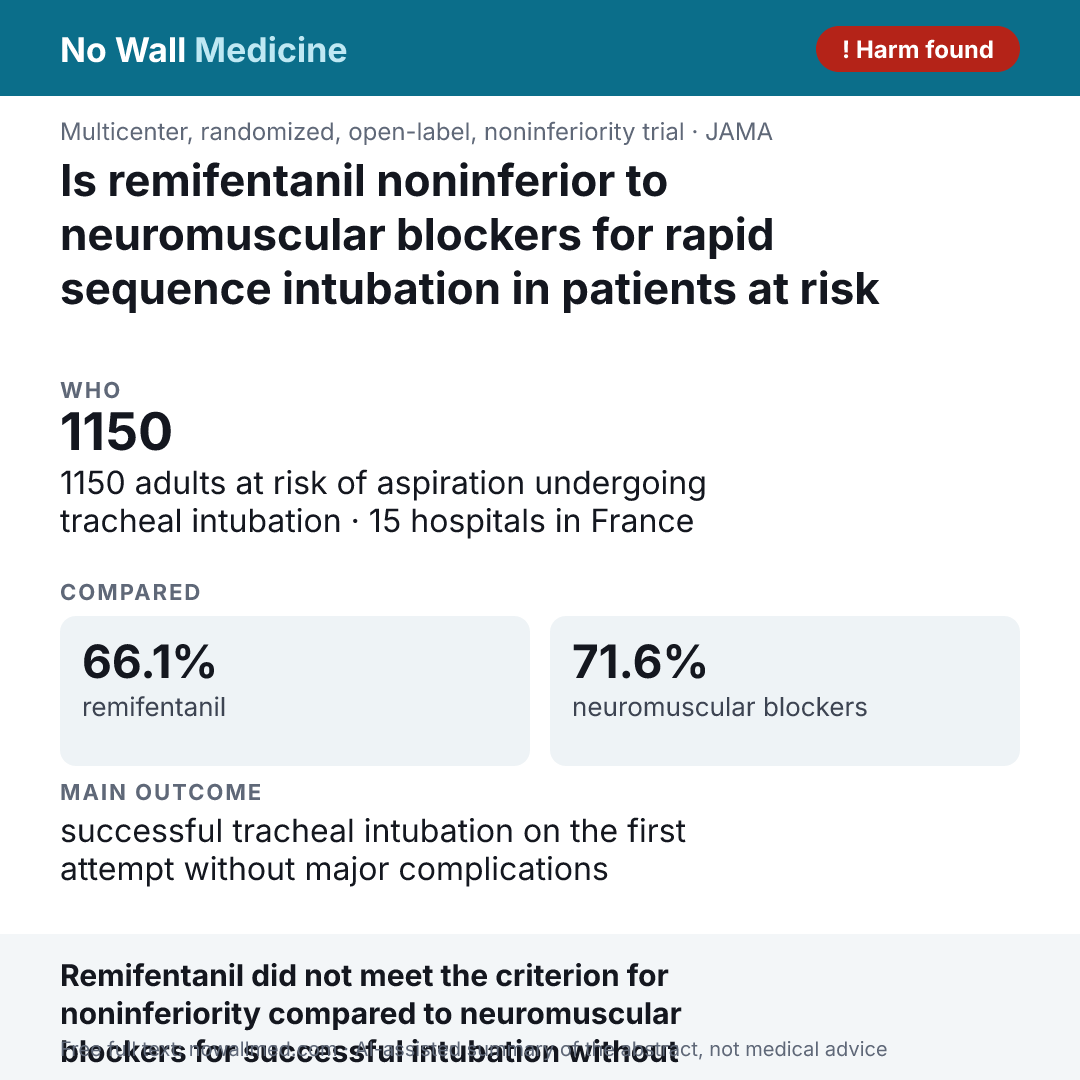
Clinical question: Is remifentanil noninferior to neuromuscular blockers for rapid sequence intubation in patients at risk of aspiration?
Key points
- Researchers studied 1150 adults at risk of aspiration who were randomized to receive either remifentanil or neuromuscular blockers, such as succinylcholine or rocuronium, during rapid sequence intubation.
- In the as-randomized population, successful first-attempt intubation without major complications occurred in 66.1% of the remifentanil group compared to 71.6% of the neuromuscular blocker group.
- Hemodynamic instability, a type of major blood pressure or heart rate change, was recorded in 3.3% of remifentanil patients and 0.5% of the neuromuscular blocker group.
Headline and key points written with AI from the paper’s abstract, with every number checked against it. Read the paper before relying on them.
Was this summary helpful?
Subject terms
Headline, design, result, key points, caveat and citation as plain text.
Cite this article
Grillot N, Lebuffe G, Huet O, et al. Effect of Remifentanil vs Neuromuscular Blockers During Rapid Sequence Intubation on Successful Intubation Without Major Complications Among Patients at Risk of Aspiration: A Randomized Clinical Trial. JAMA. 2023;329(1):28-38. doi:10.1001/jama.2022.23550
Spotted a mistake? Suggest a correction