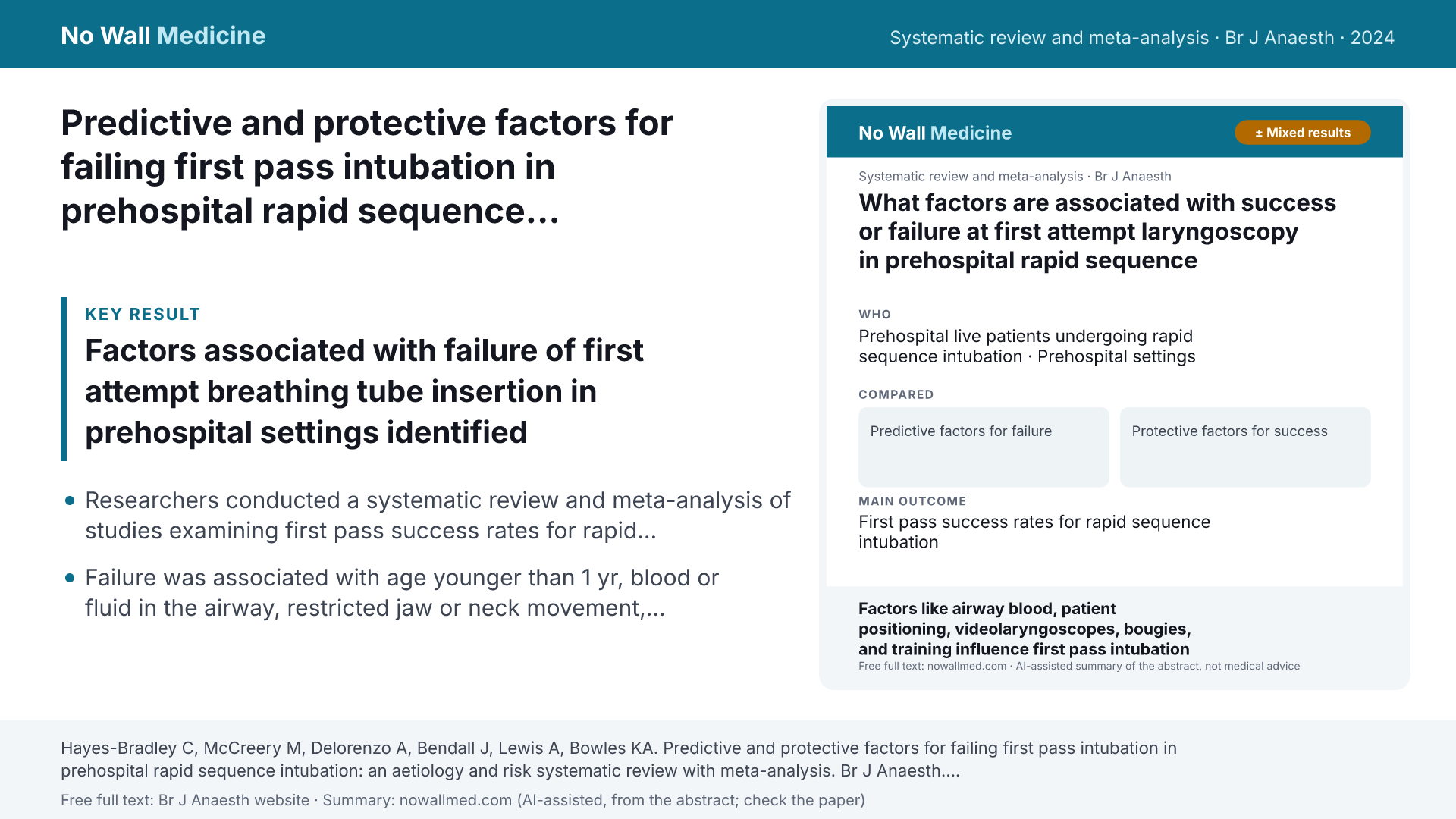
Factors associated with failure of first attempt breathing tube insertion in prehospital settings identified
Predictive and protective factors for failing first pass intubation in prehospital rapid sequence intubation: an aetiology and risk systematic review with meta-analysis
Systematic review and meta-analysisMixed results
What factors are associated with success or failure at first attempt laryngoscopy in prehospital rapid sequence intubation?
Who
Prehospital live patients undergoing rapid sequence intubation · Prehospital settings
Compared
Predictive factors for failure
Protective factors for success
Main outcome
First pass success rates for rapid sequence intubation
Bottom line: Factors like airway blood, patient positioning, videolaryngoscopes, bougies, and training influence first pass intubation success.
Br J Anaesth · 2024-03-19Download image
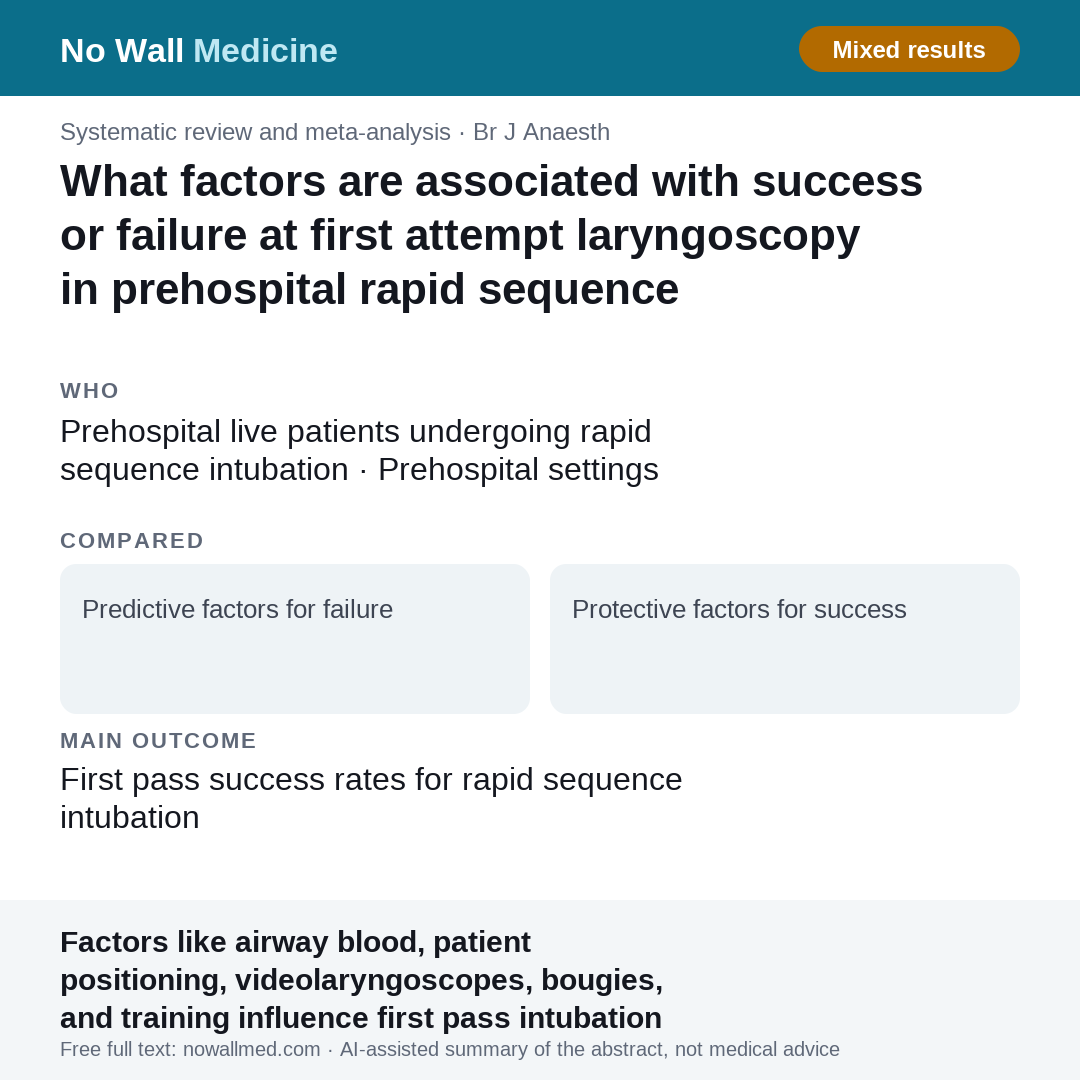
Clinical question: What factors are associated with success or failure at first attempt laryngoscopy in prehospital rapid sequence intubation?
Why it matters: Prehospital first pass success rates for rapid sequence intubation vary between 59% and 98%, and it is unknown which specific factors are associated with success or failure.
Key points
- Researchers conducted a systematic review and meta-analysis of studies examining first pass success rates for rapid sequence intubation, which is the quick insertion of a breathing tube, in prehospital patients.
- Failure was associated with age younger than 1 yr, blood or fluid in the airway, restricted jaw or neck movement, trauma, nighttime procedures, airway anatomy distortions, and equipment issues.
- Protective factors associated with success included an experienced intubator, adequate training, use of certain videolaryngoscopes, elevating the patient on a stretcher, use of a bougie, and laryngeal manoeuvres.
Headline and key points written with AI from the paper’s abstract, with every number checked against it. Read the paper before relying on them.
Was this summary helpful?
Subject terms
Cite this article
Hayes-Bradley C, McCreery M, Delorenzo A, Bendall J, Lewis A, Bowles KA. Predictive and protective factors for failing first pass intubation in prehospital rapid sequence intubation: an aetiology and risk systematic review with meta-analysis. Br J Anaesth. 2024. doi:10.1016/j.bja.2024.02.004
Spotted a mistake? Suggest a correction