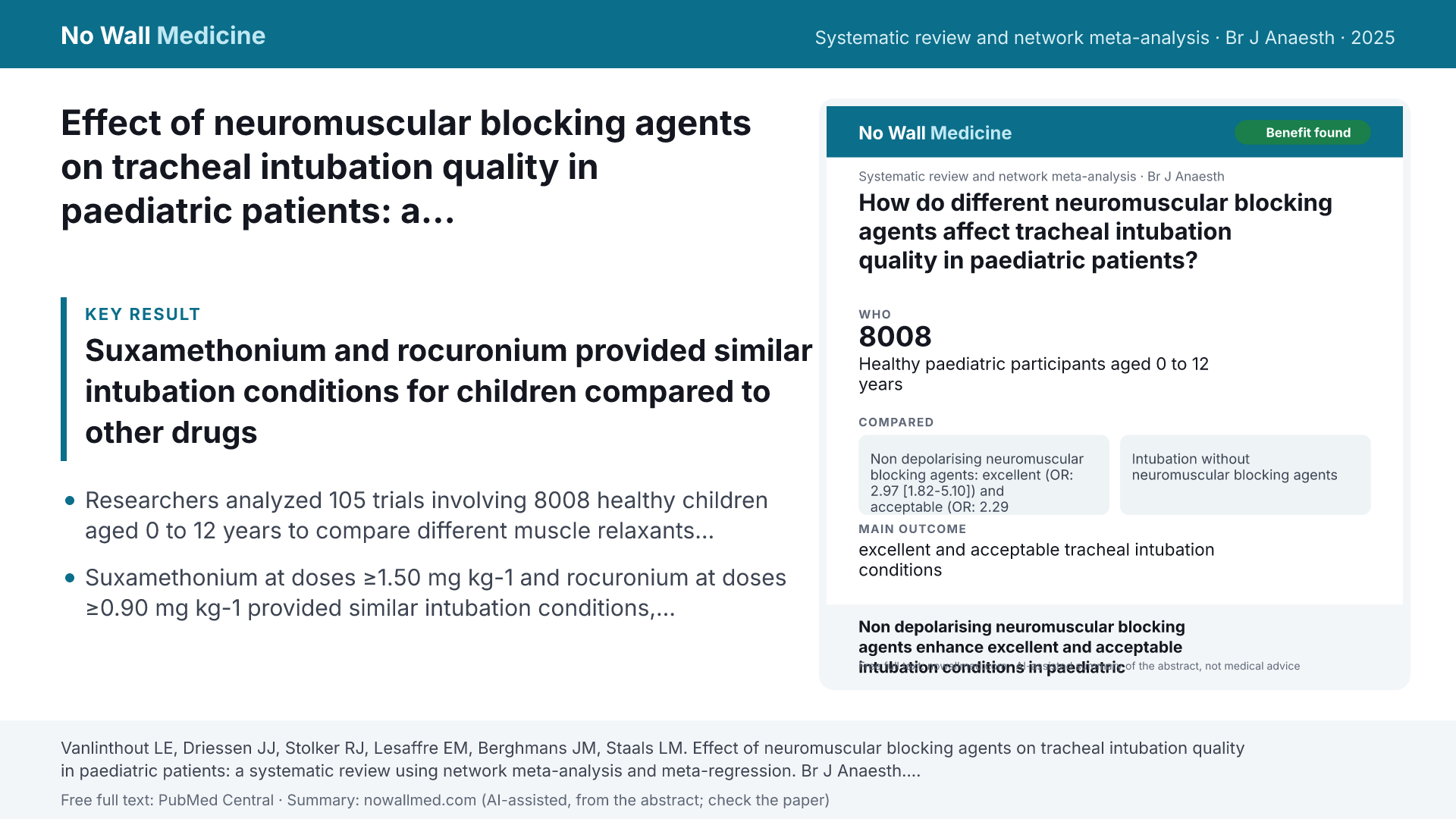
Suxamethonium and rocuronium provided similar intubation conditions for children compared to other drugs
Effect of neuromuscular blocking agents on tracheal intubation quality in paediatric patients: a systematic review using network meta-analysis and meta-regression
Systematic review and network meta-analysisBenefit found
How do different neuromuscular blocking agents affect tracheal intubation quality in paediatric patients?
Who
8008
Healthy paediatric participants aged 0 to 12 years
Compared
Non depolarising neuromuscular blocking agents: excellent (OR: 2.97 [1.82-5.10]) and acceptable (OR: 2.29 [1.14-4.39]) intubation conditions
Intubation without neuromuscular blocking agents
Main outcome
excellent and acceptable tracheal intubation conditions
Bottom line: Non depolarising neuromuscular blocking agents enhance excellent and acceptable intubation conditions in paediatric patients.
Br J Anaesth · 2025-10-10Download image
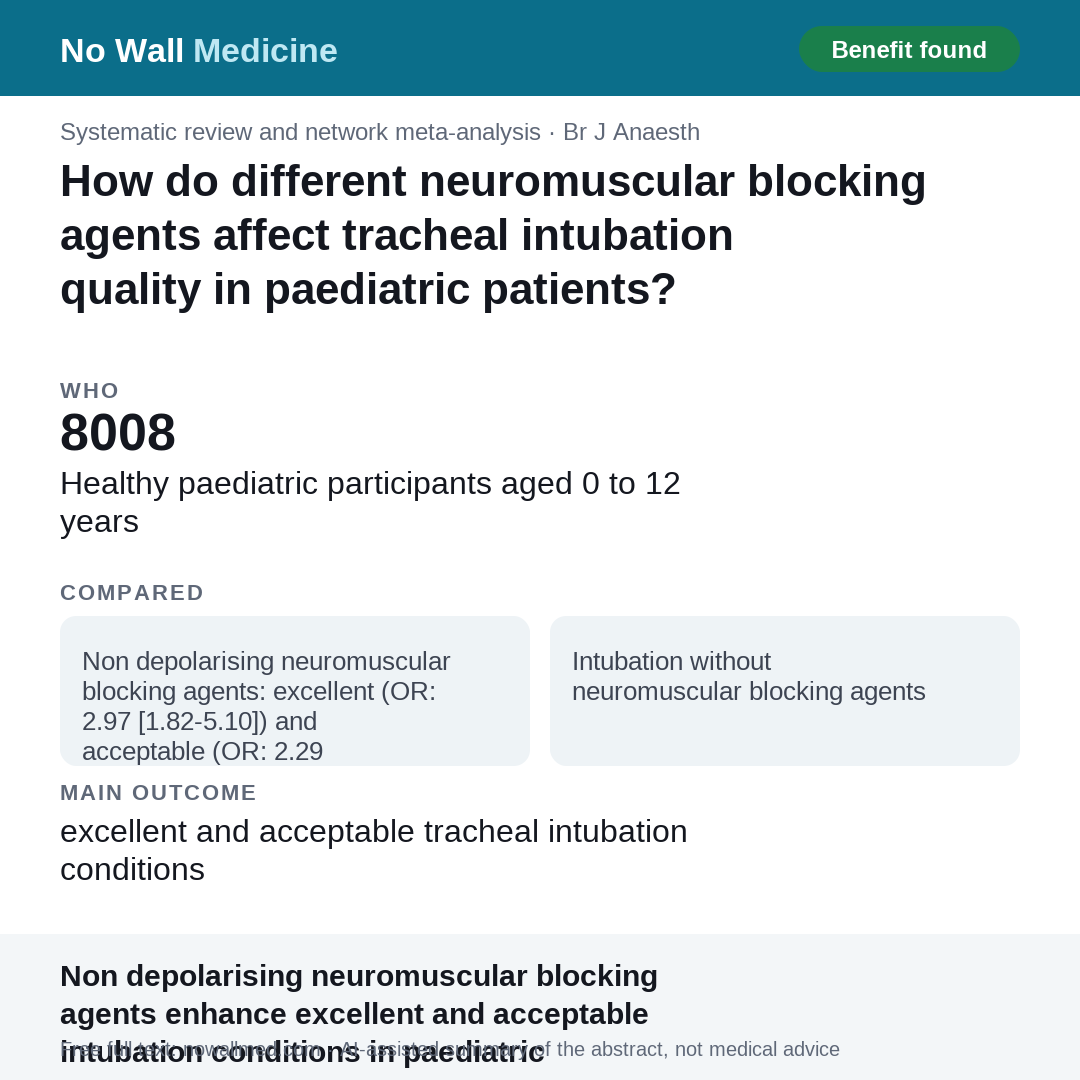
Clinical question: How do different neuromuscular blocking agents affect tracheal intubation quality in paediatric patients?
Why it matters: Clinicians need to understand how different types and doses of muscle relaxants affect the quality of tracheal intubation and heart rate responses in pediatric patients.
Key points
- Researchers analyzed 105 trials involving 8008 healthy children aged 0 to 12 years to compare different muscle relaxants and intubation conditions.
- Suxamethonium at doses ≥1.50 mg kg-1 and rocuronium at doses ≥0.90 mg kg-1 provided similar intubation conditions, though not always within 60 s.
- Non-depolarizing muscle relaxants were associated with higher odds of excellent (OR: 2.97 [1.82-5.10]) and acceptable (OR: 2.29 [1.14-4.39]) intubation conditions.
Headline and key points written with AI from the paper’s abstract, with every number checked against it. Read the paper before relying on them.
Was this summary helpful?
Subject terms
Cite this article
Vanlinthout LE, Driessen JJ, Stolker RJ, Lesaffre EM, Berghmans JM, Staals LM. Effect of neuromuscular blocking agents on tracheal intubation quality in paediatric patients: a systematic review using network meta-analysis and meta-regression. Br J Anaesth. 2025. doi:10.1016/j.bja.2025.08.036
Spotted a mistake? Suggest a correction