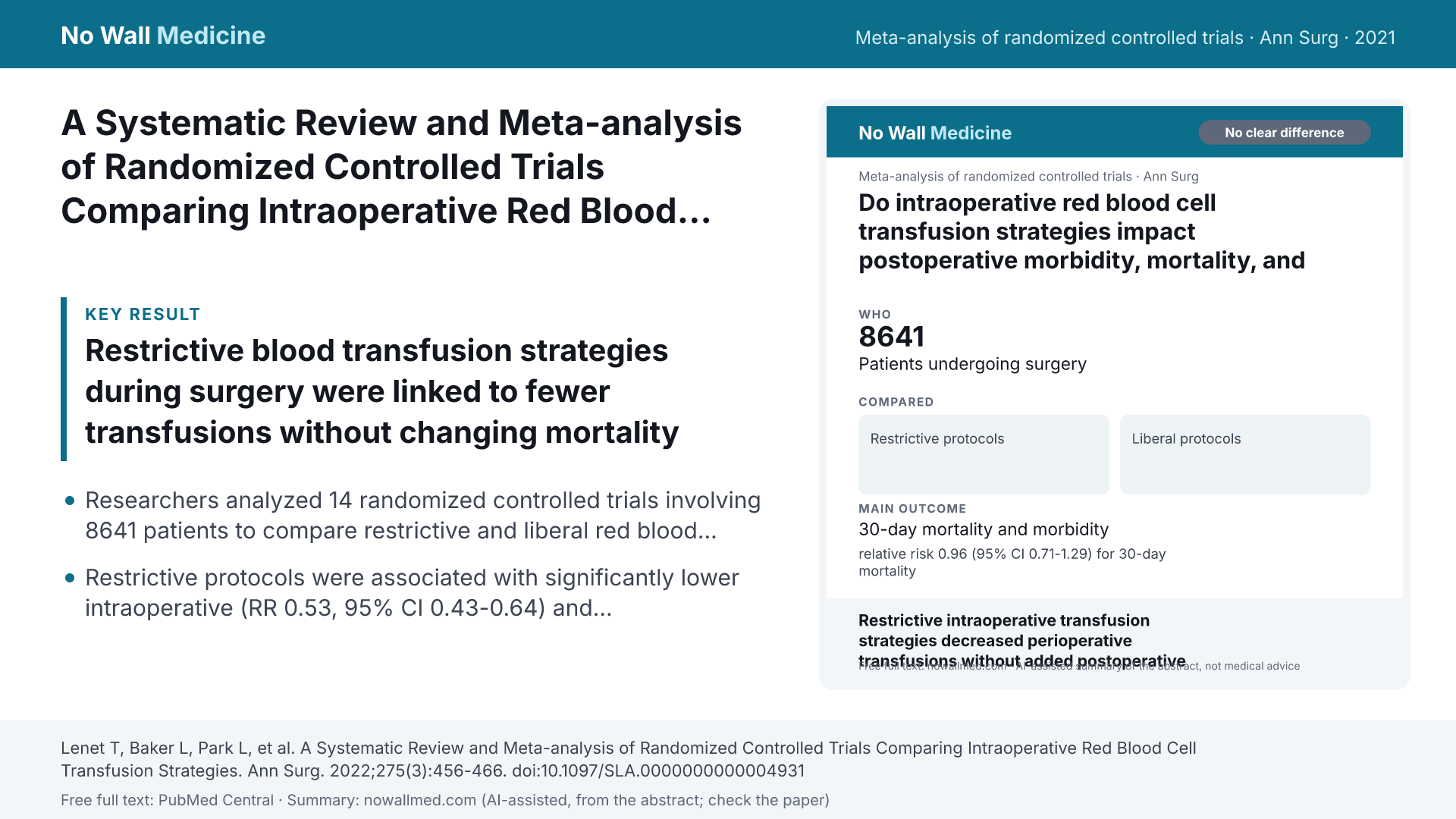
Restrictive blood transfusion strategies during surgery were linked to fewer transfusions without changing mortality
A Systematic Review and Meta-analysis of Randomized Controlled Trials Comparing Intraoperative Red Blood Cell Transfusion Strategies
Meta-analysis of randomized controlled trialsNo clear difference
Do intraoperative red blood cell transfusion strategies impact postoperative morbidity, mortality, and blood use?
Who
8641
Patients undergoing surgery
Compared
Restrictive protocols
Liberal protocols
Main outcome
30-day mortality and morbidity
Result: relative risk 0.96 (95% CI 0.71-1.29) for 30-day mortality
Bottom line: Restrictive intraoperative transfusion strategies decreased perioperative transfusions without added postoperative morbidity and mortality in most trials.
Limitation: Trial design and generalizability limitations leave uncertainty regarding broad application.
Ann Surg · 2021-07-29 · Save PNG
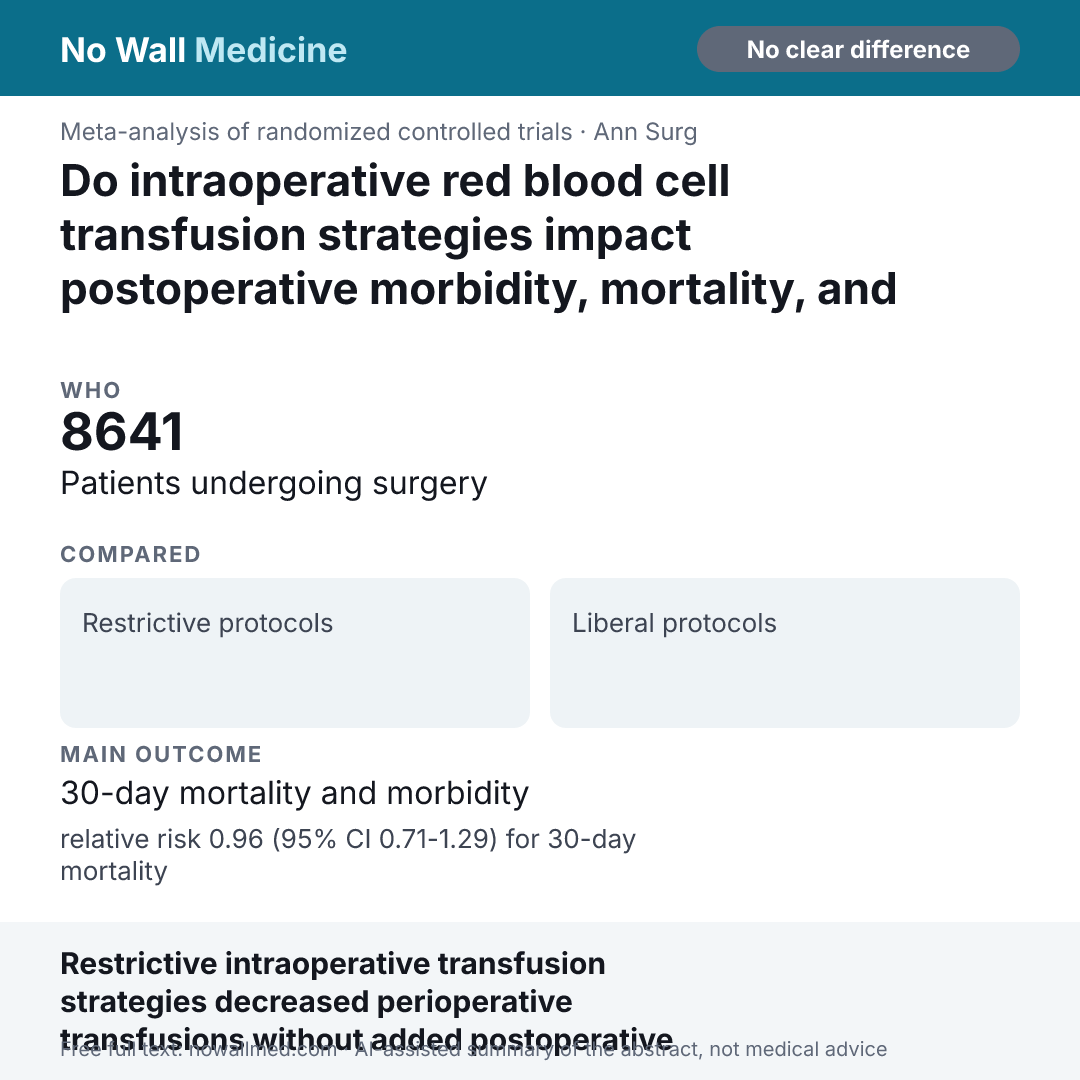
Clinical question: Do intraoperative red blood cell transfusion strategies impact postoperative morbidity, mortality, and blood use?
Why it matters: Evidence-based recommendations for guiding red blood cell transfusion during surgery are limited due to widespread variability in practice.
Key points
- Researchers analyzed 14 randomized controlled trials involving 8641 patients to compare restrictive and liberal red blood cell transfusion strategies.
- Restrictive protocols were associated with significantly lower intraoperative (RR 0.53, 95% CI 0.43-0.64) and perioperative (RR 0.70, 95% CI 0.62-0.79) blood transfusions.
- There was no difference in 30-day mortality (RR 0.96, 95% CI 0.71-1.29) or pooled postoperative morbidity between the two strategies.
Limitation the authors note: The authors noted uncertainty regarding the safety of broad application due to trial design and generalizability limitations.
Headline and key points written with AI from the paper’s abstract, with every number checked against it. Read the paper before relying on them.
Was this summary helpful?
Subject terms
Headline, design, result, key points, caveat and citation as plain text.
Cite this article
Lenet T, Baker L, Park L, et al. A Systematic Review and Meta-analysis of Randomized Controlled Trials Comparing Intraoperative Red Blood Cell Transfusion Strategies. Ann Surg. 2021. doi:10.1097/SLA.0000000000004931
Spotted a mistake? Suggest a correction