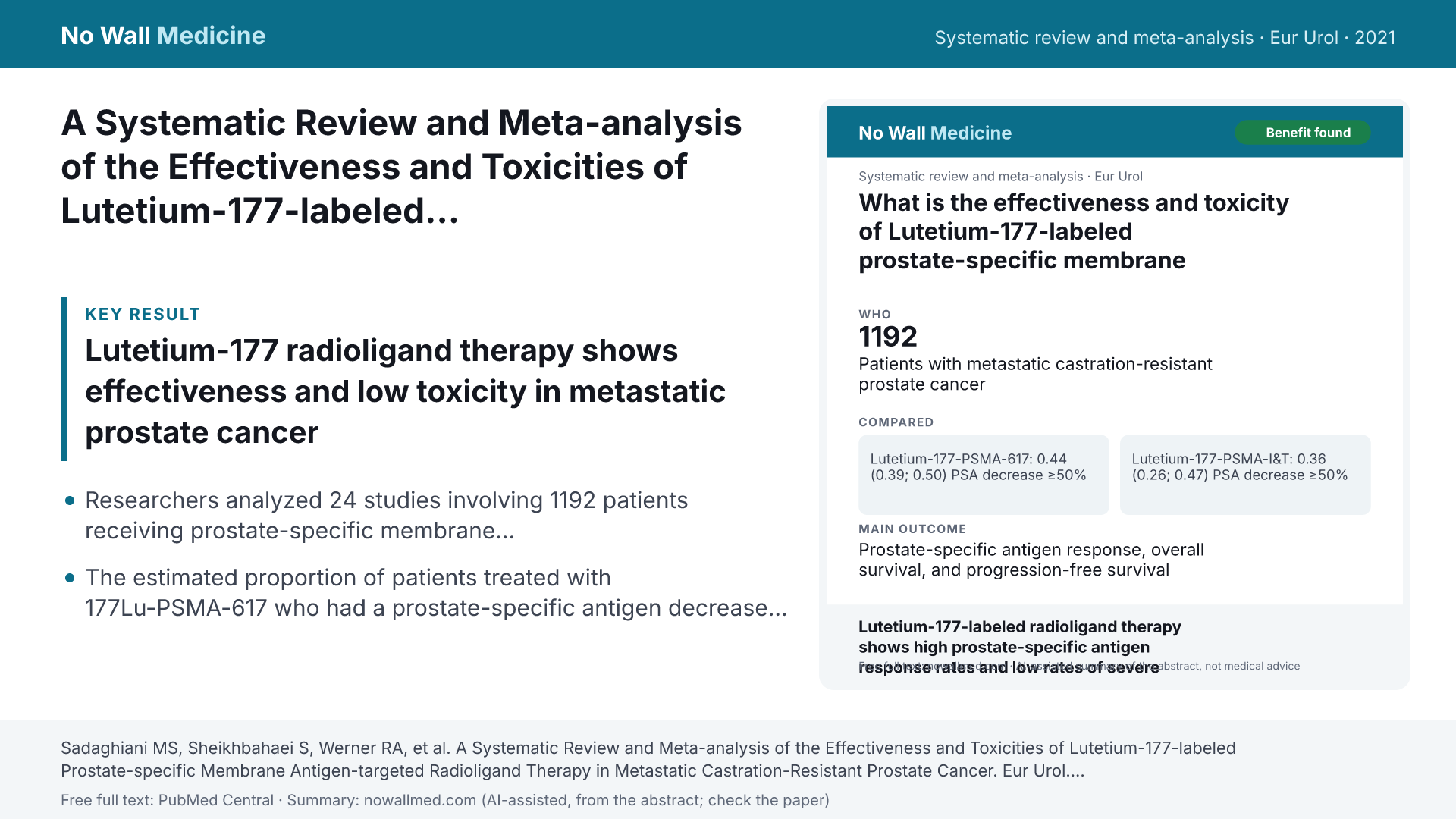
A Systematic Review and Meta-analysis of the Effectiveness and Toxicities of Lutetium-177-labeled Prostate-specific Membrane Antigen-targeted Radioligand Therapy in Metastatic Castration-Resistant Prostate Cancer
Key result: Lutetium-177 radioligand therapy shows effectiveness and low toxicity in metastatic prostate cancer
Key points
- Researchers analyzed 24 studies involving 1192 patients receiving prostate-specific membrane antigen-targeted radioligand therapy for metastatic castration-resistant prostate cancer.
- The estimated proportion of patients treated with 177Lu-PSMA-617 who had a prostate-specific antigen decrease of ≥50% was 0.44 (0.39; 0.50).
- Severe grade 3 and 4 toxicities were uncommon, with estimated proportions ranging from 0.01 (0.00; 0.04) for nausea to 0.08 (0.05; 0.12) for anemia.
Why it matters: The effectiveness and toxicity profiles of different lutetium-177-labeled prostate-specific membrane antigen-targeted radioligand therapies were not fully synthesized.
Limitation the authors note: There was considerable heterogeneity among the studies in the any-grade toxicity groups.
Discussion prompts
- Would these patients look like yours? Who was left out?
- Is the main outcome one that matters to patients?
- Is the difference large enough to change what you do?
Cite: Sadaghiani MS, Sheikhbahaei S, Werner RA, et al. A Systematic Review and Meta-analysis of the Effectiveness and Toxicities of Lutetium-177-labeled Prostate-specific Membrane Antigen-targeted Radioligand Therapy in Metastatic Castration-Resistant Prostate Cancer. Eur Urol. 2021;80(1):82-94. doi:10.1016/j.eururo.2021.03.004
Free full text: PubMed Central · Summary and visual abstract: nowallmed.com/a/a-systematic-review-and-meta-analysis-of-the-effectiveness-and-107a29r/ (AI-assisted from the abstract; check the paper before relying on it).