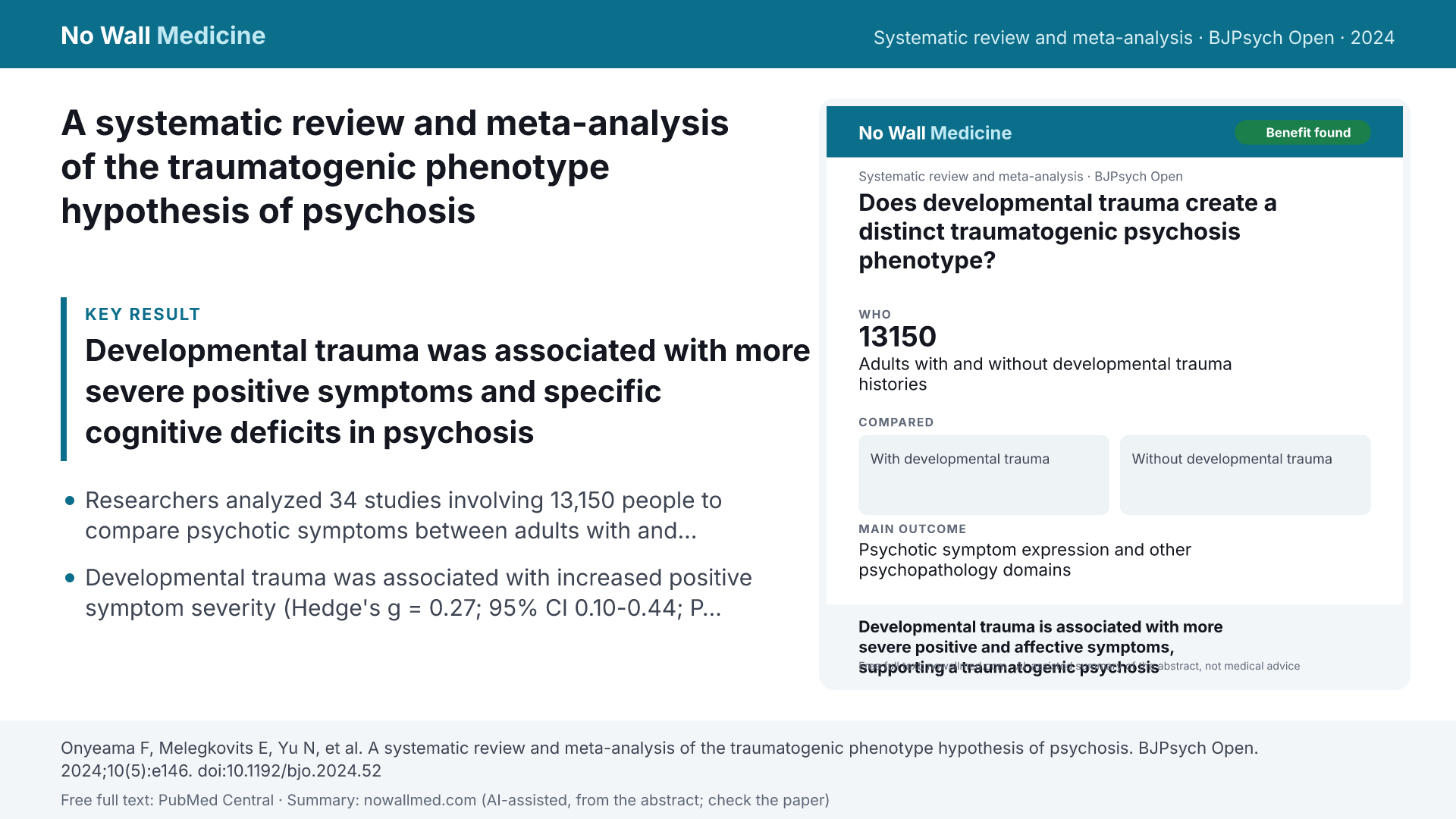
Developmental trauma was associated with more severe positive symptoms and specific cognitive deficits in psychosis
A systematic review and meta-analysis of the traumatogenic phenotype hypothesis of psychosis
Systematic review and meta-analysisBenefit found
Does developmental trauma create a distinct traumatogenic psychosis phenotype?
Who
13150
Adults with and without developmental trauma histories
Compared
With developmental trauma
Without developmental trauma
Main outcome
Psychotic symptom expression and other psychopathology domains
Result: positive symptoms Hedge's g = 0.27 (95% CI 0.10-0.44)
Bottom line: Developmental trauma is associated with more severe positive and affective symptoms, supporting a traumatogenic psychosis phenotype.
Limitation: Underdiagnosis of post-traumatic stress disorder may also explain some findings.
BJPsych Open · 2024-08-09 · Save PNG

Clinical question: Does developmental trauma create a distinct traumatogenic psychosis phenotype?
Key points
- Researchers analyzed 34 studies involving 13,150 people to compare psychotic symptoms between adults with and without histories of developmental trauma.
- Developmental trauma was associated with increased positive symptom severity (Hedge's g = 0.27; 95% CI 0.10-0.44; P = 0.002) but not negative symptoms (Hedge's g = 0.13; 95% CI -0.04 to 0.30; P = 0.14).
- Trauma history was linked to greater executive function deficits, poorer affect regulation, dissociation, and social cognition, as well as symptoms related to traumatic memories.
Headline and key points written with AI from the paper’s abstract, with every number checked against it. Read the paper before relying on them.
Was this summary helpful?
Headline, design, result, key points, caveat and citation as plain text.
Cite this article
Onyeama F, Melegkovits E, Yu N, et al. A systematic review and meta-analysis of the traumatogenic phenotype hypothesis of psychosis. BJPsych Open. 2024;10(5):e146. doi:10.1192/bjo.2024.52
Spotted a mistake? Suggest a correction