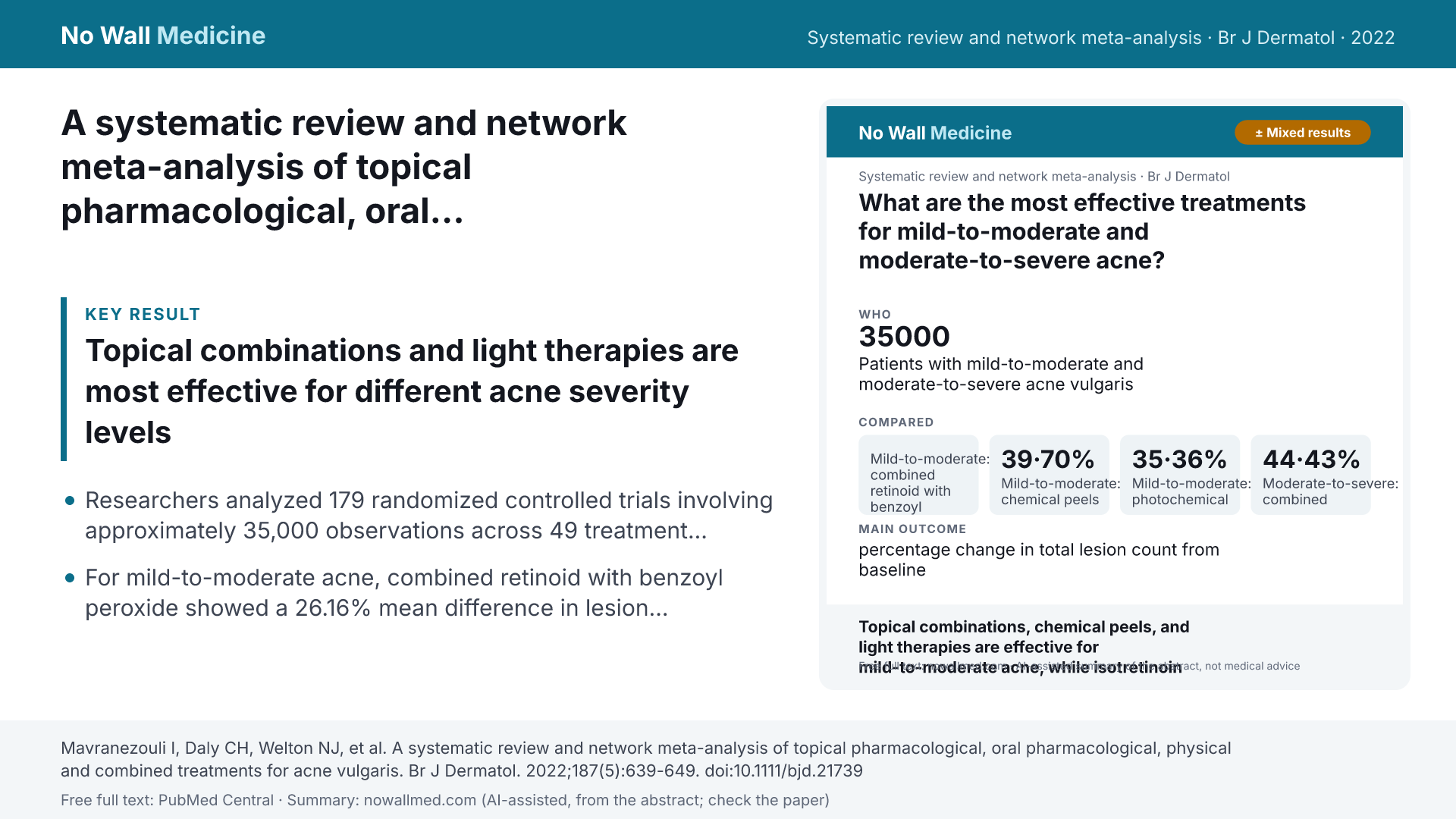
Topical combinations and light therapies are most effective for different acne severity levels
A systematic review and network meta-analysis of topical pharmacological, oral pharmacological, physical and combined treatments for acne vulgaris
Systematic review and network meta-analysisMixed results
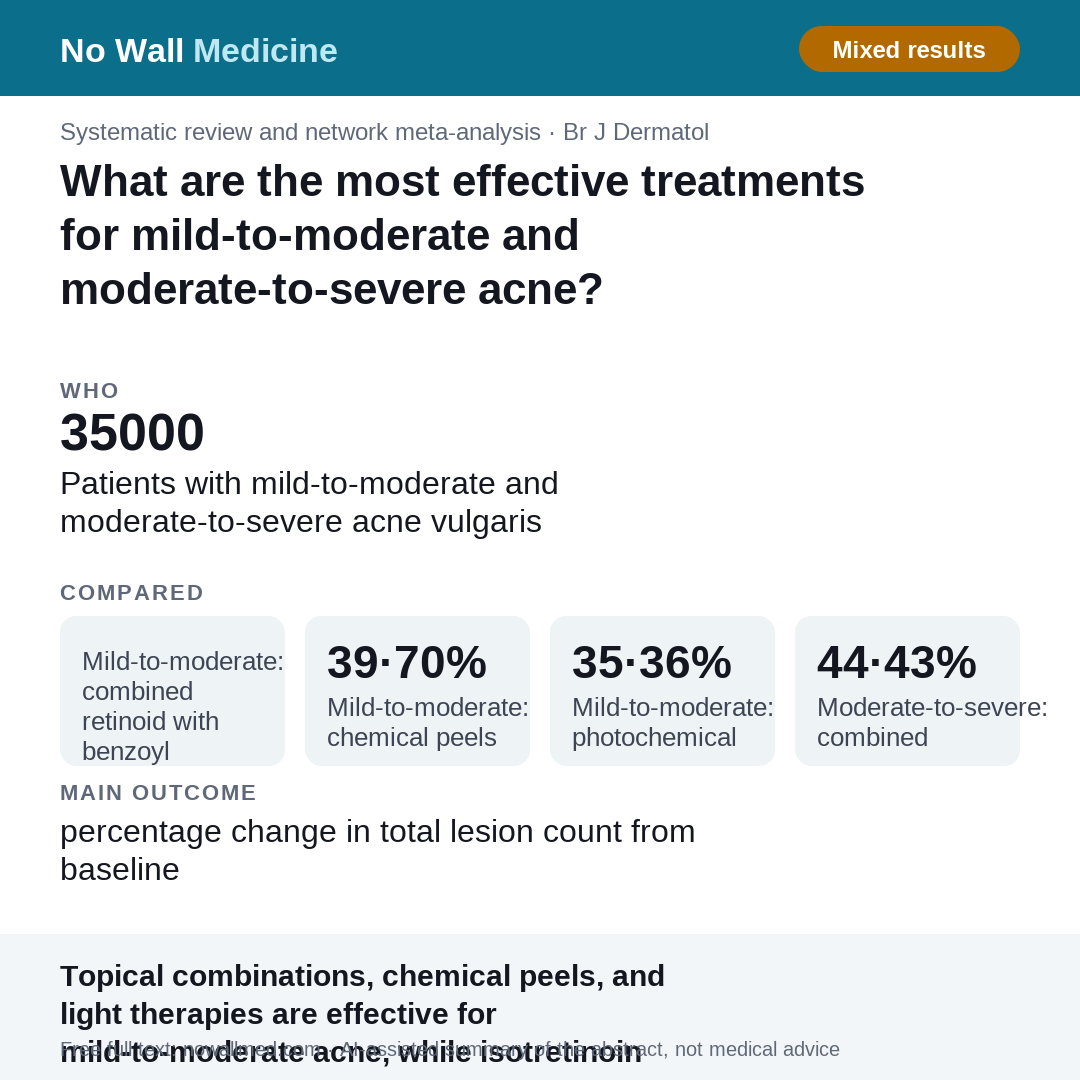
What are the most effective treatments for mild-to-moderate and moderate-to-severe acne?
Who
35000
Patients with mild-to-moderate and moderate-to-severe acne vulgaris
Compared
Mild-to-moderate: combined retinoid with benzoyl peroxide: mean difference 26·16%
39·70%Mild-to-moderate: chemical peels
35·36%Mild-to-moderate: photochemical therapy
44·43%Moderate-to-severe: combined retinoid with lincosamide
Main outcome
percentage change in total lesion count from baseline
Bottom line: Topical combinations, chemical peels, and light therapies are effective for mild-to-moderate acne, while isotretinoin and photodynamic therapy suit moderate-to-severe cases.
Limitation: Quality of included randomized controlled trials was moderate to very low with high uncertainty in findings.
Br J Dermatol · 2022-08-22Download image
Clinical question: What are the most effective treatments for mild-to-moderate and moderate-to-severe acne?
Key points
- Researchers analyzed 179 randomized controlled trials involving approximately 35,000 observations across 49 treatment classes for acne.
- For mild-to-moderate acne, combined retinoid with benzoyl peroxide showed a 26.16% mean difference in lesion reduction compared to placebo.
- For moderate-to-severe acne, oral isotretinoin with a cumulative dose of ≥ 120 mg kg-1 showed a 58.09% mean difference in lesion reduction.
Limitation the authors note: The quality of included randomized controlled trials was moderate to very low, and uncertainty in findings was high for chemical peels, photochemical therapy, and photodynamic therapy.
Headline and key points written with AI from the paper’s abstract, with every number checked against it. Read the paper before relying on them.
Was this summary helpful?
Subject terms
Cite this article
Mavranezouli I, Daly CH, Welton NJ, et al. A systematic review and network meta-analysis of topical pharmacological, oral pharmacological, physical and combined treatments for acne vulgaris. Br J Dermatol. 2022. doi:10.1111/bjd.21739
Spotted a mistake? Suggest a correction