A systematic review of antimicrobial susceptibility testing as a tool in clinical trials assessing antimicrobials against infections due to gram-negative pathogens
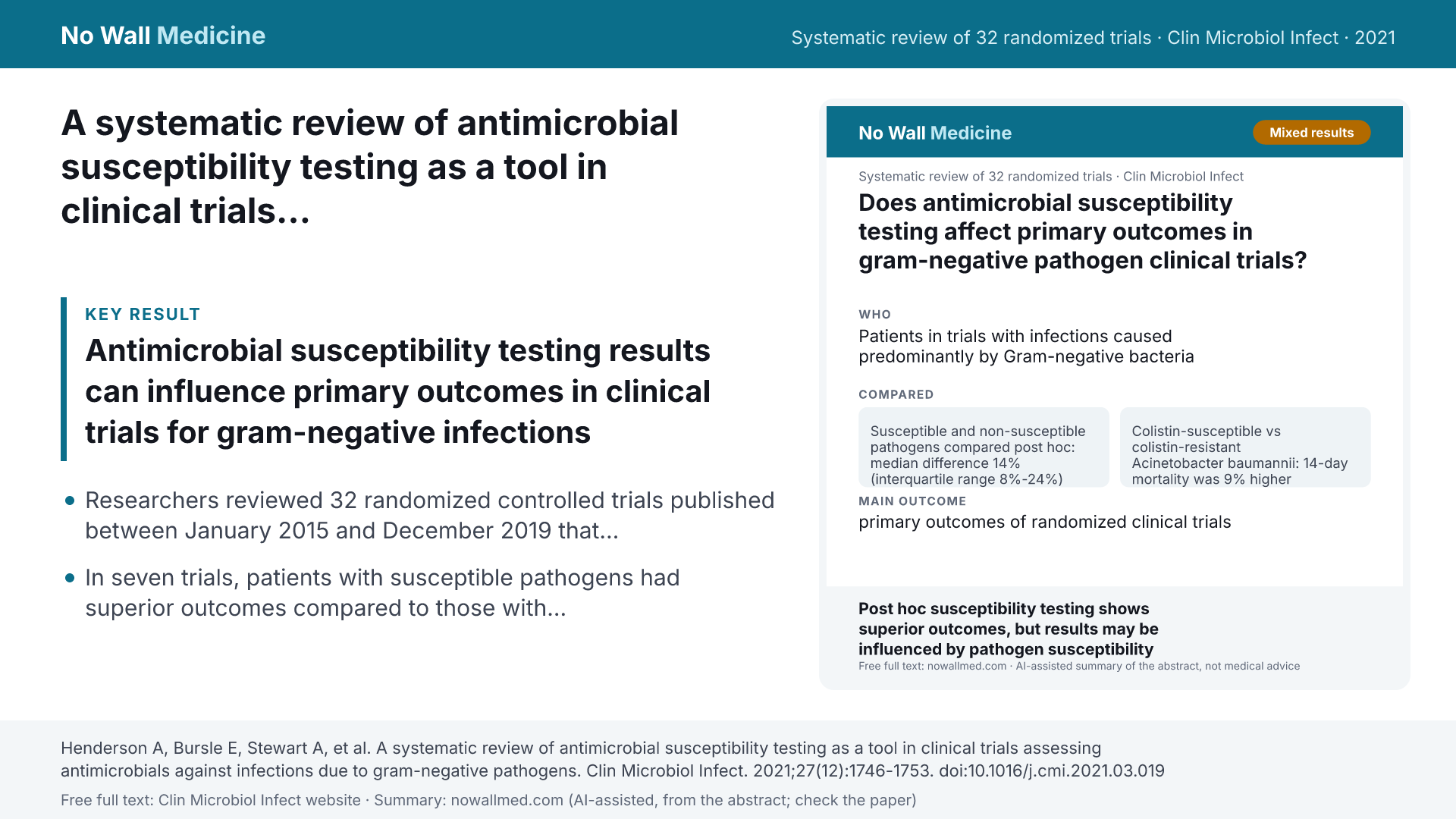
Key result: Antimicrobial susceptibility testing results can influence primary outcomes in clinical trials for gram-negative infections
Key points
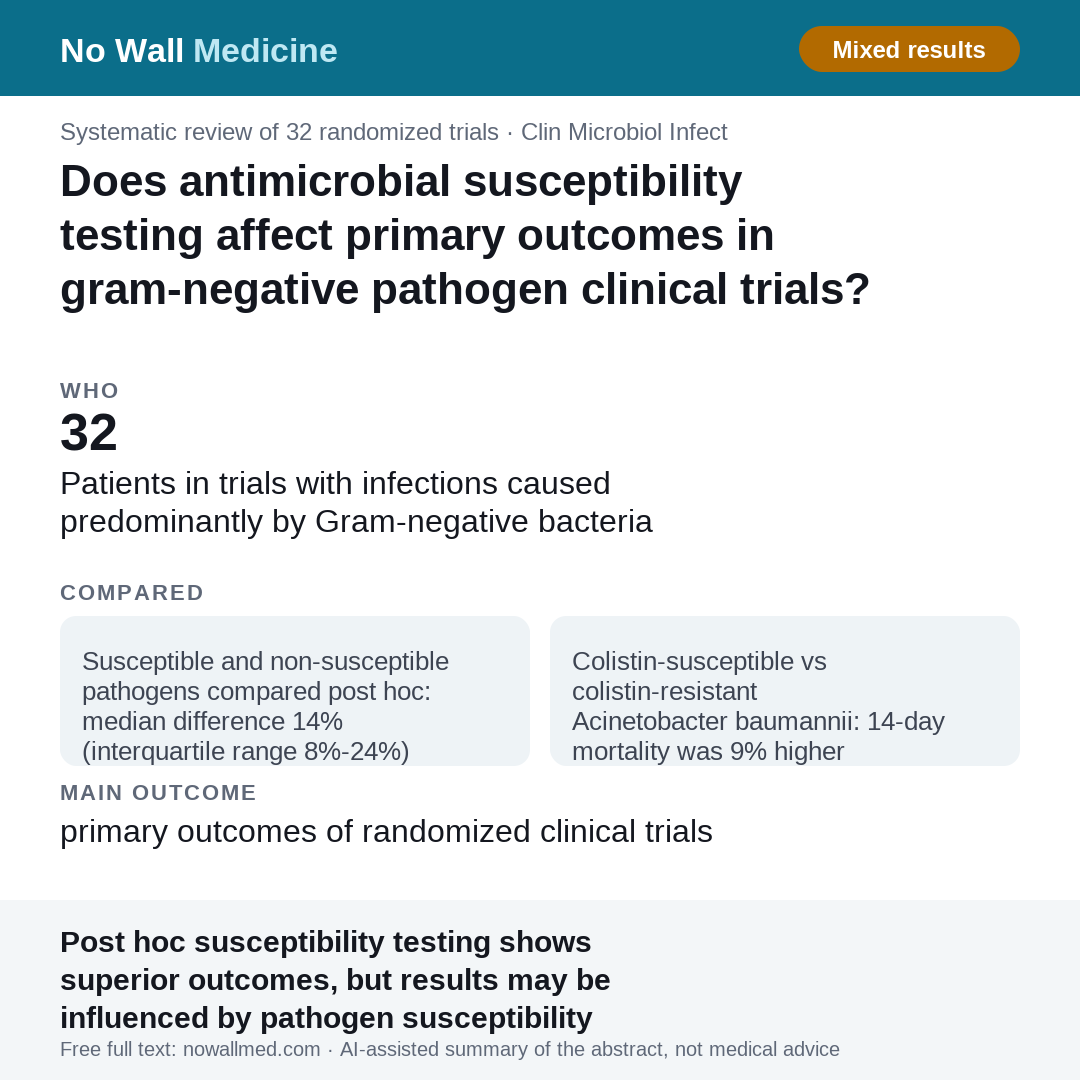
- Researchers reviewed 32 randomized controlled trials published between January 2015 and December 2019 that compared antibiotics for gram-negative bacterial infections.
- In seven trials, patients with susceptible pathogens had superior outcomes compared to those with non-susceptible pathogens, with a median difference of 14% (interquartile range 8%-24%).
- For colistin, 14-day mortality was 9% higher when patients were treated for colistin-susceptible versus colistin-resistant carbapenem-resistant Acinetobacter baumannii.
Why it matters: It is unknown how the timing and use of antimicrobial susceptibility testing, which measures how sensitive bacteria are to drugs, affects the primary outcomes of clinical trials.
Discussion prompts
- Would these patients look like yours? Who was left out?
- Is the main outcome one that matters to patients?
- Is the difference large enough to change what you do?
Cite: Henderson A, Bursle E, Stewart A, Harris PNA, Paterson D, Chatfield MD. A systematic review of antimicrobial susceptibility testing as a tool in clinical trials assessing antimicrobials against infections due to gram-negative pathogens. Clin Microbiol Infect. 2021. doi:10.1016/j.cmi.2021.03.019
Free full text: Clin Microbiol Infect website · Summary and visual abstract: nowallmed.com/a/a-systematic-review-of-antimicrobial-susceptibility-testing-as-a-tool-19ock9k/ (AI-assisted from the abstract; check the paper before relying on it).