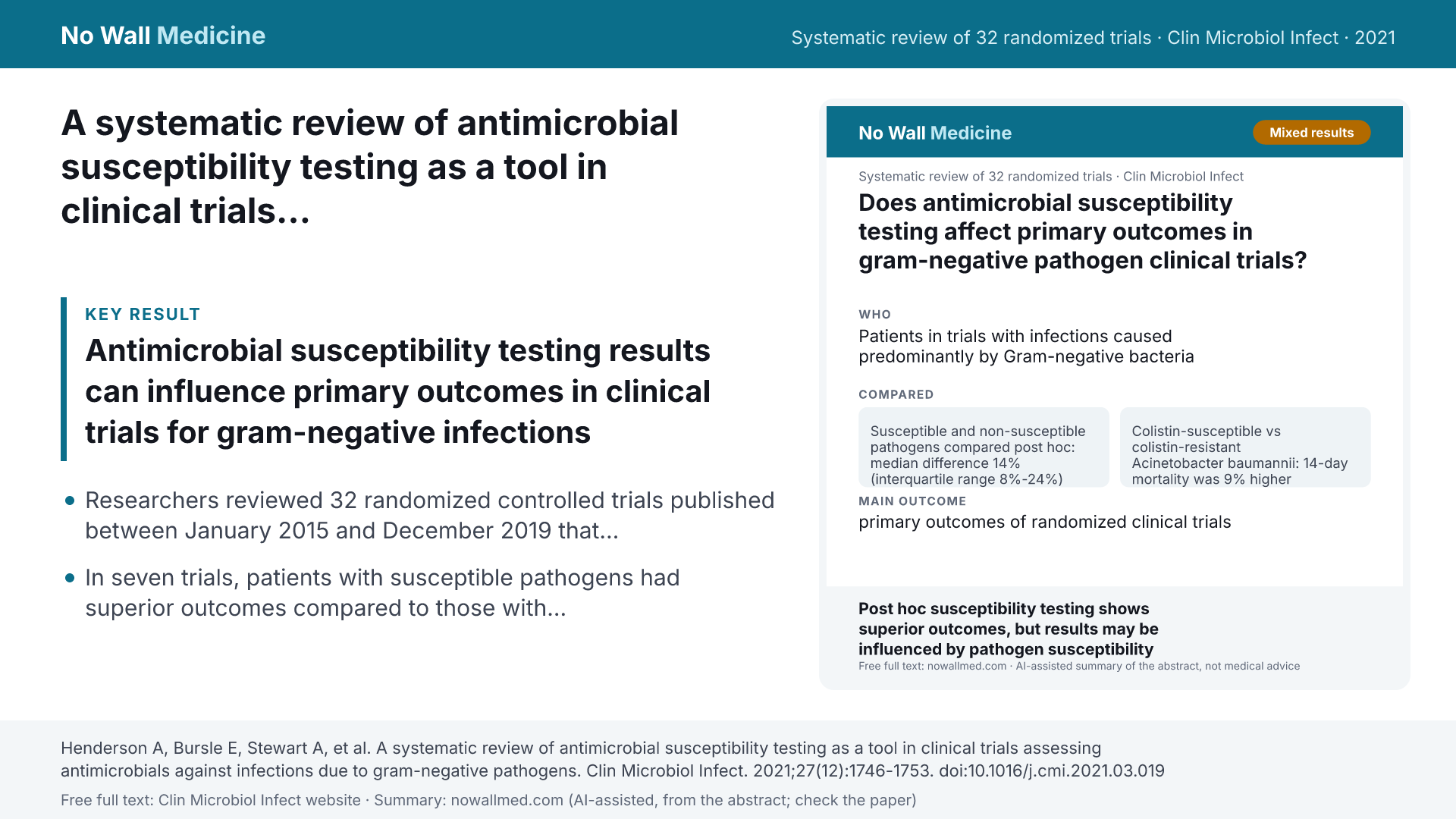
Antimicrobial susceptibility testing results can influence primary outcomes in clinical trials for gram-negative infections
A systematic review of antimicrobial susceptibility testing as a tool in clinical trials assessing antimicrobials against infections due to gram-negative pathogens
Systematic review of 32 randomized trialsMixed results
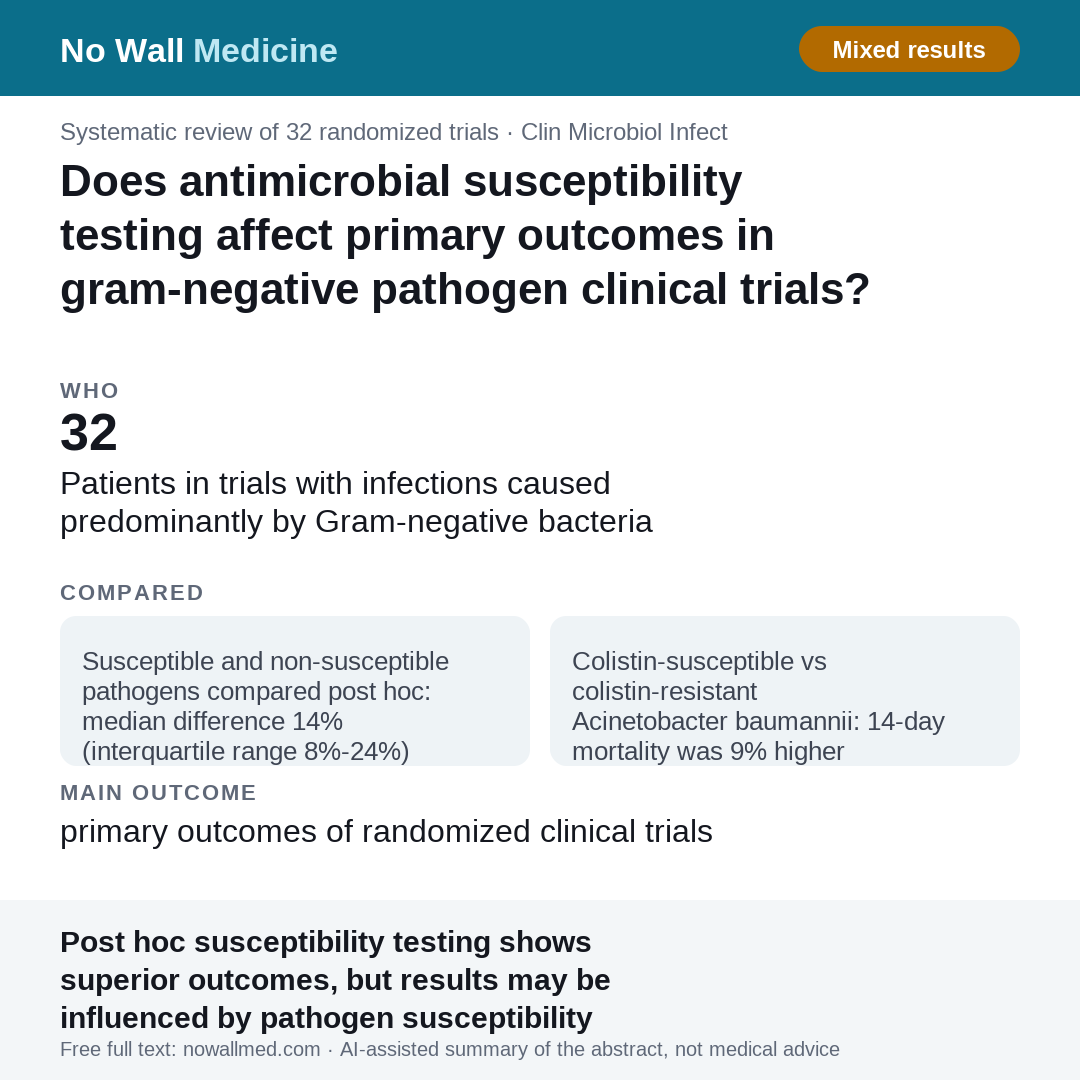
Does antimicrobial susceptibility testing affect primary outcomes in gram-negative pathogen clinical trials?
Who
32
Patients in trials with infections caused predominantly by Gram-negative bacteria
Compared
Susceptible and non-susceptible pathogens compared post hoc: median difference 14% (interquartile range 8%-24%)
Colistin-susceptible vs colistin-resistant Acinetobacter baumannii: 14-day mortality was 9% higher
Main outcome
primary outcomes of randomized clinical trials
Bottom line: Post hoc susceptibility testing shows superior outcomes, but results may be influenced by pathogen susceptibility status.
Clin Microbiol Infect · 2021-04-01Download image
Clinical question: Does antimicrobial susceptibility testing affect primary outcomes in gram-negative pathogen clinical trials?
Why it matters: It is unknown how the timing and use of antimicrobial susceptibility testing, which measures how sensitive bacteria are to drugs, affects the primary outcomes of clinical trials.
Key points
- Researchers reviewed 32 randomized controlled trials published between January 2015 and December 2019 that compared antibiotics for gram-negative bacterial infections.
- In seven trials, patients with susceptible pathogens had superior outcomes compared to those with non-susceptible pathogens, with a median difference of 14% (interquartile range 8%-24%).
- For colistin, 14-day mortality was 9% higher when patients were treated for colistin-susceptible versus colistin-resistant carbapenem-resistant Acinetobacter baumannii.
Headline and key points written with AI from the paper’s abstract, with every number checked against it. Read the paper before relying on them.
Was this summary helpful?
Subject terms
Cite this article
Henderson A, Bursle E, Stewart A, Harris PNA, Paterson D, Chatfield MD. A systematic review of antimicrobial susceptibility testing as a tool in clinical trials assessing antimicrobials against infections due to gram-negative pathogens. Clin Microbiol Infect. 2021. doi:10.1016/j.cmi.2021.03.019
Spotted a mistake? Suggest a correction