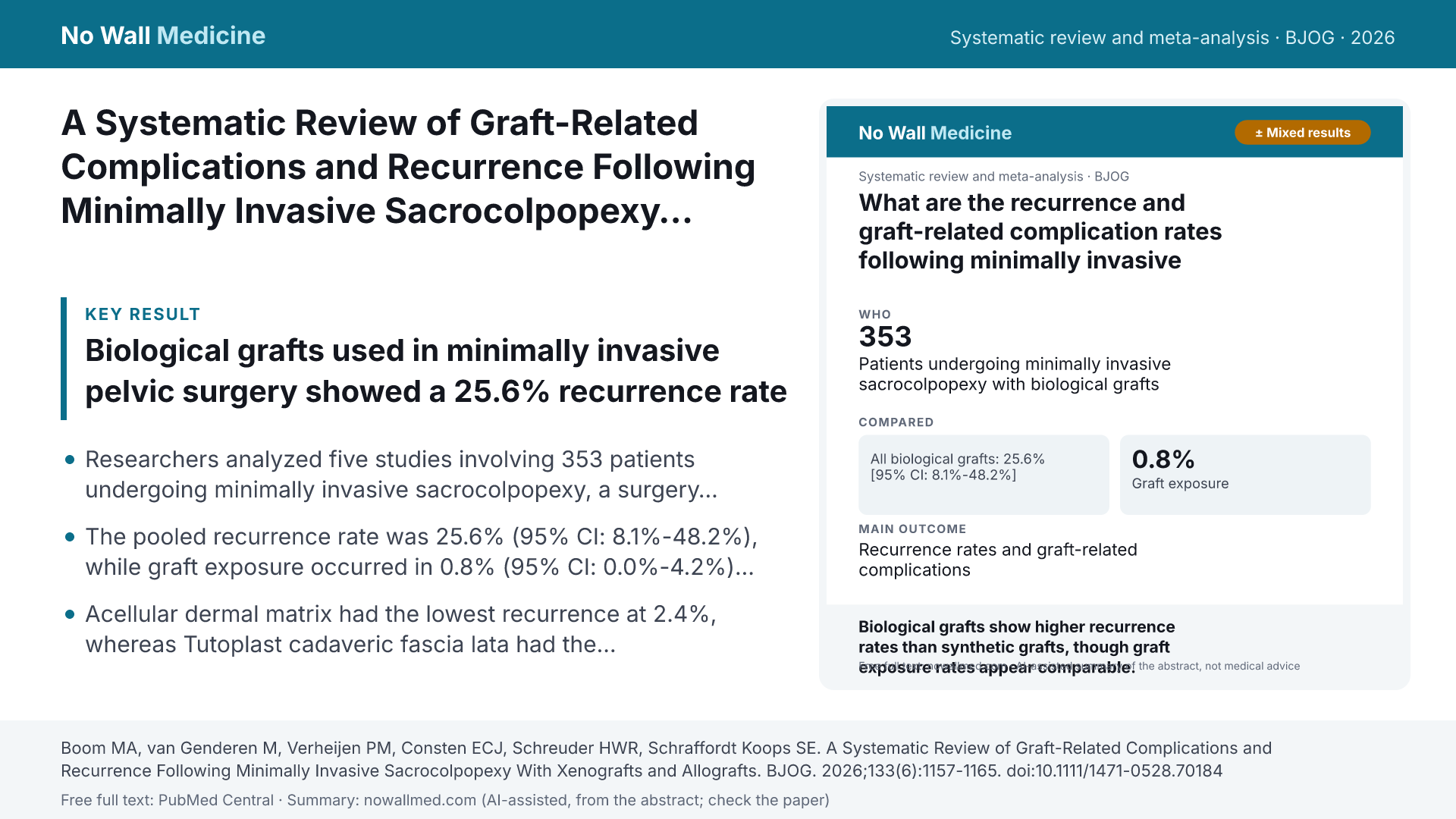
Biological grafts used in minimally invasive pelvic surgery showed a 25.6% recurrence rate
A Systematic Review of Graft-Related Complications and Recurrence Following Minimally Invasive Sacrocolpopexy With Xenografts and Allografts
Systematic review and meta-analysisMixed results
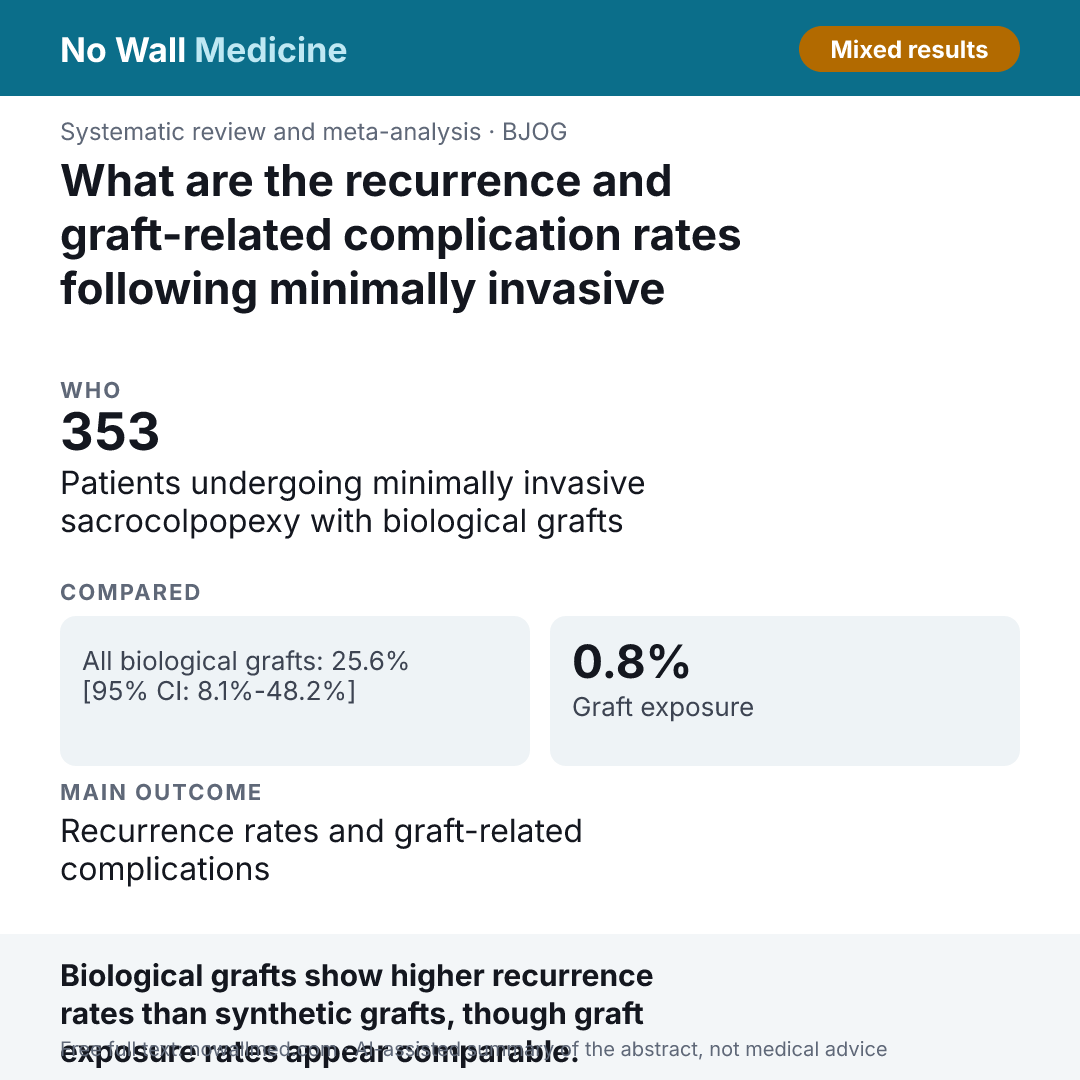
What are the recurrence and graft-related complication rates following minimally invasive sacrocolpopexy with biological grafts?
Who
353
Patients undergoing minimally invasive sacrocolpopexy with biological grafts
Compared
All biological grafts: 25.6% [95% CI: 8.1%-48.2%]
0.8%Graft exposure (95% CI: 0.0%-4.2%)
Main outcome
Recurrence rates and graft-related complications
Result: pooled recurrence 25.6% [95% CI: 8.1%-48.2%]
Bottom line: Biological grafts show higher recurrence rates than synthetic grafts, though graft exposure rates appear comparable.
Limitation: Given study heterogeneity, further research is required to determine the optimal graft choice.
BJOG · 2026-03-02 · Save PNG
Clinical question: What are the recurrence and graft-related complication rates following minimally invasive sacrocolpopexy with biological grafts?
Why it matters: Biological grafts are proposed as an alternative to synthetic materials to reduce complications, but concerns remain regarding their long-term durability.
Key points
- Researchers analyzed five studies involving 353 patients undergoing minimally invasive sacrocolpopexy, a surgery to repair pelvic organ prolapse, using biological grafts.
- The pooled recurrence rate was 25.6% (95% CI: 8.1%-48.2%), while graft exposure occurred in 0.8% (95% CI: 0.0%-4.2%) of cases.
- Acellular dermal matrix had the lowest recurrence at 2.4%, whereas Tutoplast cadaveric fascia lata had the highest recurrence at 52.6% and exposure at 5.3%.
Headline and key points written with AI from the paper’s abstract, with every number checked against it. Read the paper before relying on them.
Was this summary helpful?
Subject terms
Headline, design, result, key points, caveat and citation as plain text.
Cite this article
Boom MA, van Genderen M, Verheijen PM, Consten ECJ, Schreuder HWR, Schraffordt Koops SE. A Systematic Review of Graft-Related Complications and Recurrence Following Minimally Invasive Sacrocolpopexy With Xenografts and Allografts. BJOG. 2026;133(6):1157-1165. doi:10.1111/1471-0528.70184
Spotted a mistake? Suggest a correction