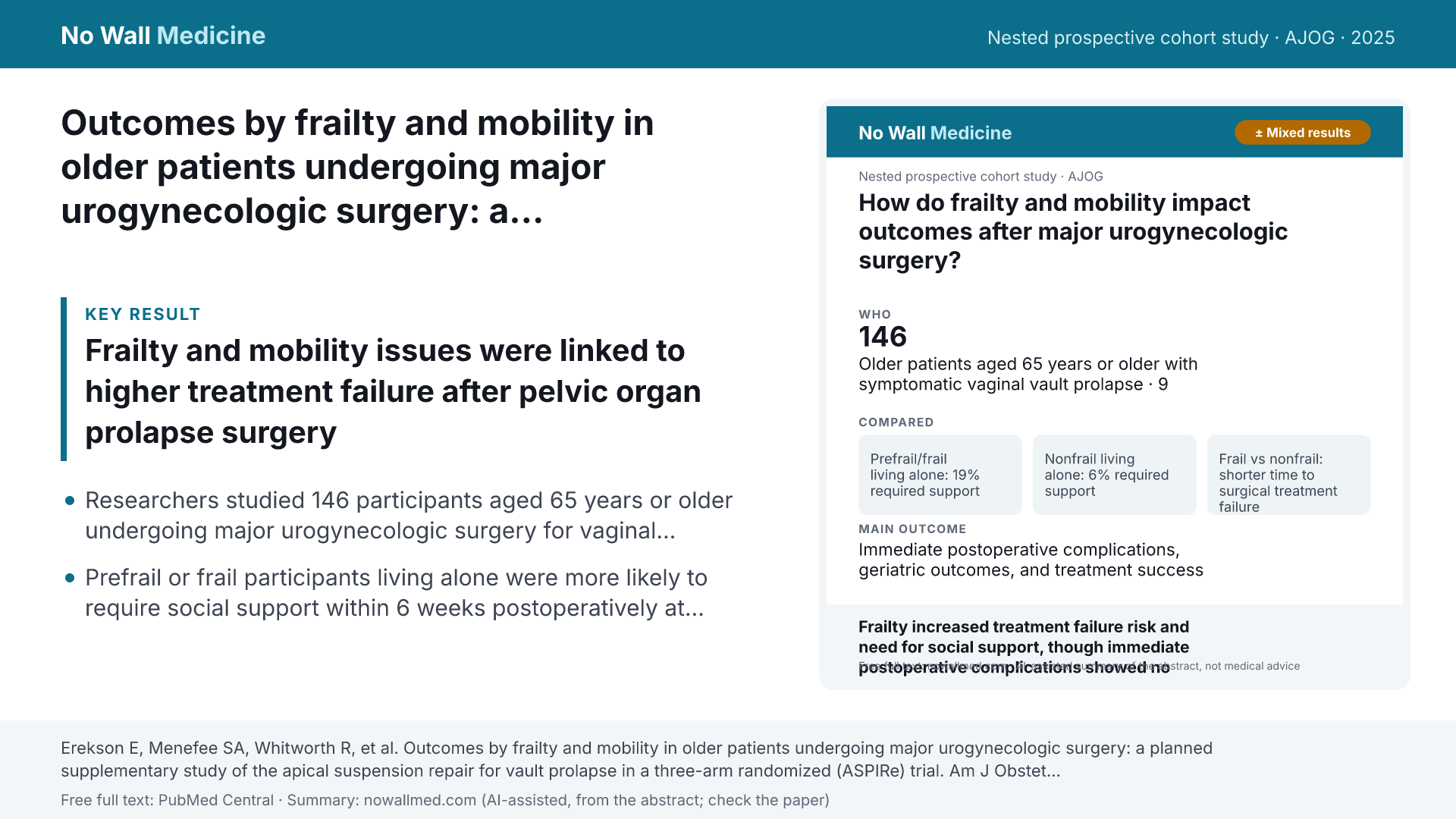
Frailty and mobility issues were linked to higher treatment failure after pelvic organ prolapse surgery
Outcomes by frailty and mobility in older patients undergoing major urogynecologic surgery: a planned supplementary study of the apical suspension repair for vault prolapse in a three-arm randomized (ASPIRe) trial
Nested prospective cohort studyMixed results
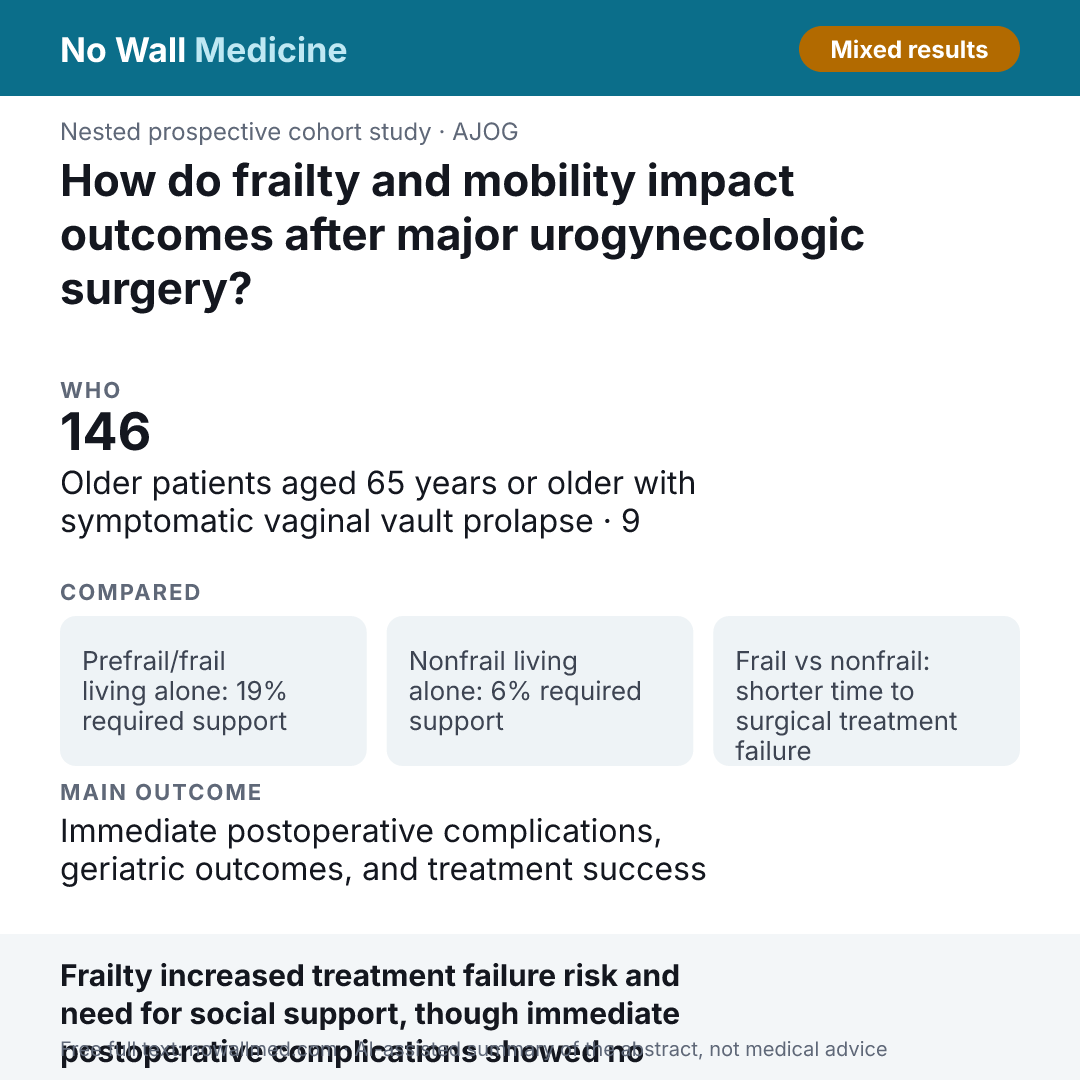
How do frailty and mobility impact outcomes after major urogynecologic surgery?
Who
146
Older patients aged 65 years or older with symptomatic vaginal vault prolapse · 9 clinical sites
Compared
Prefrail/frail living alone: 19% required support
Nonfrail living alone: 6% required support
Frail vs nonfrail: shorter time to surgical treatment failure
Main outcome
Immediate postoperative complications, geriatric outcomes, and treatment success
Result: adjusted hazard ratio 2.1 (95% confidence interval, 1.2, 3.6)
Bottom line: Frailty increased treatment failure risk and need for social support, though immediate postoperative complications showed no difference.
AJOG · 2025-11-08 · Save PNG
Clinical question: How do frailty and mobility impact outcomes after major urogynecologic surgery?
Key points
- Researchers studied 146 participants aged 65 years or older undergoing major urogynecologic surgery for vaginal vault prolapse.
- Prefrail or frail participants living alone were more likely to require social support within 6 weeks postoperatively at 19% compared to 6% for others.
- Frailty and compromised mobility were associated with a shorter time to surgical treatment failure, with an adjusted hazard ratio of 2.1.
Headline and key points written with AI from the paper’s abstract, with every number checked against it. Read the paper before relying on them.
Was this summary helpful?
Subject terms
Headline, design, result, key points, caveat and citation as plain text.
Cite this article
Erekson E, Menefee SA, Whitworth R, et al. Outcomes by frailty and mobility in older patients undergoing major urogynecologic surgery: a planned supplementary study of the apical suspension repair for vault prolapse in a three-arm randomized (ASPIRe) trial. Am J Obstet Gynecol. 2026;234(3):689-729. doi:10.1016/j.ajog.2025.11.002
Spotted a mistake? Suggest a correction