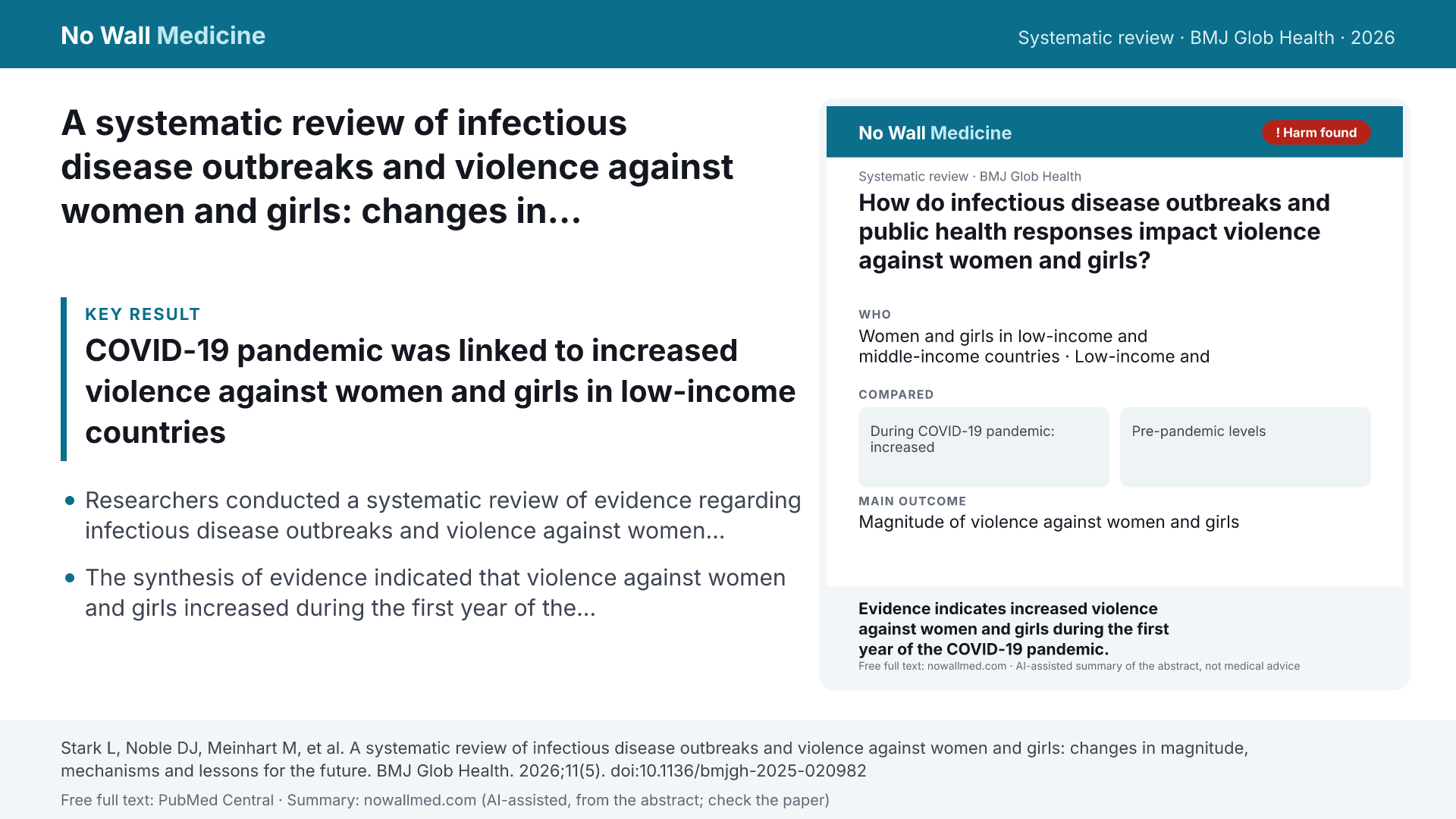
COVID-19 pandemic was linked to increased violence against women and girls in low-income countries
A systematic review of infectious disease outbreaks and violence against women and girls: changes in magnitude, mechanisms and lessons for the future
Systematic reviewHarm found
How do infectious disease outbreaks and public health responses impact violence against women and girls?
Who
Women and girls in low-income and middle-income countries · Low-income and middle-income countries
Compared
During COVID-19 pandemic: increased
Pre-pandemic levels
Main outcome
Magnitude of violence against women and girls
Bottom line: Evidence indicates increased violence against women and girls during the first year of the COVID-19 pandemic.
BMJ Glob Health · 2026-05-05 · Save PNG
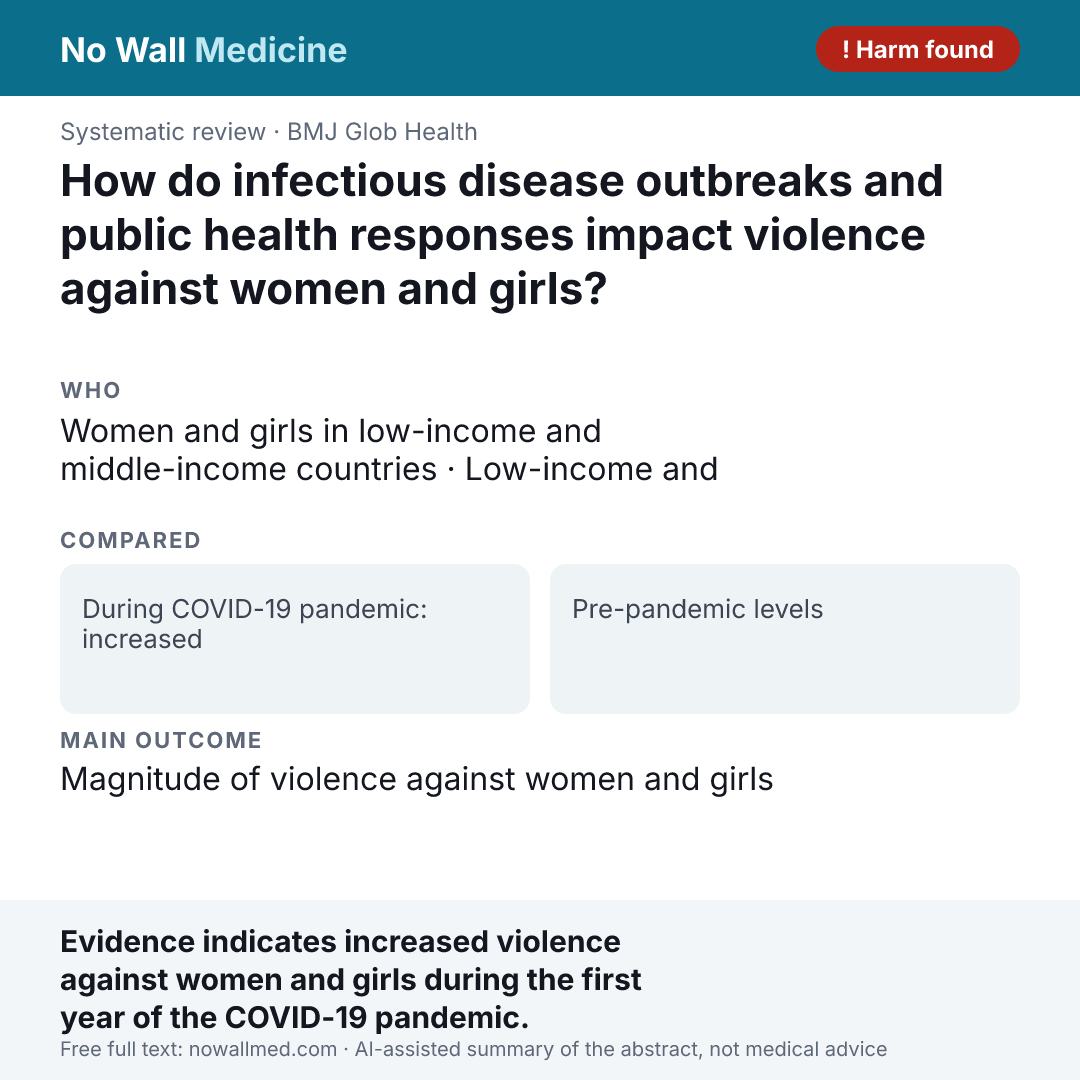
Clinical question: How do infectious disease outbreaks and public health responses impact violence against women and girls?
Why it matters: Public health responses to infectious disease outbreaks may impact risk factors for violence against women and girls.
Key points
- Researchers conducted a systematic review of evidence regarding infectious disease outbreaks and violence against women and girls in low-income and middle-income countries.
- The synthesis of evidence indicated that violence against women and girls increased during the first year of the COVID-19 pandemic compared to pre-pandemic levels.
- Five mechanisms were identified as drivers of violence, including income loss, movement restrictions, changes in service access, fear of disease, and mistrust in health systems.
Limitation the authors note: All quantitative evidence and almost all qualitative studies focused on the COVID-19 pandemic, and only three studies separated outcomes for women and girls.
Headline and key points written with AI from the paper’s abstract, with every number checked against it. Read the paper before relying on them.
Was this summary helpful?
Abstract
Infectious disease outbreaks (outbreaks) are increasing across the globe due to climate change, urbanisation and changes in land use, and many of their response measures impact risk factors for violence against women and girls (VAWG). We conducted a systematic review to consolidate existing evidence on the impact of any outbreaks, and their public health responses, on the change in magnitude of VAWG and mechanisms facilitating violence among women and girls in low-income and middle-income countries. Though our search strategy aimed to capture studies from any outbreak since 2014, all quantitative evidence on VAWG impacts, and all but one qualitative study, focused on the COVID-19 pandemic, and only three studies disaggregated outcomes for women versus girls. Overall, our synthesis of the evidence points to increased VAWG during the first year of the COVID-19 pandemic compared with pre-pandemic levels. We identified five broad mechanisms through which violence occurred against women and girls: (1) income loss due to economic shutdown, financial insecurity, and/or job loss, (2) movement restrictions, (3) changes in access to public services, (4) fear of exposure to infectious disease, and (5) a legacy of mistrust in health systems from previous outbreaks. Our study demonstrates the novelty of VAWG monitoring during outbreaks, the need for increased surveillance and the known mechanisms to date through which VAWG may be perpetrated during outbreaks. By implementing both short-term protective measures and long-term structural reforms, outbreak responses may not only break the cycle of VAWG exacerbated by public health emergencies but build resilient systems that protect women, girls and marginalised populations before, during and after crises.
Abstract reproduced under the article’s CC BY NC licence.
Subject terms
Headline, design, result, key points, caveat and citation as plain text.
Cite this article
Stark L, Noble DJ, Meinhart M, et al. A systematic review of infectious disease outbreaks and violence against women and girls: changes in magnitude, mechanisms and lessons for the future. BMJ Glob Health. 2026;11(5). doi:10.1136/bmjgh-2025-020982
Spotted a mistake? Suggest a correction