Extreme events and gender-based violence: a mixed-methods systematic review
Mixed-methods systematic reviewMixed results
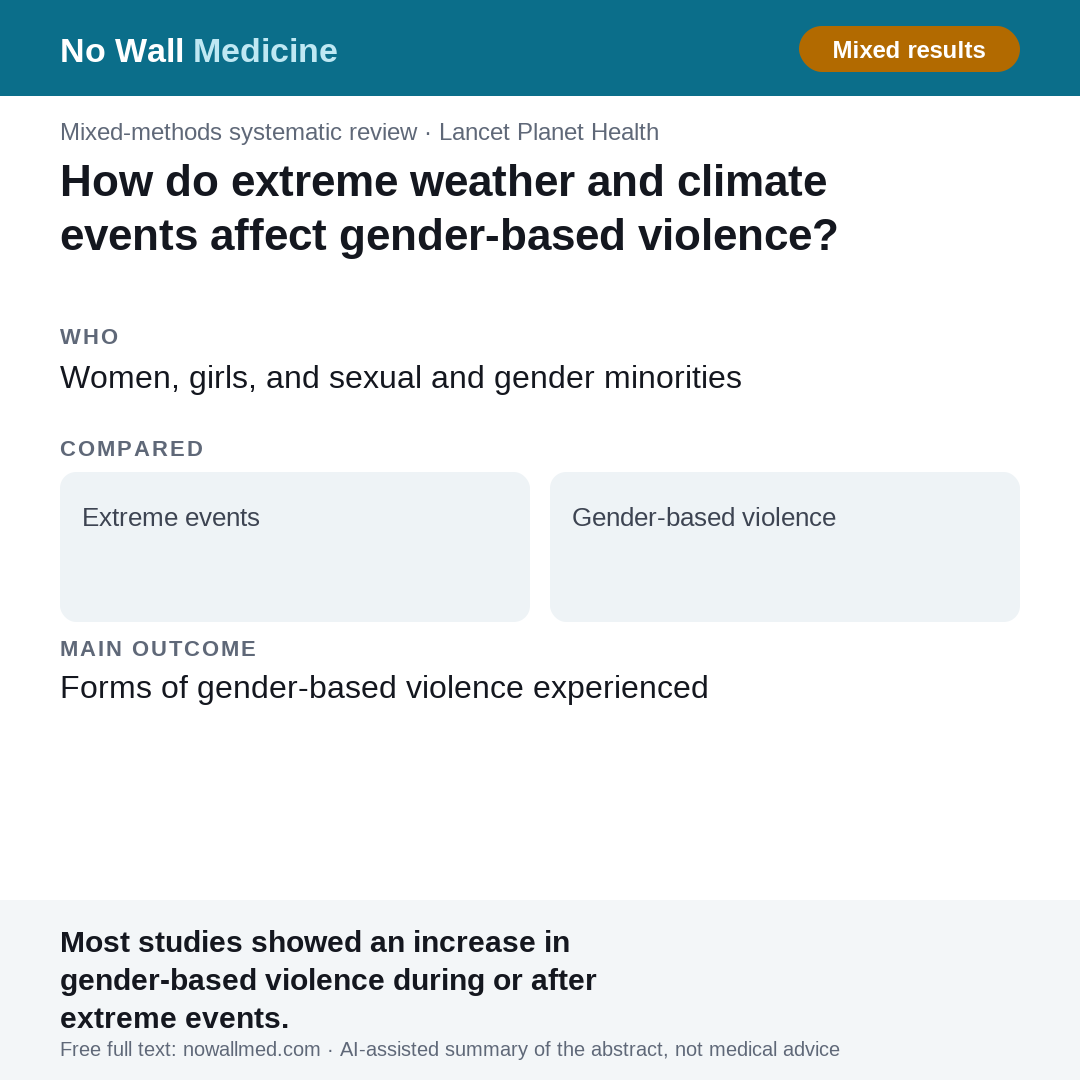
How do extreme weather and climate events affect gender-based violence?
Who
Women, girls, and sexual and gender minorities
Compared
Extreme events
Gender-based violence
Main outcome
Forms of gender-based violence experienced
Bottom line: Most studies showed an increase in gender-based violence during or after extreme events.
Lancet Planet Health · 2022-06-17Download image
Clinical question: How do extreme weather and climate events affect gender-based violence?
Abstract
The intensity and frequency of extreme weather and climate events are expected to increase due to anthropogenic climate change. This systematic review explores extreme events and their effect on gender-based violence (GBV) experienced by women, girls, and sexual and gender minorities. We searched ten databases until February, 2022. Grey literature was searched using the websites of key organisations working on GBV and Google. Quantitative studies were described narratively, whereas qualitative studies underwent thematic analysis. We identified 26 381 manuscripts. 41 studies were included exploring several types of extreme events (ie, storms, floods, droughts, heatwaves, and wildfires) and GBV (eg, sexual violence and harassment, physical violence, witch killing, early or forced marriage, and emotional violence). Studies were predominantly cross-sectional. Although most qualitative studies were of reasonable quality, most quantitative studies were of poor quality. Only one study included sexual and gender minorities. Most studies showed an increase in one or several GBV forms during or after extreme events, often related to economic instability, food insecurity, mental stress, disrupted infrastructure, increased exposure to men, tradition, and exacerbated gender inequality. These findings could have important implications for sexual-transformative and gender-transformative interventions, policies, and implementation. High-quality evidence from large, ethnographically diverse cohorts is essential to explore the effects and driving factors of GBV during and after extreme events.
Abstract reproduced under the article’s CC BY licence.
Subject terms
Cite this article
van Daalen KR, Kallesøe SS, Davey F, Dada S, Jung L, Singh L. Extreme events and gender-based violence: a mixed-methods systematic review. Lancet Planet Health. 2022. doi:10.1016/S2542-5196(22)00088-2
Spotted a mistake? Suggest a correction
Top studies every Monday
The week’s key trials and guidelines in your specialties, plus any topics you follow. By email, free.
Get the weekly digest