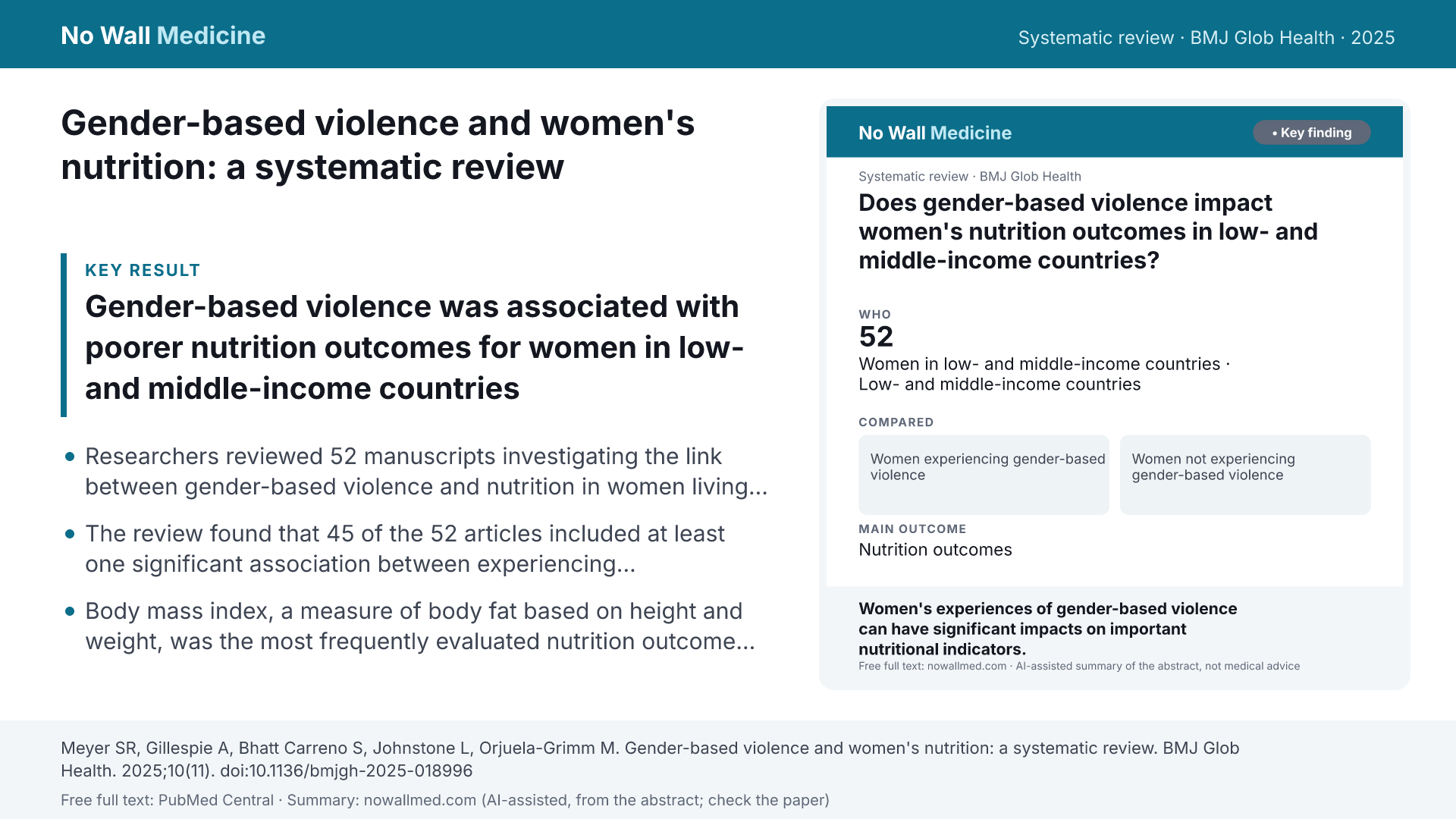
Gender-based violence was associated with poorer nutrition outcomes for women in low- and middle-income countries
Gender-based violence and women's nutrition: a systematic review
Systematic reviewKey finding
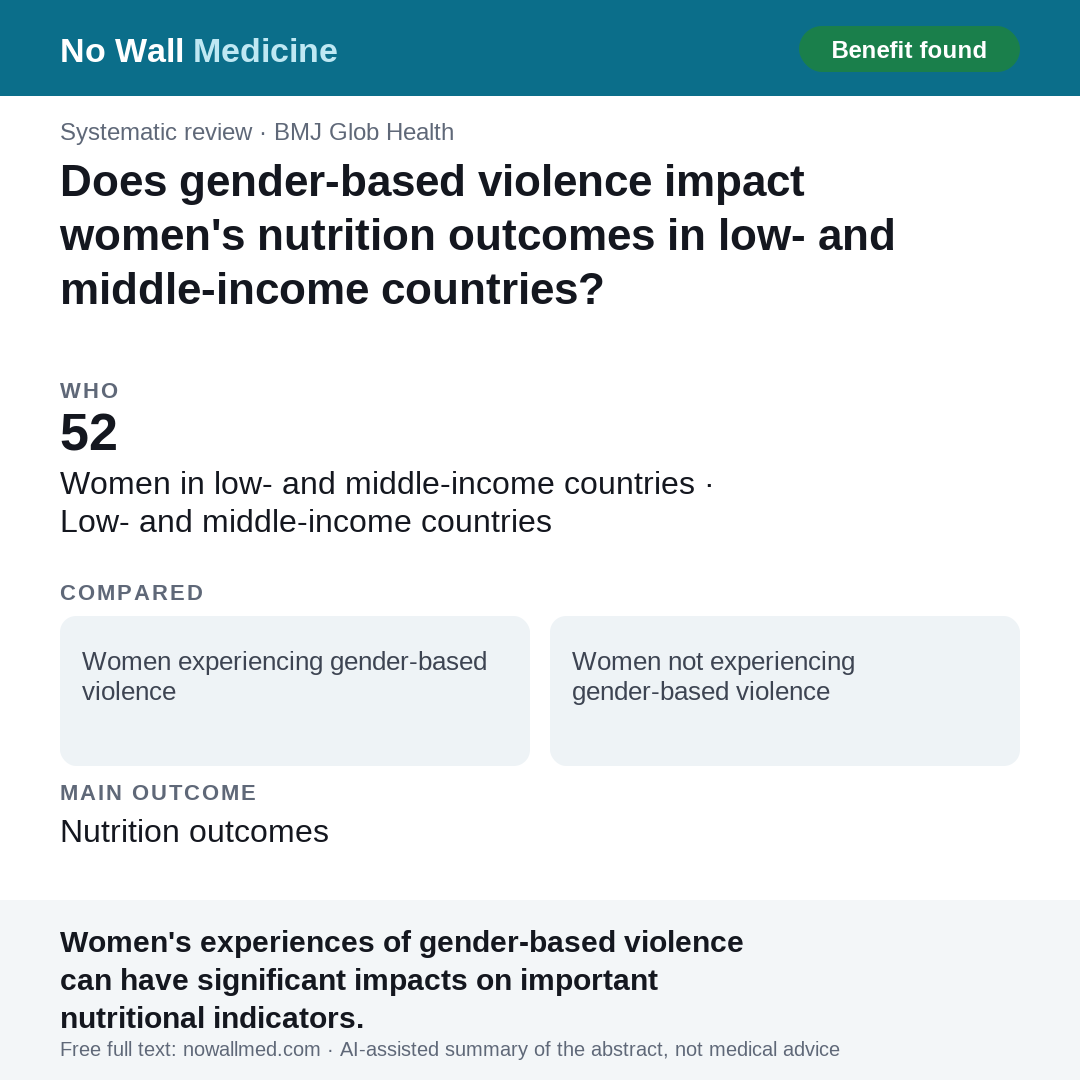
Does gender-based violence impact women's nutrition outcomes in low- and middle-income countries?
Who
52
Women in low- and middle-income countries · Low- and middle-income countries
Compared
Women experiencing gender-based violence
Women not experiencing gender-based violence
Main outcome
Nutrition outcomes
Bottom line: Women's experiences of gender-based violence can have significant impacts on important nutritional indicators.
Limitation: Sparse consideration of role and need for study designs enabling understanding of causal mechanisms.
BMJ Glob Health · 2025-11-19Download image
Clinical question: Does gender-based violence impact women's nutrition outcomes in low- and middle-income countries?
Why it matters: Current evidence syntheses do not focus on how gender-based violence affects women's nutrition outcomes in low- and middle-income countries.
Key points
- Researchers reviewed 52 manuscripts investigating the link between gender-based violence and nutrition in women living in low- and middle-income countries.
- The review found that 45 of the 52 articles included at least one significant association between experiencing gender-based violence and poorer nutrition outcomes.
- Body mass index, a measure of body fat based on height and weight, was the most frequently evaluated nutrition outcome in the included studies.
Headline and key points written with AI from the paper’s abstract, with every number checked against it. Read the paper before relying on them.
Was this summary helpful?
Abstract
Introduction
Women's nutrition is vital to their health and well-being. Among many factors influencing women's nutrition in low- and middle-income countries (LMICs), gender-based violence (GBV) may result in poorer nutrition outcomes. Current evidence syntheses do not focus on GBV and women's nutrition outcomes. We conducted a systematic review of quantitative evidence on women's experience of GBV and their nutrition outcomes in LMICs. Methods
We conducted a structured search of six databases to identify manuscripts meeting inclusion criteria. Following the title and abstract and full-text review, we piloted and refined a data extraction template that included variables such as study design, research question, type(s) of GBV and nutrition indicators included in the study. Results
Of the 52 manuscripts that met inclusion criteria, approximately 92.5% (n=48) had a cross-sectional study design, four manuscripts had longitudinal prospective cohort study designs. 44.2% (n=23) of the included manuscripts used secondary data from Demographic and Health Surveys specifically, while 40.4% (n=21) of the manuscripts used primary data collection methods in their analyses. Around half (n=27) of the included manuscripts looked at intimate partner violence as the violence exposure, and approximately 28.8% (n=15) of the included papers looked at child/early/forced marriage as the violence exposure. The most frequently evaluated outcome measure was body mass index, which was used in the majority of the included publications (n=32). A total of 45 of the 52 articles included at least one significant association between women's experience of GBV and poorer nutrition outcomes. Conclusion
Consideration of the role of GBV in influencing women's nutrition outcomes in LMIC settings is sparse; however, this review indicates that women's experiences of GBV can have significant impacts on important nutritional indicators. Further research with a wider range of nutrition outcomes and study designs that enable understanding of causal mechanisms is warranted. Prospero registration number
CRD42023402727.
Abstract reproduced under the article’s CC BY NC licence.
Subject terms
Headline, design, result, key points, caveat and citation as plain text.
Cite this article
Meyer SR, Gillespie A, Bhatt Carreno S, Johnstone L, Orjuela-Grimm M. Gender-based violence and women's nutrition: a systematic review. BMJ Glob Health. 2025. doi:10.1136/bmjgh-2025-018996
Spotted a mistake? Suggest a correction