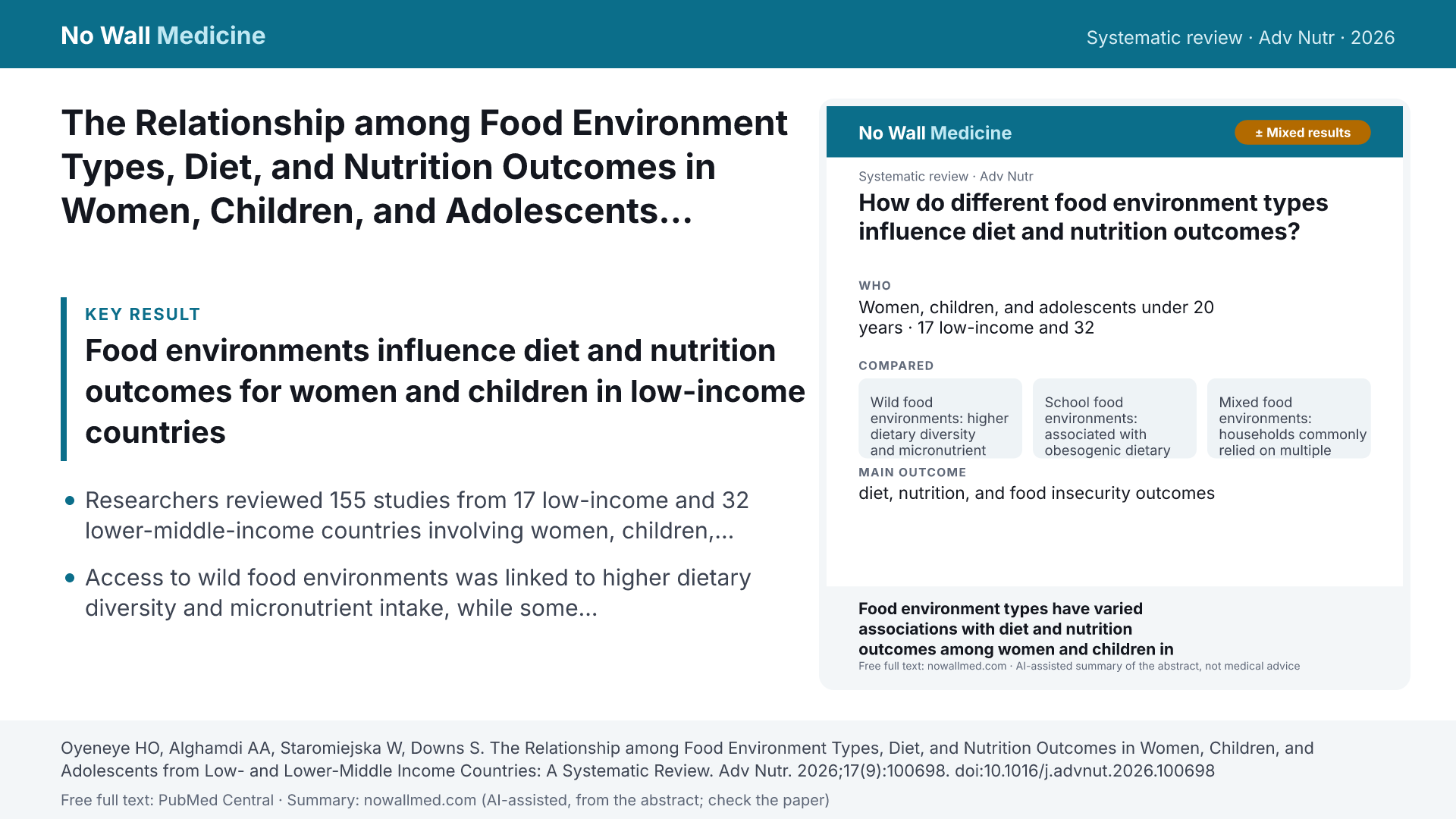
Food environments influence diet and nutrition outcomes for women and children in low-income countries
The Relationship among Food Environment Types, Diet, and Nutrition Outcomes in Women, Children, and Adolescents from Low- and Lower-Middle Income Countries: A Systematic Review
Systematic reviewMixed results
How do different food environment types influence diet and nutrition outcomes?
Who
Women, children, and adolescents under 20 years · 17 low-income and 32 lower-middle-income countries
Compared
Wild food environments: higher dietary diversity and micronutrient intake
School food environments: associated with obesogenic dietary patterns
Mixed food environments: households commonly relied on multiple food sources
Main outcome
diet, nutrition, and food insecurity outcomes
Bottom line: Food environment types have varied associations with diet and nutrition outcomes among women and children in low-income countries.
Adv Nutr · 2026-07-04 · Save PNG
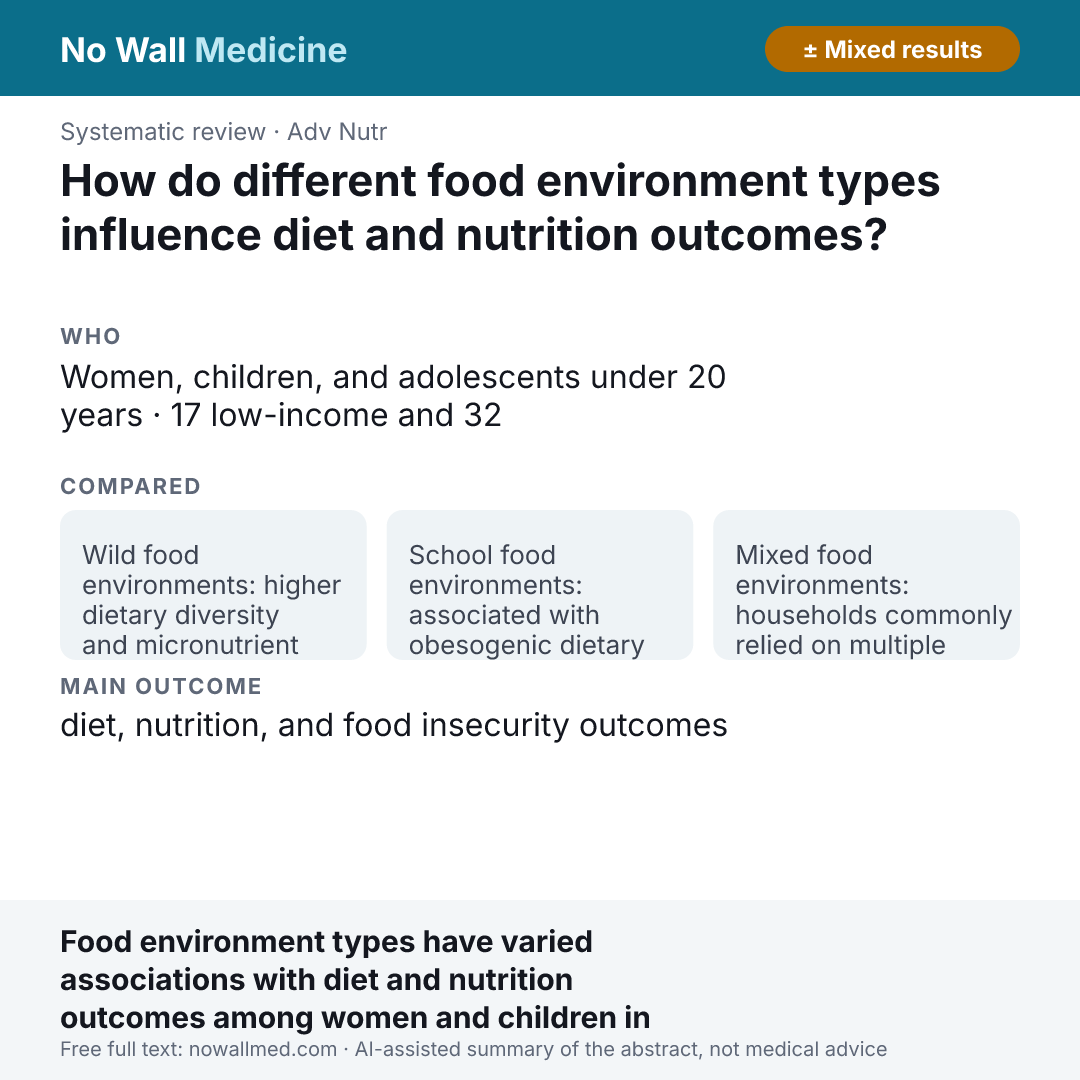
Clinical question: How do different food environment types influence diet and nutrition outcomes?
Why it matters: Evidence on how different food environments influence diets and nutrition outcomes is fragmented and mostly concentrated in high-income settings.
Key points
- Researchers reviewed 155 studies from 17 low-income and 32 lower-middle-income countries involving women, children, and adolescents under 20 years old.
- Access to wild food environments was linked to higher dietary diversity and micronutrient intake, while some school environments were associated with obesity-promoting dietary patterns.
- Associations between food environments and body measurements like height and weight were modest and variable across the different settings studied.
Headline and key points written with AI from the paper’s abstract, with every number checked against it. Read the paper before relying on them.
Was this summary helpful?
Subject terms
Headline, design, result, key points, caveat and citation as plain text.
Cite this article
Oyeneye HO, Alghamdi AA, Staromiejska W, Downs S. The Relationship among Food Environment Types, Diet, and Nutrition Outcomes in Women, Children, and Adolescents from Low- and Lower-Middle Income Countries: A Systematic Review. Adv Nutr. 2026;17(9):100698. doi:10.1016/j.advnut.2026.100698
Spotted a mistake? Suggest a correction