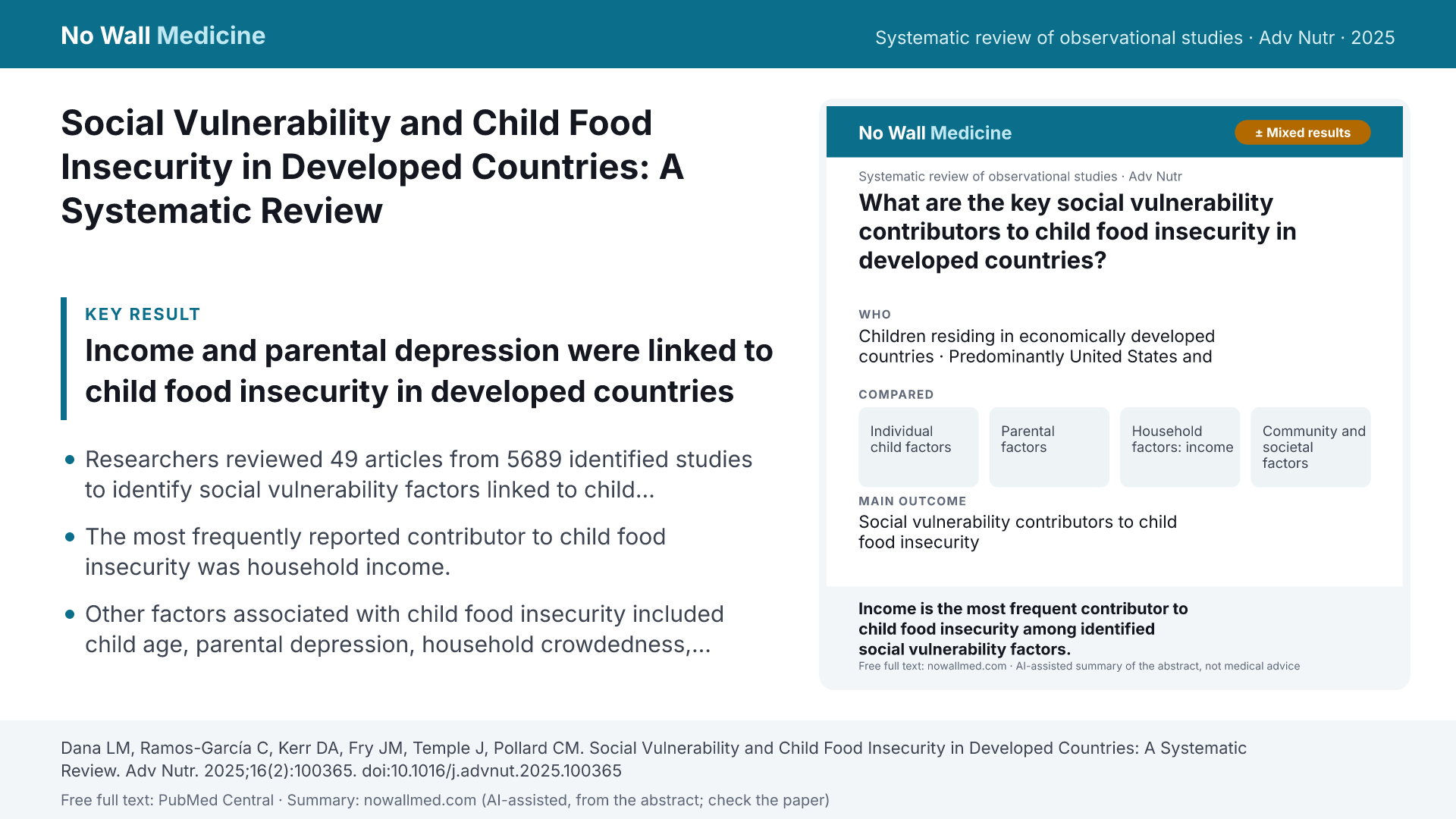
Income and parental depression were linked to child food insecurity in developed countries
Social Vulnerability and Child Food Insecurity in Developed Countries: A Systematic Review
Systematic review of observational studiesMixed results
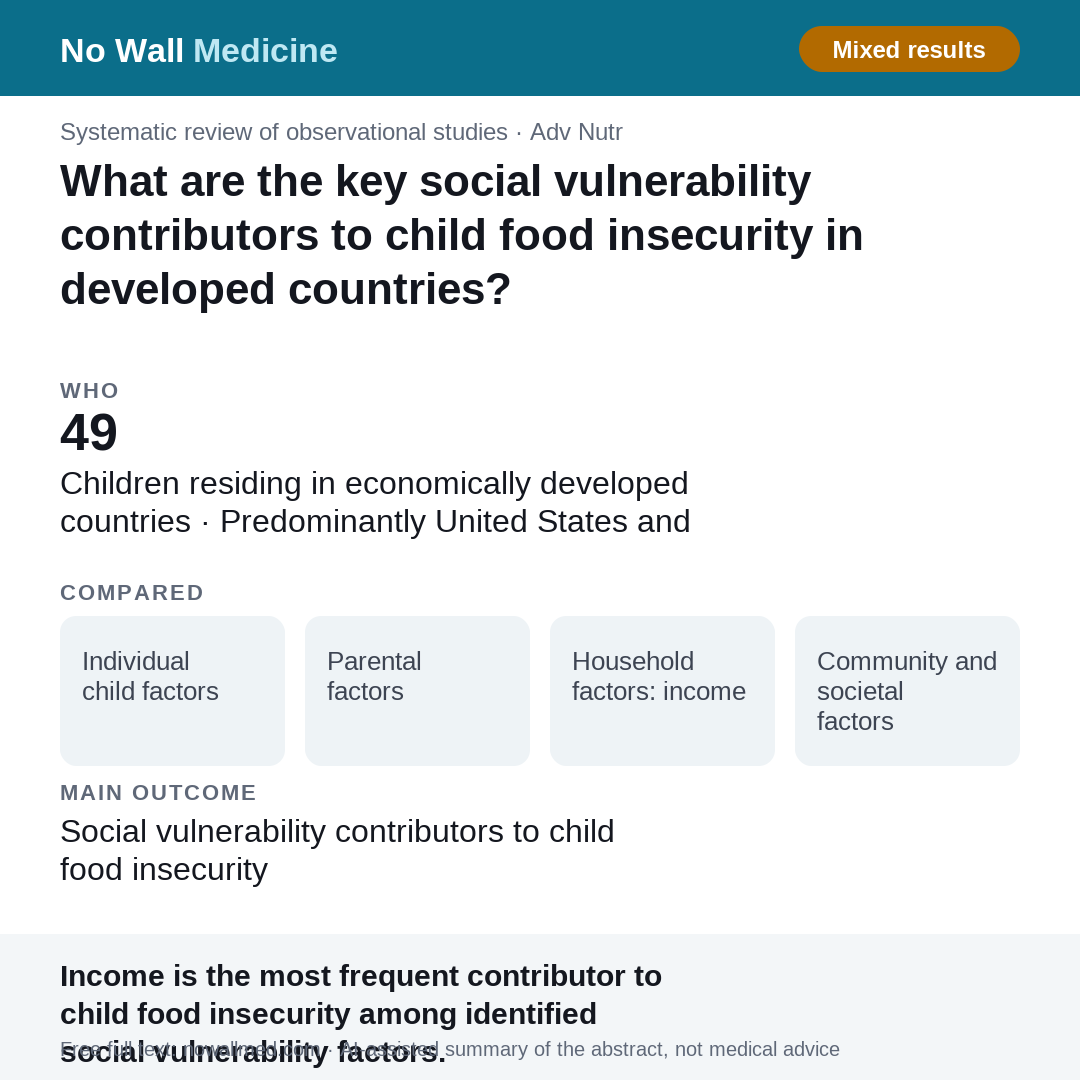
What are the key social vulnerability contributors to child food insecurity in developed countries?
Who
49
Children residing in economically developed countries · Predominantly United States and Canada
Compared
Individual child factors
Parental factors
Household factors: income
Community and societal factors
Main outcome
Social vulnerability contributors to child food insecurity
Bottom line: Income is the most frequent contributor to child food insecurity among identified social vulnerability factors.
Limitation: Lack of consistent measures to define social vulnerability and food insecurity impeded meaningful pooling.
Adv Nutr · 2025-01-10Download image
Clinical question: What are the key social vulnerability contributors to child food insecurity in developed countries?
Why it matters: It was unknown which specific social vulnerability factors are linked to child food insecurity in economically developed countries.
Key points
- Researchers reviewed 49 articles from 5689 identified studies to identify social vulnerability factors linked to child food insecurity in developed nations.
- The most frequently reported contributor to child food insecurity was household income.
- Other factors associated with child food insecurity included child age, parental depression, household crowdedness, social connection, poverty, and residential instability.
Limitation the authors note: The lack of consistent measures to define social vulnerability and food insecurity in diverse subgroups impeded meaningful pooling and interpretation of interacting factors.
Headline and key points written with AI from the paper’s abstract, with every number checked against it. Read the paper before relying on them.
Was this summary helpful?
Subject terms
Cite this article
Dana LM, Ramos-García C, Kerr DA, Fry JM, Temple J, Pollard CM. Social Vulnerability and Child Food Insecurity in Developed Countries: A Systematic Review. Adv Nutr. 2025. doi:10.1016/j.advnut.2025.100365
Spotted a mistake? Suggest a correction