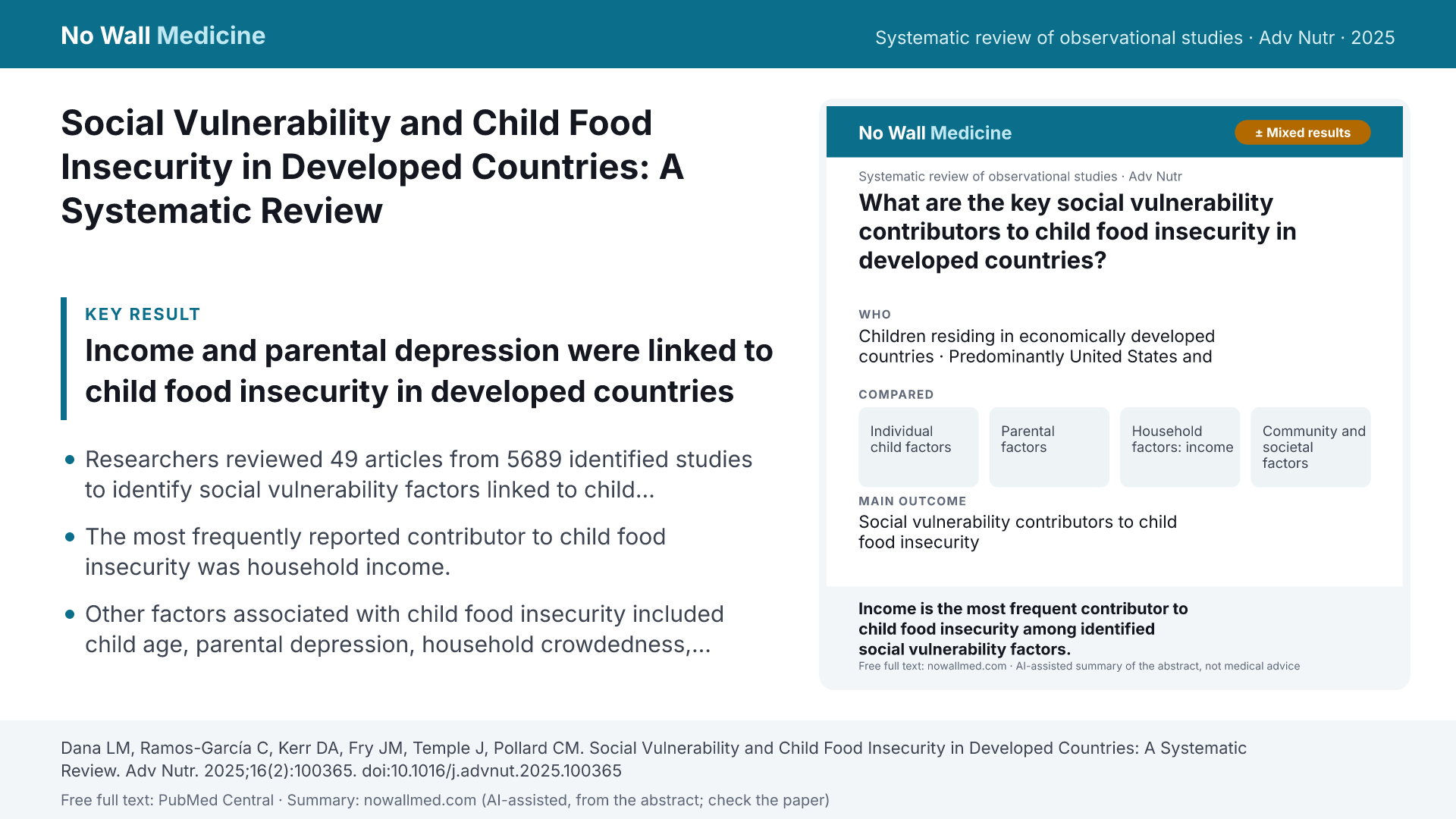
Social Vulnerability and Child Food Insecurity in Developed Countries: A Systematic Review
Key result: Income and parental depression were linked to child food insecurity in developed countries
Key points
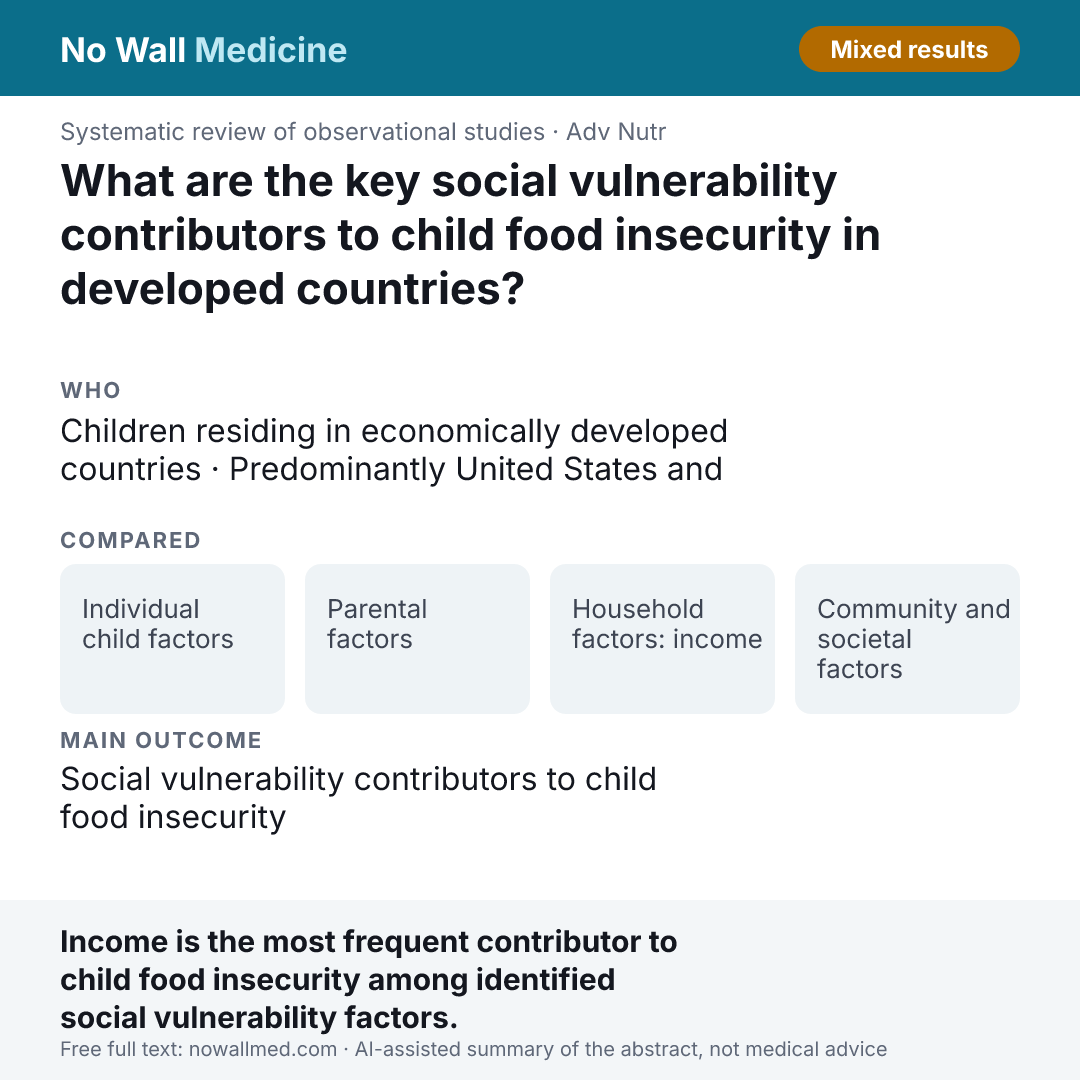
- Researchers reviewed 49 articles from 5689 identified studies to identify social vulnerability factors linked to child food insecurity in developed nations.
- The most frequently reported contributor to child food insecurity was household income.
- Other factors associated with child food insecurity included child age, parental depression, household crowdedness, social connection, poverty, and residential instability.
Limitation the authors note: The lack of consistent measures to define social vulnerability and food insecurity in diverse subgroups impeded meaningful pooling and interpretation of interacting factors.
Discussion prompts
- Would these patients look like yours? Who was left out?
- Is the main outcome one that matters to patients?
- Is the difference large enough to change what you do?
Cite: Dana LM, Ramos-García C, Kerr DA, Fry JM, Temple J, Pollard CM. Social Vulnerability and Child Food Insecurity in Developed Countries: A Systematic Review. Adv Nutr. 2025;16(2):100365. doi:10.1016/j.advnut.2025.100365
Free full text: PubMed Central · Summary and visual abstract: nowallmed.com/a/social-vulnerability-and-child-food-insecurity-in-developed-countries-2mu8tt/ (AI-assisted from the abstract; check the paper before relying on it).