Machine learning methods for managing acute respiratory distress syndrome were reviewed across 52 studies
A systematic review of machine learning models for management, prediction and classification of ARDS
Systematic reviewUnclear result
What are the machine learning models for management, prediction and classification of ARDS?
Who
52
Studies on acute respiratory distress syndrome · Google Scholar, PubMed, and EBSCO
Compared
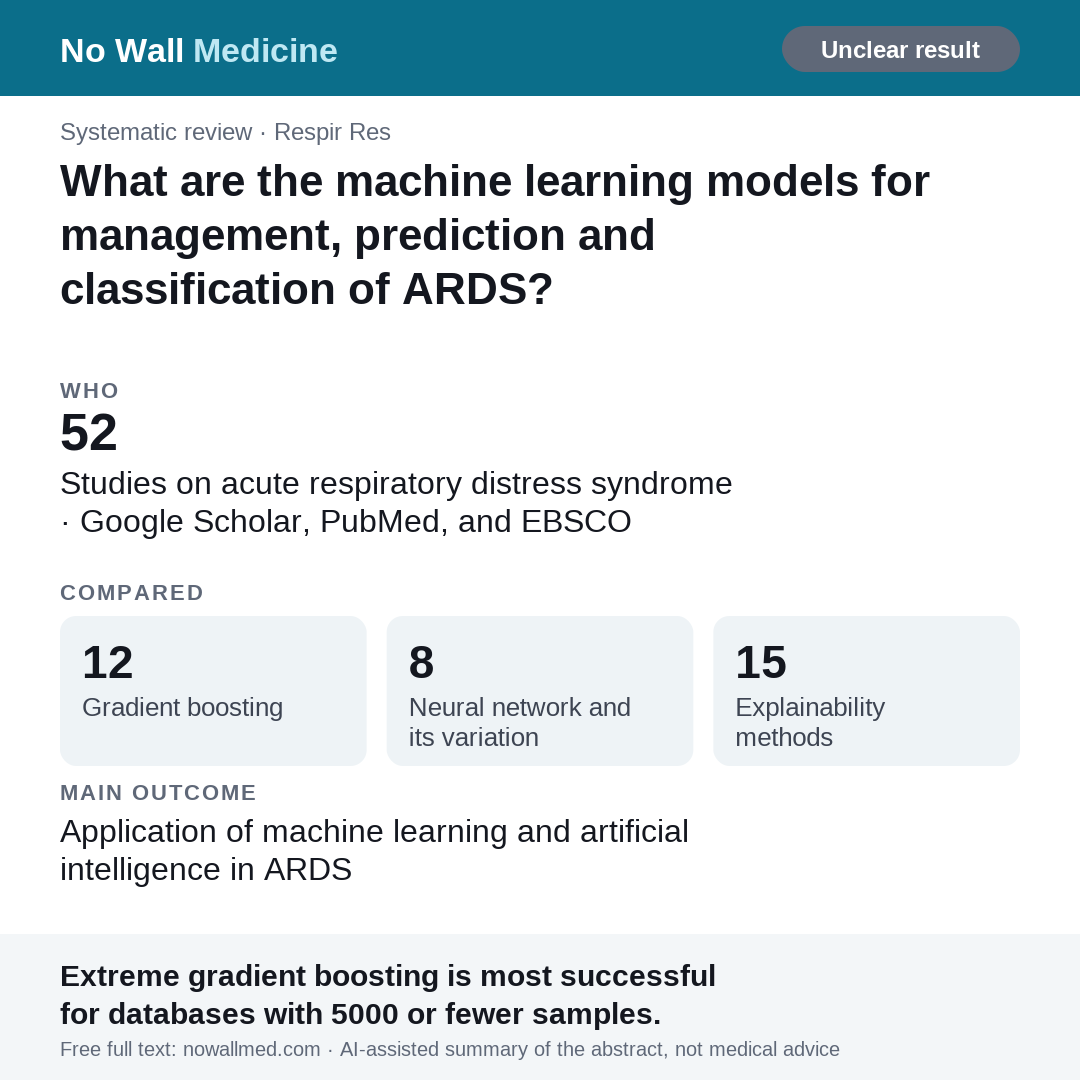
12Gradient boosting (23.1%)
8Neural network and its variation (15.4%)
15Explainability methods (28.8%)
Main outcome
Application of machine learning and artificial intelligence in ARDS
Bottom line: Extreme gradient boosting is most successful for databases with 5000 or fewer samples.
Limitation: Small data sizes limit the use of neural network methods.
Respir Res · 2024-06-04Download image
Clinical question: What are the machine learning models for management, prediction and classification of ARDS?
Why it matters: The current state of machine learning applications for the classification, prediction, and management of acute respiratory distress syndrome requires a systematic overview.
Key points
- Researchers reviewed 52 studies published between 2009 and 2023 regarding machine learning and artificial intelligence for acute respiratory distress syndrome, a severe form of respiratory failure.
- Gradient boosting was the most common and successful method used in 12 (23.1%) of the reviewed studies.
- Only 1 study validated its model using input from clinicians, and explainability methods were presented in 15 (28.8%) of the studies.
Limitation the authors note: The authors state that a large, multi-region, multi-centre database is required to reduce bias and utilize neural network methods.
Headline and key points written with AI from the paper’s abstract, with every number checked against it. Read the paper before relying on them.
Was this summary helpful?
Subject terms
Cite this article
Tran TK, Tran MC, Joseph A, Phan PA, Grau V, Farmery AD. A systematic review of machine learning models for management, prediction and classification of ARDS. Respir Res. 2024. doi:10.1186/s12931-024-02834-x
Spotted a mistake? Suggest a correction
Top studies every Monday
The week’s key trials and guidelines in your specialties, plus any topics you follow. By email, free.
Get the weekly digest