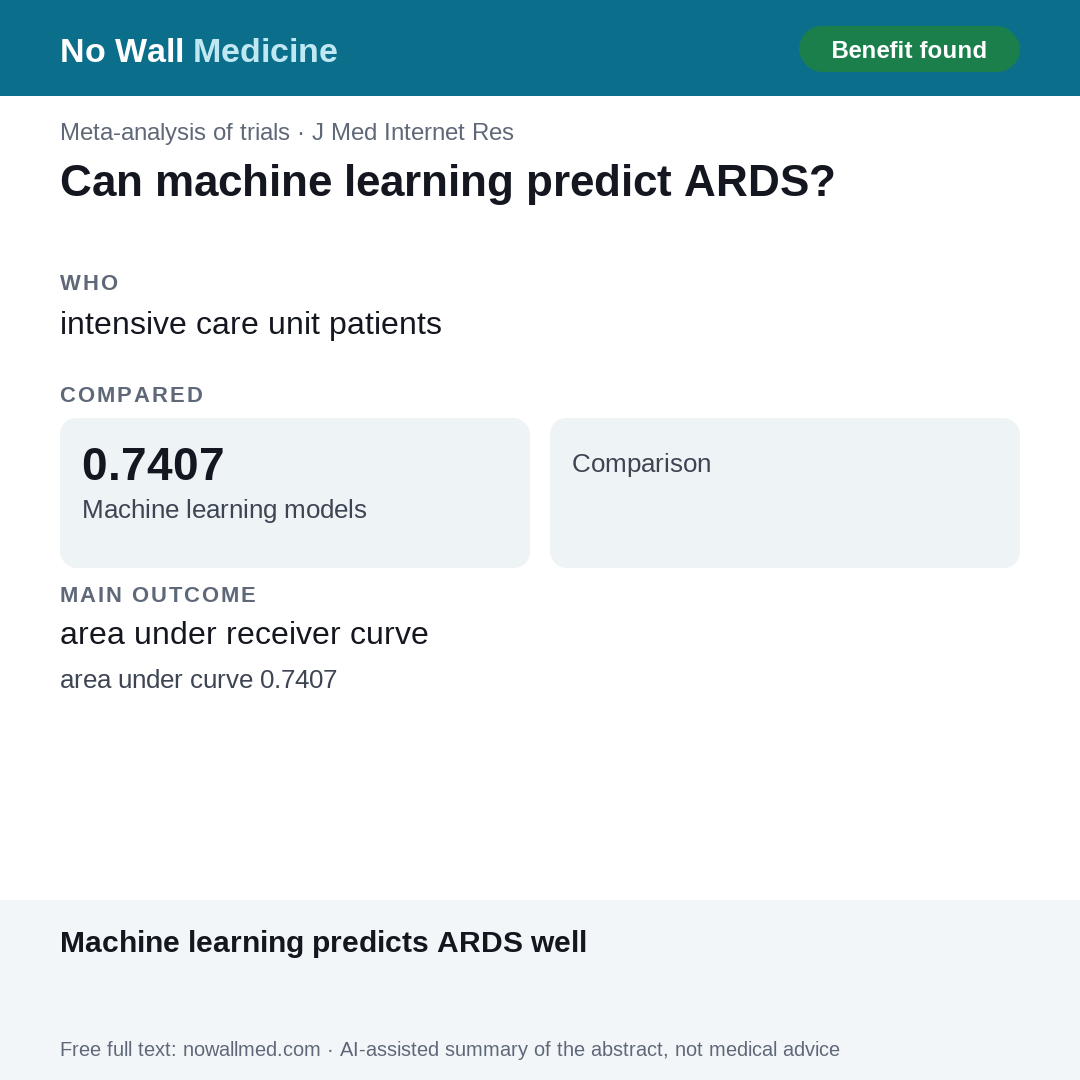
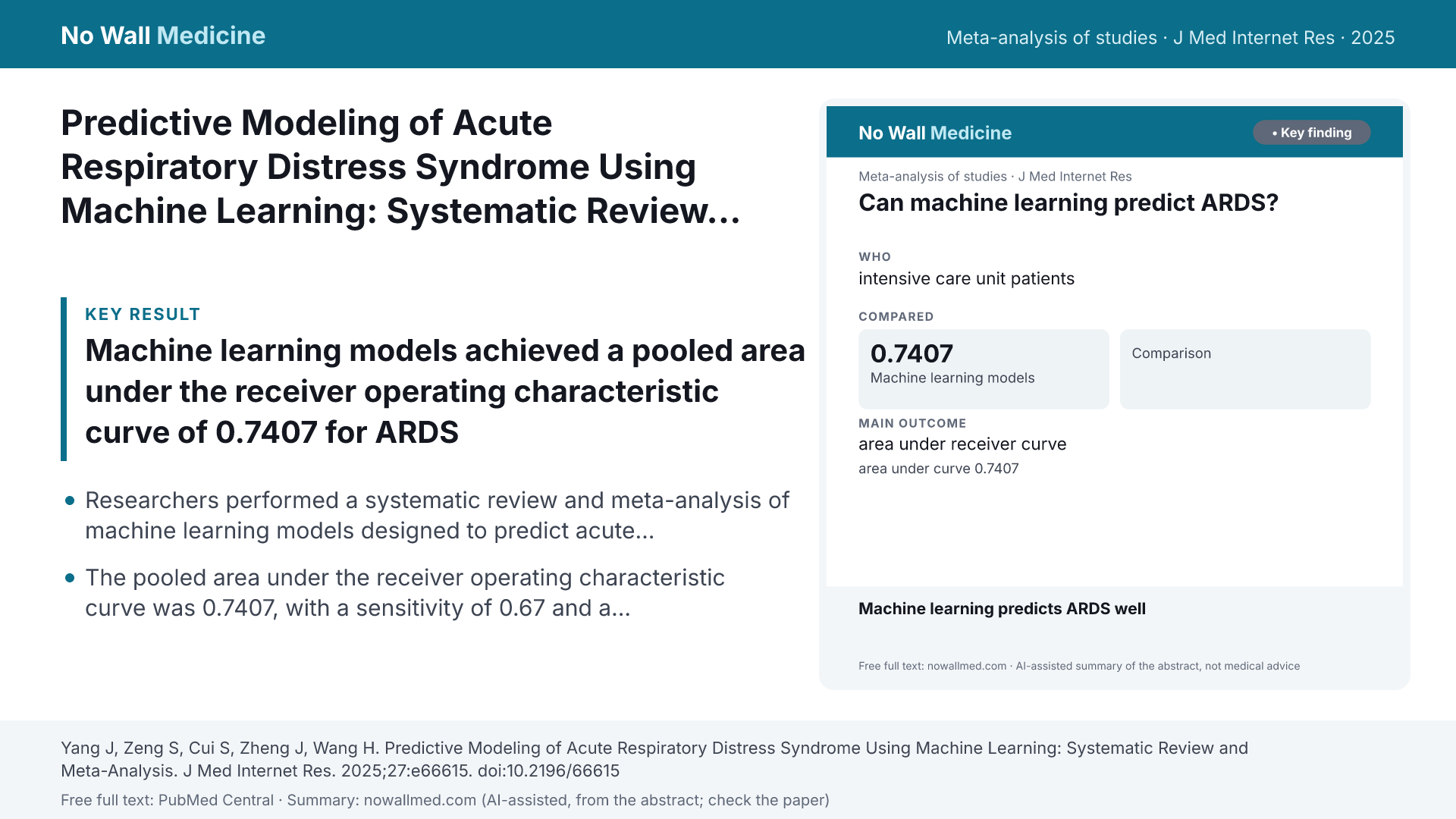
Machine learning models achieved a pooled area under the receiver operating characteristic curve of 0.7407 for ARDS
Predictive Modeling of Acute Respiratory Distress Syndrome Using Machine Learning: Systematic Review and Meta-Analysis
Meta-analysis of trialsBenefit found
Can machine learning predict ARDS?
Who
intensive care unit patients
Compared
0.7407Machine learning models
Comparison
Main outcome
area under receiver curve
Result: area under curve 0.7407
Bottom line: Machine learning predicts ARDS well
Limitation: many models have limitations
J Med Internet Res · 2025-05-13Download image
Clinical question: Can machine learning predict ARDS?
Why it matters: There is a lack of consensus on the most effective machine learning model or methodology for predicting acute respiratory distress syndrome.
Key points
- Researchers performed a systematic review and meta-analysis of machine learning models designed to predict acute respiratory distress syndrome, a critical lung condition.
- The pooled area under the receiver operating characteristic curve was 0.7407, with a sensitivity of 0.67 and a specificity of 0.68.
- The diagnostic odds ratio was 6.26, the positive likelihood ratio was 2.80, and the negative likelihood ratio was 0.51.
Limitation the authors note: The authors note that many existing models have limitations regarding bias risk, sample size, external validation, and interpretability.
Headline and key points written with AI from the paper’s abstract, with every number checked against it. Read the paper before relying on them.
Was this summary helpful?
Subject terms
Cite this article
Yang J, Zeng S, Cui S, Zheng J, Wang H. Predictive Modeling of Acute Respiratory Distress Syndrome Using Machine Learning: Systematic Review and Meta-Analysis. J Med Internet Res. 2025. doi:10.2196/66615
Spotted a mistake? Suggest a correction