Predictive Modeling of Acute Respiratory Distress Syndrome Using Machine Learning: Systematic Review and Meta-Analysis
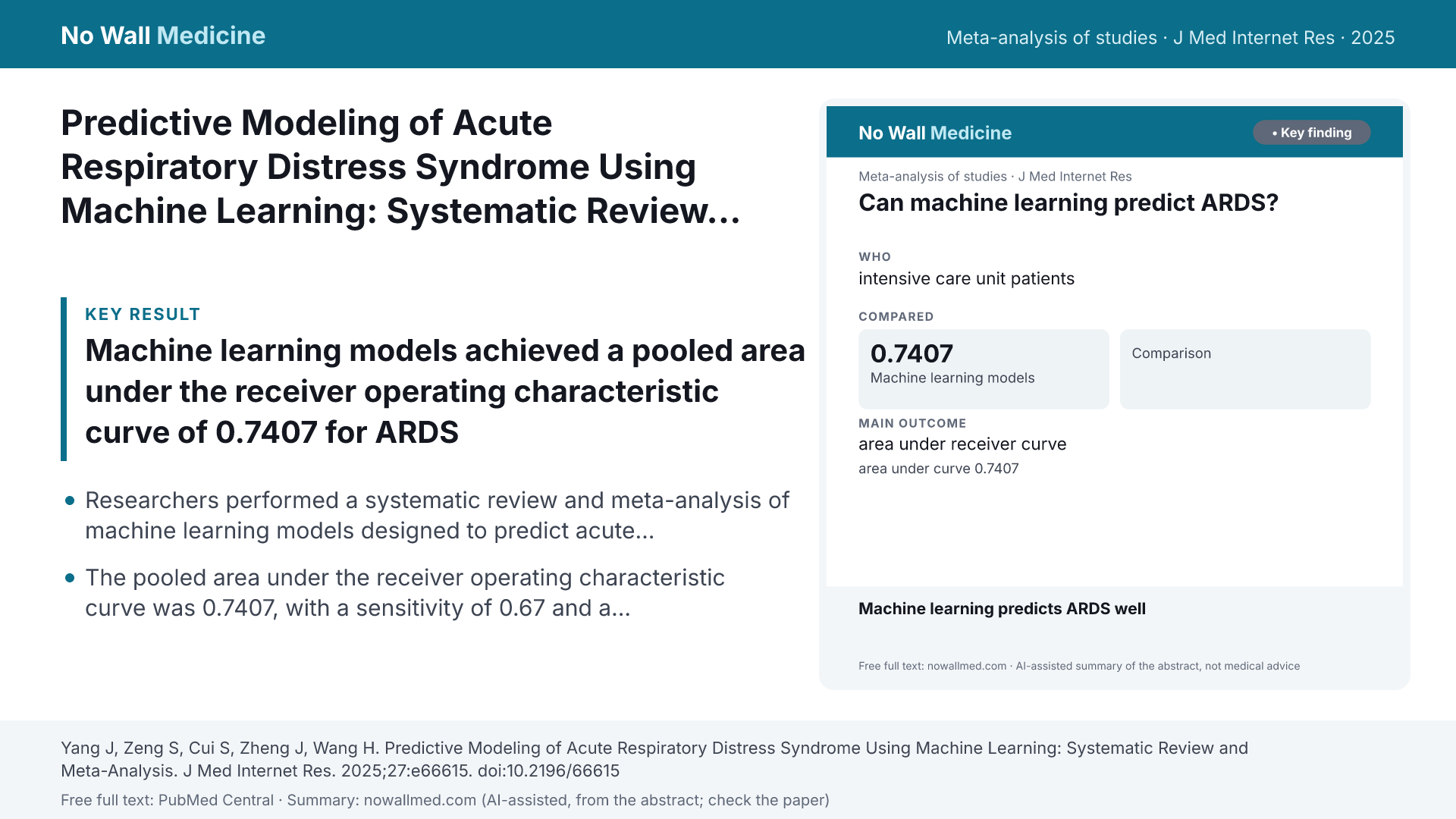
Key result: Machine learning models achieved a pooled area under the receiver operating characteristic curve of 0.7407 for ARDS
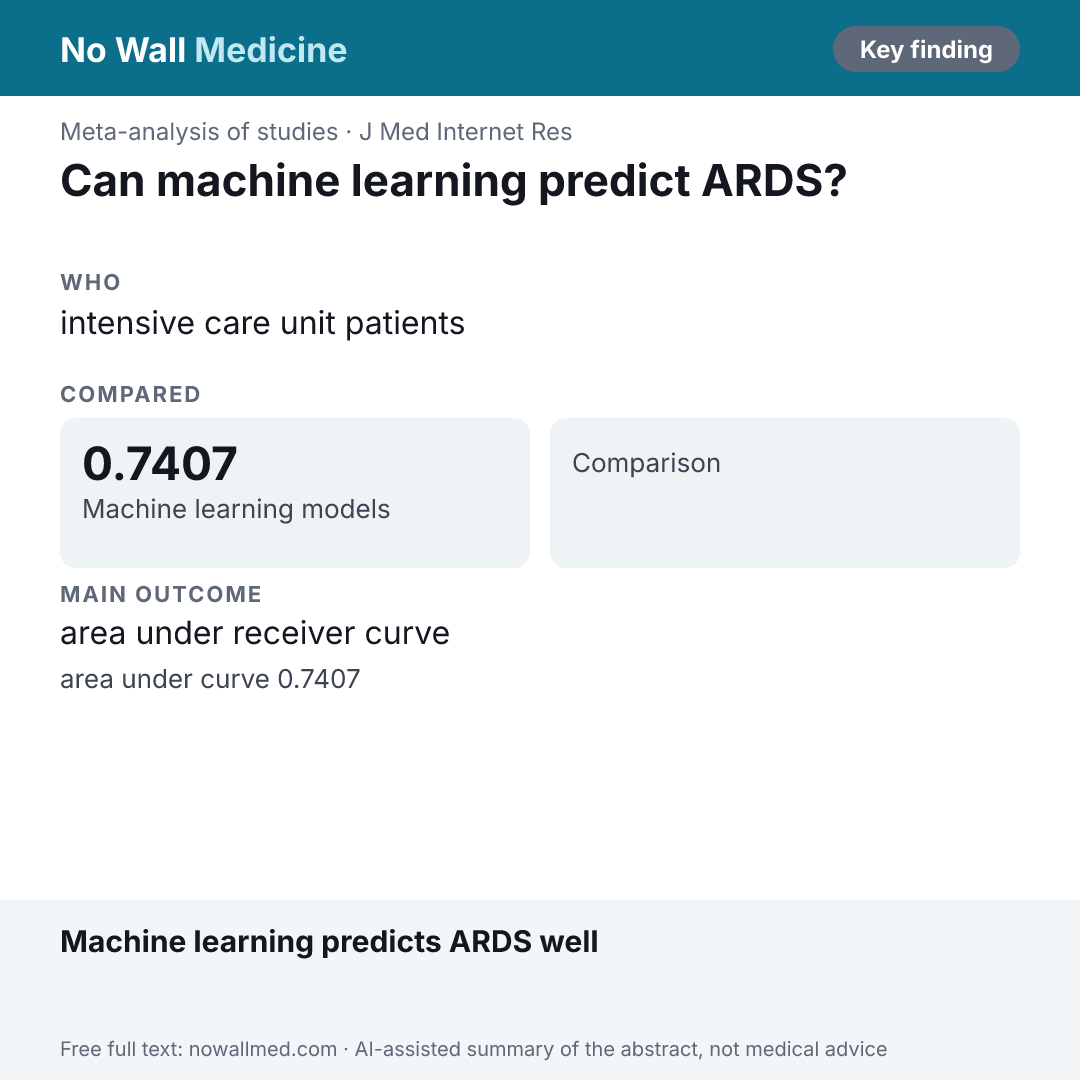
Meta-analysis of studiesKey finding
Can machine learning predict ARDS?
Who
intensive care unit patients
Compared
0.7407Machine learning models
Comparison
Main outcome
area under receiver curve
Result: area under curve 0.7407
Bottom line: Machine learning predicts ARDS well
Limitation: many models have limitations
J Med Internet Res · 2025-05-13 · Save PNG
Key points
- Researchers performed a systematic review and meta-analysis of machine learning models designed to predict acute respiratory distress syndrome, a critical lung condition.
- The pooled area under the receiver operating characteristic curve was 0.7407, with a sensitivity of 0.67 and a specificity of 0.68.
- The diagnostic odds ratio was 6.26, the positive likelihood ratio was 2.80, and the negative likelihood ratio was 0.51.
Limitation the authors note: The authors note that many existing models have limitations regarding bias risk, sample size, external validation, and interpretability.
Discussion prompts
- Would these patients look like yours? Who was left out?
- Is the main outcome one that matters to patients?
- Is the difference large enough to change what you do?
Cite: Yang J, Zeng S, Cui S, Zheng J, Wang H. Predictive Modeling of Acute Respiratory Distress Syndrome Using Machine Learning: Systematic Review and Meta-Analysis. J Med Internet Res. 2025;27:e66615. doi:10.2196/66615
Free full text: PubMed Central · Summary and visual abstract: nowallmed.com/a/predictive-modeling-of-acute-respiratory-distress-syndrome-using-nx8svv/ (AI-assisted from the abstract; check the paper before relying on it).