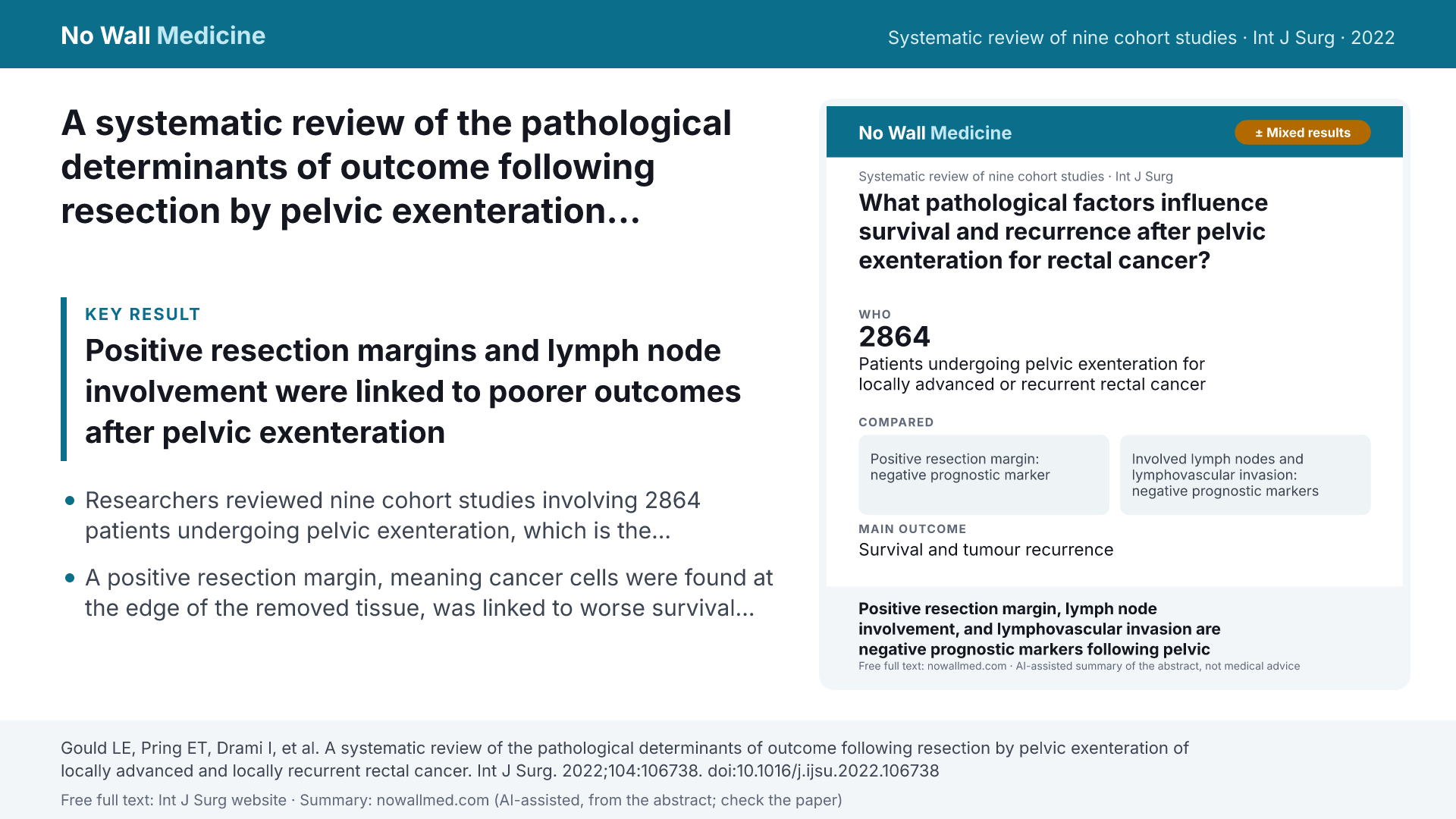
Positive resection margins and lymph node involvement were linked to poorer outcomes after pelvic exenteration
A systematic review of the pathological determinants of outcome following resection by pelvic exenteration of locally advanced and locally recurrent rectal cancer
Systematic review of nine cohort studiesMixed results
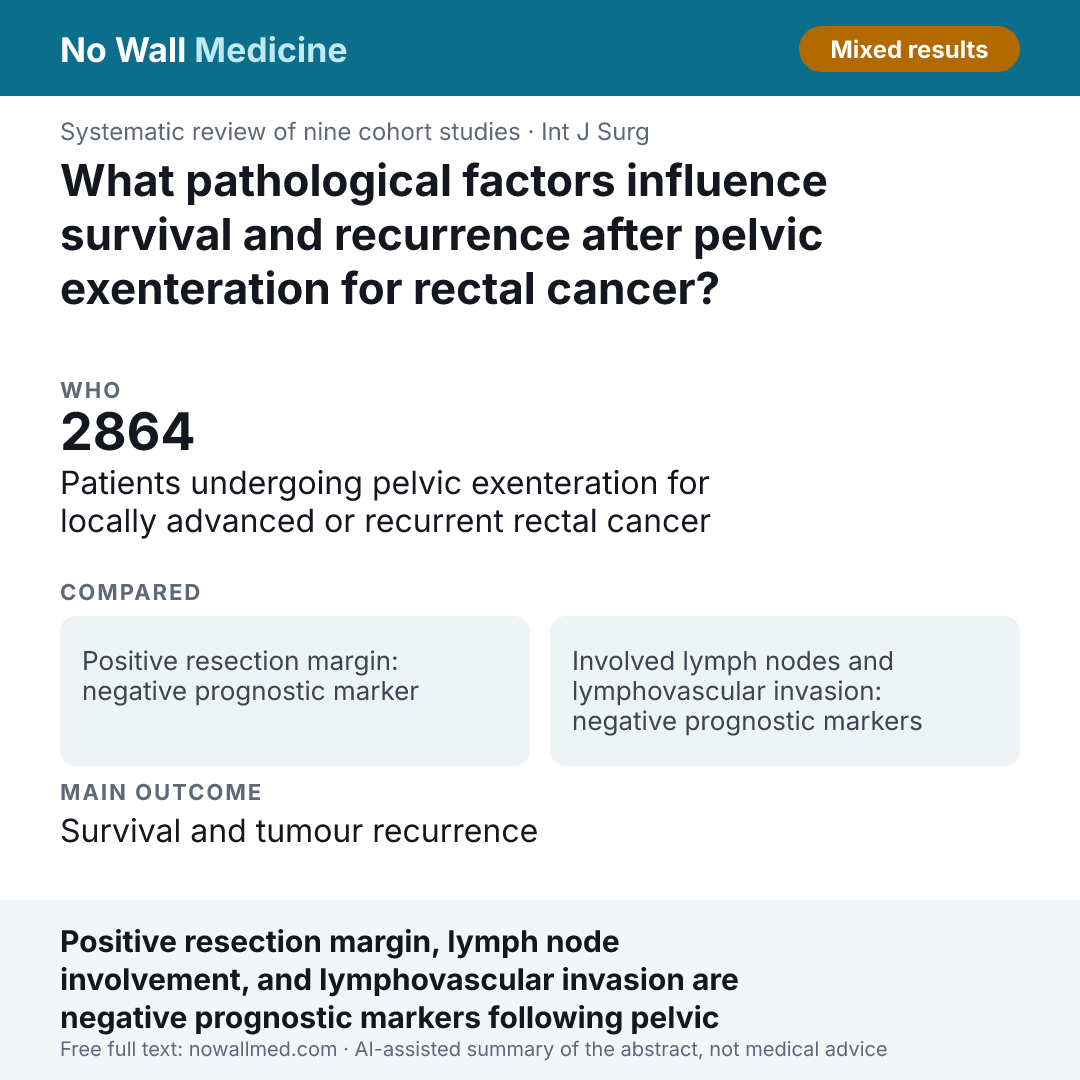
What pathological factors influence survival and recurrence after pelvic exenteration for rectal cancer?
Who
2864
Patients undergoing pelvic exenteration for locally advanced or recurrent rectal cancer
Compared
Positive resection margin: negative prognostic marker
Involved lymph nodes and lymphovascular invasion: negative prognostic markers
Main outcome
Survival and tumour recurrence
Bottom line: Positive resection margin, lymph node involvement, and lymphovascular invasion are negative prognostic markers following pelvic exenteration.
Limitation: Significant heterogeneity of reported outcomes prevented meta-analysis.
Int J Surg · 2022-07-01 · Save PNG
Clinical question: What pathological factors influence survival and recurrence after pelvic exenteration for rectal cancer?
Key points
- Researchers reviewed nine cohort studies involving 2864 patients undergoing pelvic exenteration, which is the surgical removal of organs in the pelvis, for advanced or recurrent rectal cancer.
- A positive resection margin, meaning cancer cells were found at the edge of the removed tissue, was linked to worse survival in six studies.
- Involved lymph nodes and lymphovascular invasion, the presence of cancer in lymphatic or blood vessels, were also associated with negative outcomes.
Limitation the authors note: A meta-analysis was not possible due to significant heterogeneity of reported outcomes.
Headline and key points written with AI from the paper’s abstract, with every number checked against it. Read the paper before relying on them.
Was this summary helpful?
Subject terms
Headline, design, result, key points, caveat and citation as plain text.
Cite this article
Gould LE, Pring ET, Drami I, et al. A systematic review of the pathological determinants of outcome following resection by pelvic exenteration of locally advanced and locally recurrent rectal cancer. Int J Surg. 2022;104:106738. doi:10.1016/j.ijsu.2022.106738
Spotted a mistake? Suggest a correction